
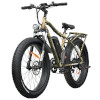
 Effective on April 5, 2024 our government updated the Motor Assisted Cycle Regulation. The new regulation creates two categories of e-bike, a standard and a light version as well as setting minimum ages for riders using them on the highway.
Standard E-Bike
- Cannot have motors exceeding 500 W continuous power output rating
- Must have a maximum speed of 32 km/h
- Can have either pedal or throttle operated motors which can be disengaged
- Must have brakes which meet braking standards
- Cannot be operated by people under 16 years old on a highway
Light E-Bike
- Cannot have motors exceeding 250 W continuous power output rating
- Must have a maximum speed of 25 km/h
- Are limited to pedal-operated motors (must not have a throttle)
- Must have brakes which meet braking standards
- Cannot be operated by people under 14 years old on a highway
- Cannot be operated by people under 16 years old on a highway if carrying or towing passengers
Braking Standards
A light ebike travelling at 25 km/h on a clean, level paved surface must come to a stop within 7.5m.
A standard ebike travelling at 32 km/h on a clean, level pave surface must come to a stop within 9m.
Violations
If your electric bicycle does not meet these standards is considered to be a motor vehicle. If you choose to ride it on the highway you are subject to the requirements for licensing, insurance and motor vehicle standards compliance.
Caution
Because the federal government has chosen not to regulate motor assisted cycles the job has been left to the provinces. What is legal in British Columbia may not be legal in other provinces and vice versa.
Insurance
While collision liability insurance is not required for motor assisted cycles in BC it is still something that you may wish to consider buying. If you regularly ride in traffic causing a collision could result in a bill that is much larger than you could easily pay.
Learn More
Share This Article
The MVA states that e-bikes cannot have a motor exceeding 500W. Exceeding that it becomes a low power motorcycle. A number of very powerful electric bikes (3000W ++) have a software switch to limit their speed to the legal limit of 32 kph. Does this switch make the motorcycle an e-bike when it's on the street?
- Log in to post comments
The regulation says:
Motor-related criteria
3 (1) For the purposes of section 182.1 (2) (c) [motor assisted cycles] of the Act, the device must have one or more attached electric motors that have a continuous power output rating that, in total, does not exceed 500 W.
(2) For the purposes of section 182.1 (2) (d) of the Act, the following motor-related criteria must also be met:
(a) the motors must not be capable of propelling the device at a speed exceeding 32 km/h when the device is being operated on a clean, paved and level surface;
In your example, the motor has both an output rating in excess of 500 W and the ability to propel the e-bike at a speed in excess of 32 km/h. That makes it illegal to operate on the street as an e-bike.
There is no provision in the law to allow the machine on the street with the software limit applied.
- Log in to post comments
- Log in to post comments
Software Motor Limits