
Most drivers associate vehicle size limits with commercial trucks and other large vehicles. However, in British Columbia, legal limits for vehicle height, width, length, and load overhang also apply to light non-commercial vehicles, including passenger cars, SUVs, and pickup trucks.
Do Vehicle Dimension Limits Apply to My Vehicle?
Yes. Vehicle dimension limits in British Columbia apply to both commercial and non-commercial vehicles. Many privately owned pickup trucks are classified as commercial vehicles under the Motor Vehicle Act, even when used for personal travel.
The definition of a commercial vehicle is established under the Commercial Transport Act and includes pickups, vans, buses, taxis, tow trucks, and combinations of vehicles, regardless of use.
This classification matters because certain exemptions and enforcement rules differ depending on vehicle type.
Commercial vs Non-Commercial Vehicles in BC
In British Columbia, classification is legal—not based on purpose. A privately owned pickup truck used for personal transportation may still be treated as a commercial vehicle under provincial law.
Understanding this distinction is important because vehicle dimension limits and enforcement provisions depend on classification, not ownership or use.
Maximum Vehicle Height in British Columbia
The maximum legal vehicle height is 4.15 m (13 ft. 7 in.), as set out in the Commercial Transport Regulations .
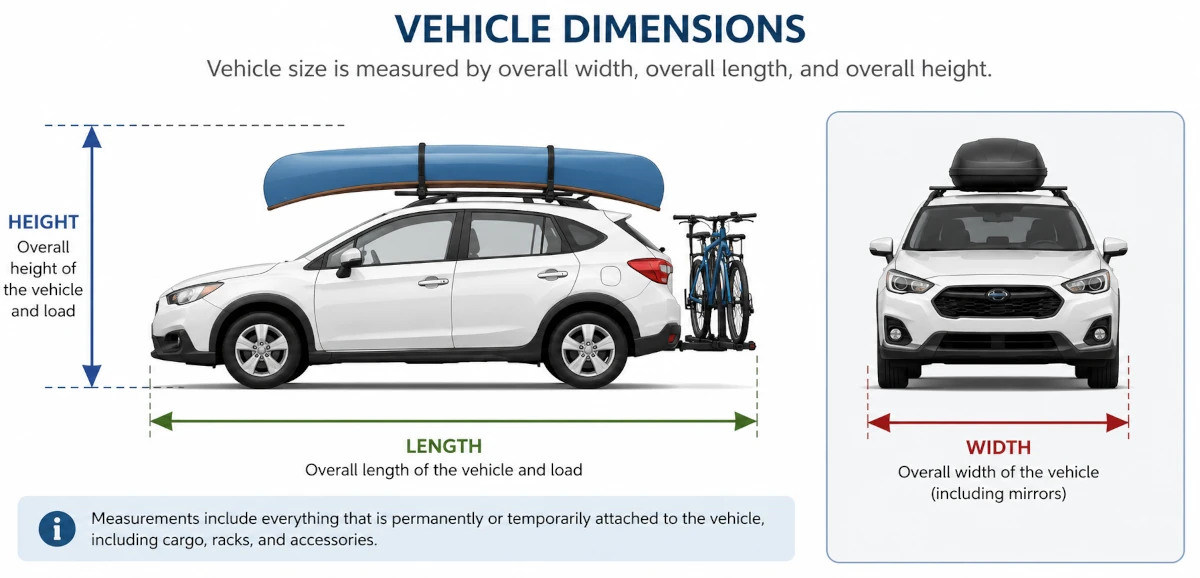
Height restrictions apply to the entire vehicle and load combined. Even legally configured vehicles can strike overhead structures if load height is not verified before travel.
Always check clearance signage when approaching bridges, tunnels, parkades, and covered structures.
Bridge strikes occur frequently enough in British Columbia that Commercial Vehicle Safety and Enforcement (CVSE) publishes public incident data on bridge strike occurrences .
Maximum Vehicle Length
A single vehicle may be up to 12.5 m (41 ft. 4 in.) in length. Buses, motorhomes, and recreational vehicles may be up to 14.65 m (48 ft.) under the Commercial Transport Regulations .
Maximum Vehicle Width
The maximum legal vehicle width is 2.6 m (8 ft. 6 in.) under the Commercial Transport Regulations.
For non-commercial vehicles, loads must not extend beyond the sides of the vehicle body. Commercial vehicles may operate under different controlled conditions.
Load Overhang Rules (Front, Rear, and Axle-Based Limits)
A load must not exceed:
- 1 m (3 ft. 3 in.) ahead of the front bumper
- 1.85 m (6 ft.) beyond the rear of the vehicle
- 4.5 m (14 ft. 9 in.) behind the centre of the last axle
Common Real-World Scenarios
These rules frequently affect everyday drivers, not just commercial operators:
- Pickup trucks carrying lumber, ladders, or construction materials
- SUVs with roof boxes or bike racks exceeding height limits
- Recreational vehicles towing trailers or boats
- Moving household items with extended rear loads
Exemptions and Special Permits
Commercial vehicles may exceed standard limits under a special permit issued by CVSE through the extraordinary loads permitting program, provided all conditions are met.
While permits technically exist for light vehicles in some contexts, CVSE has indicated that these are not currently issued for typical passenger vehicle scenarios.
How to Check If Your Vehicle Complies
Before travelling, measure your vehicle’s total height, width, length, and any load extensions. Do not rely on manufacturer specifications alone when carrying external cargo.
If you are unsure, contact a local CVSE inspection station or weigh scale. Inspectors can confirm applicable requirements and help prevent violations or infrastructure damage.
Common Misconceptions About Vehicle Dimensions in BC
Several misunderstandings persist around how vehicle dimension rules are applied in British Columbia. These issues often arise from real-world driving situations where perception and legal measurement do not align.
- Pickup trucks are exempt from vehicle dimension rules: They are not. Under British Columbia legislation, pickup trucks are classified as commercial vehicles and are subject to applicable vehicle dimension limits regardless of use.
- Only commercial vehicles are measured for width, height, and length compliance: This is incorrect. Dimension limits apply to both commercial and non-commercial vehicles, although some rules differ by classification.
- Aftermarket modifications do not affect compliance: Add-ons such as lift kits, roof racks, cargo boxes, and bike carriers can change a vehicle’s effective height, width, or load profile and may result in non-compliance even if the base vehicle is legal.
- Vehicle size limits are based only on manufacturer specifications: Enforcement is based on the actual dimensions of the vehicle as operated, including any load or attachments at the time of travel.
Frequently Asked Questions
Do pickup trucks have to follow commercial vehicle size limits in BC?
Yes. Many pickup trucks are legally classified as commercial vehicles under provincial legislation, regardless of personal or business use.
What happens if my vehicle exceeds height or width limits?
Operating a vehicle beyond legal dimensions may result in enforcement action, fines, or removal from service until compliance is restored.
Does a roof rack or cargo box count toward vehicle height?
Yes. Vehicle height includes all permanently or temporarily attached cargo and accessories.
Are trailers included in vehicle length limits?
Yes. Combined vehicle and trailer length must comply with applicable regulations depending on configuration.
Learn More
Understanding and verifying your vehicle’s dimensions before travel helps prevent collisions with infrastructure, avoids enforcement issues, and improves road safety for all users.
- Log in to post comments