
Discussions about bicycle lanes have become increasingly contentious in several Canadian cities. Some municipalities are reconsidering planned cycling infrastructure, while provincial governments have begun intervening in decisions about how existing road space is allocated.
Much of the debate centres on a seemingly straightforward question: should road space be taken away from motor vehicles to accommodate cyclists? But there is another way to look at the problem. What if reducing the number of lanes available to motor vehicles could actually make a road safer and, in some circumstances, improve traffic flow?
This is the idea behind a traffic-engineering concept known as a road diet. Rather than simply adding more pavement to accommodate growing traffic volumes, a road diet reallocates existing road space to better serve the people using it.
What Is a Road Diet?
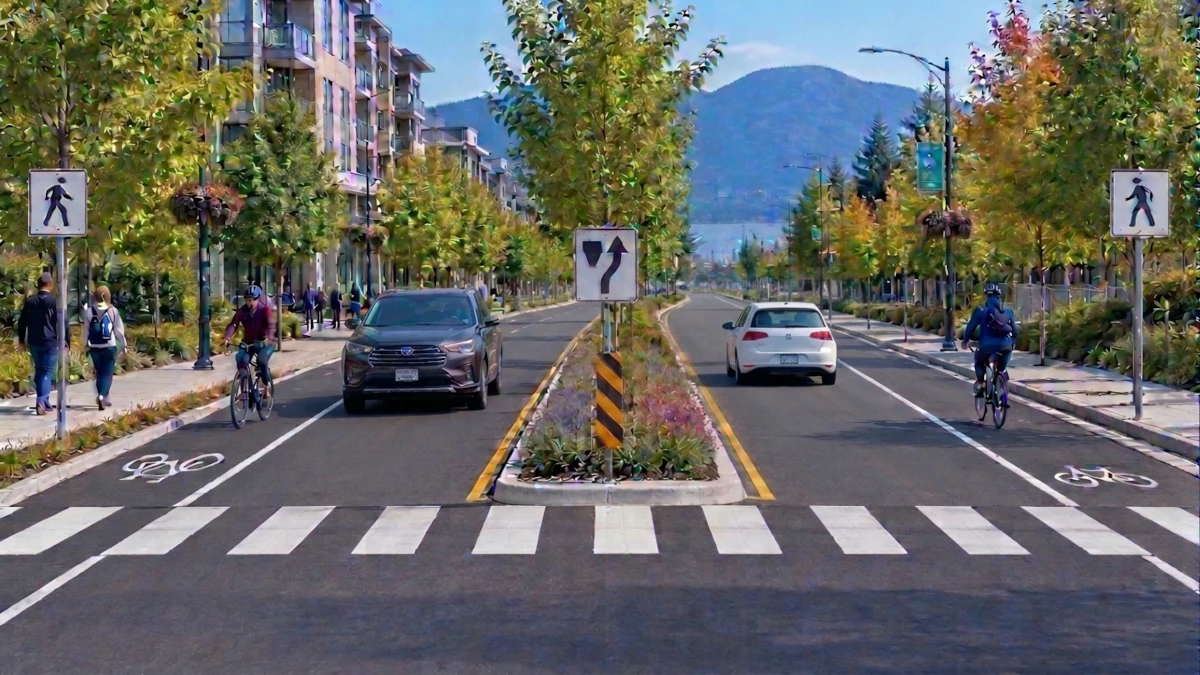
A road diet is a redesign of an existing roadway that reduces the number of travel lanes and uses the recovered space for other purposes. A common example is converting a four-lane undivided road, with two lanes in each direction, into a three-lane road.
The resulting configuration normally has one through lane in each direction and a centre two-way left-turn lane. The space gained can also be used for bicycle lanes, wider sidewalks, pedestrian crossing refuges, landscaped medians or on-street parking.
This arrangement addresses a problem with many four-lane undivided roads. Vehicles turning left must wait in a through lane, creating a conflict with traffic approaching from behind. Drivers may change lanes unexpectedly to get around a waiting vehicle, creating additional opportunities for collisions.
Providing a dedicated centre turning lane removes much of this conflict. Through traffic can continue moving while vehicles waiting to turn are kept out of its path.
Reducing the number of through lanes can also discourage excessive speed and make pedestrian crossings shorter. Where bicycle lanes are included, cyclists have designated space rather than having to share a general-purpose traffic lane.
What Happens to On-Street Parking?
One consequence of some road diets is the loss of on-street parking. Road space that was previously used for parking may be reassigned to bicycle lanes, wider sidewalks, pedestrian facilities, turning lanes or other features.
This can be a significant concern on commercial streets. Businesses may depend on convenient curbside parking for customers, while residents, delivery vehicles and people with mobility limitations may also rely on it. Removing parking can change how people access the businesses and properties along a road.
Research from Toronto provides one example of what can happen. In 2016, the City removed 136 on-street parking spaces and one traffic lane to install a pilot bicycle lane along a 2.4-kilometre section of Bloor Street, a commercial corridor. A subsequent study found that customer spending and the number of customers served by businesses increased during the pilot. Vacancy rates remained stable.
However, similar increases in customer spending and activity occurred on Danforth Avenue, a comparable commercial street without a new bicycle lane. The researchers therefore cautioned that the positive results could reflect broader economic conditions rather than the bicycle lane itself. The study did not find a negative economic impact associated with the project, but it did not establish that removing parking improved business activity.
Vancouver provides a contrasting example. A 2011 business impact study examined the separated bicycle lanes on Hornby and Dunsmuir Streets. Businesses that responded reported sales declines associated with the changes. However, only 32 per cent of businesses responded, and a later academic review noted that the results were not statistically tested and did not control for other factors that could have affected sales. The review also raised the possibility that businesses already opposed to the lanes were more likely to respond.
These studies illustrate why the effect of parking changes should not be assumed in advance. The Toronto results did not demonstrate that parking removal caused economic growth, while the Vancouver survey could not establish that the bicycle lanes caused the reported losses. Local access, loading arrangements, available alternative parking and the characteristics of the businesses all matter.
Parking is not necessarily eliminated in every road diet. Depending on the available space and the objectives of the project, some parking may be retained, moved to another location or replaced with designated loading and accessible parking areas. Municipalities need to consider those trade-offs before deciding how existing road space will be reassigned.
Can Removing a Traffic Lane Improve Traffic Flow?
It seems counterintuitive that taking away a traffic lane could improve the movement of vehicles. More lanes should mean more capacity, shouldn't they?
Not necessarily. The number of lanes is only one factor affecting how efficiently a roadway operates. Intersections, turning movements, traffic signals, vehicle speeds and conflicts between road users all influence traffic flow.
A road with several traffic signals and frequent interruptions may move fewer vehicles than a road with fewer lanes but better-controlled intersections.
Roundabouts are one way of addressing some intersection delays. Rather than stopping traffic for a red light, vehicles entering a roundabout yield to circulating traffic and proceed when there is an appropriate gap. Drivers may still have to stop or wait, particularly when traffic is heavy.
Groups of vehicles, sometimes called platoons, can form when traffic signals release vehicles together or when traffic conditions cause vehicles to travel in groups. Roundabouts do not automatically create platoons or guarantee uninterrupted traffic flow. Their effect on a corridor depends on traffic volumes, intersection spacing, design and the interaction between successive intersections.
Combining a road diet with roundabouts can therefore change the way traffic moves along an entire corridor. A reduction in lanes does not automatically improve traffic flow, but neither does adding lanes automatically solve congestion.
The Carmel, Indiana Example
An interesting illustration of this approach comes from Carmel, Indiana. In 2017, the city announced a major reconstruction of Range Line Road, a predominantly commercial corridor that carried approximately 10,000 to 20,000 vehicles per day.
The existing roadway had five lanes: two through lanes in each direction and a centre left-turn lane. The project proposed reducing portions of the road to fewer travel lanes, adding landscaped medians, pedestrian and cycling facilities, and replacing several traffic signals with roundabouts.
The final design varied along the corridor. Some sections retained two lanes in each direction, while other sections were reduced to one lane in each direction. Multi-use paths and protected cycling facilities were also incorporated.
The objective was not to discourage motor vehicle travel. It was to create a corridor that could accommodate motorists, cyclists and pedestrians while improving the overall streetscape and traffic operation.
Road Guy Rob examines this project and the principles behind it in the following video:
The video illustrates how changing the configuration of a road can benefit more than just cyclists. It also discusses the relationship between roundabouts, traffic flow and the ability to move different groups of road users through an area.
The Carmel project is an example of a comprehensive roadway redesign, not simply the installation of bicycle lanes. The combination of changes is important when considering its potential benefits.
Road Diets Have Been Studied in British Columbia
This isn't just an American traffic-engineering concept. Road diets have been implemented and studied in British Columbia.
A 2011 paper presented to the Transportation Association of Canada, titled Shedding Excess Width: Establishing Criteria for the Suitability of Candidate Road Diet Projects, examined six road diet projects in the province.
The projects were located in Coquitlam, Esquimalt, Kamloops, Prince George and Victoria. Researchers compared collision experience before and after the changes and also considered control locations.
Collision reductions ranging from 23% to 78% were observed at four of the six locations. Collision rates increased at the other two. The researchers noted that site-specific circumstances may have contributed to those results.
These findings are worth considering, but they do not mean that every road diet will produce the same results. The researchers emphasized the importance of selecting suitable locations.
Their evaluation considered factors such as existing roadway configuration, traffic volumes, driveway and access density, and the types of collisions occurring before the changes were made.
The Canadian Road Safety Strategy also describes road diets as a way to improve accommodation for pedestrians, cyclists and public transit while continuing to provide adequate service for motor vehicles. Its road diet information identifies roadways carrying up to 20,000 vehicles daily as possible candidates for further evaluation.
A Local Example: Quadra Street in Saanich
Road redesign can be controversial, particularly when it involves reallocating existing road space. A recent example close to home is the Quadra McKenzie Plan in the District of Saanich.
The plan considered changes to Quadra Street that included reducing the space allocated to motor vehicle traffic to make room for improved walking, cycling and transit facilities.
During Council deliberations on February 2, 2026, Council directed staff to remove the proposed Quadra Street cross-sections and lane reductions from the plan, anticipating that the corridor would be examined through a future process involving the broader regional transportation network.
The Quadra McKenzie Plan was subsequently adopted by Saanich Council on July 6, 2026. The adopted plan does not include those proposed Quadra Street lane-reduction cross-sections. Future corridor design is to be considered through a separate transportation planning and design process.
This decision illustrates the competing priorities that municipalities face when considering changes to established roadways. Motorists want roads that accommodate their travel needs, while cyclists, pedestrians and transit users also need safe and convenient facilities.
It is important to distinguish between deciding not to proceed with a proposed road redesign and removing existing bicycle lanes. The Saanich decision concerned proposed changes, not the removal of an established cycling facility.
The District of Saanich's Quadra McKenzie Plan information describes the adopted plan and the Council decisions that shaped it.
Not Every Road Is a Candidate
Road diets are not a universal solution to traffic problems. A design that works well on one road may create unacceptable congestion or other difficulties on another.
Traffic volumes are an important consideration, but they are not the only one. Engineers must also examine:
- Existing traffic volumes and anticipated future growth.
- The number and spacing of intersections.
- Turning movements and access to adjacent properties.
- Collision history and the types of conflicts occurring.
- Available alternative routes and the potential for traffic diversion.
- Public transit, commercial vehicle and emergency service requirements.
- The needs of pedestrians and cyclists using the corridor.
An interactive resource developed by the Southeast Michigan Council of Governments, the Multimodal Tool, provides an interesting way to explore these considerations. Users can select a roadway and examine how different configurations and priorities serve people walking, cycling, driving, using transit and moving freight.
The tool is intended to help explore roadway design alternatives. It is not a substitute for detailed traffic engineering and site-specific analysis.
What Should We Expect From Our Roads?
Removing a bicycle lane and restoring a motor vehicle lane may appear to be a simple way to increase road capacity. Similarly, reducing the number of motor vehicle lanes to provide space for cyclists and pedestrians may appear to be a straightforward way to improve their safety.
Neither assumption tells the whole story.
Road design involves more than counting the number of lanes available to motor vehicles. How traffic enters, leaves and moves along a corridor, the number of conflict points, vehicle speeds and the needs of other road users all influence how well a road performs.
A road diet can be an effective way to make better use of existing pavement, but it must be appropriate for the location and supported by sound engineering.
Rather than automatically favouring or opposing the removal of traffic lanes or bicycle facilities, we should be asking a more useful question: Does the proposed design move people safely and efficiently, and does it serve the needs of the community?
Learn More
- Log in to post comments