
You may have noticed a new version of the familiar highway sign in British Columbia: Keep Right, Let Others Pass.
The wording is different from the older Keep Right Except to Pass signs, but the message is essentially the same: on roads where the keep-right rules apply, drivers are expected to use the right-hand lane unless there is a reason to be in another lane.
This is more than a matter of courtesy. B.C.'s Motor Vehicle Act contains two provisions dealing with keeping right, and they apply in somewhat different circumstances.
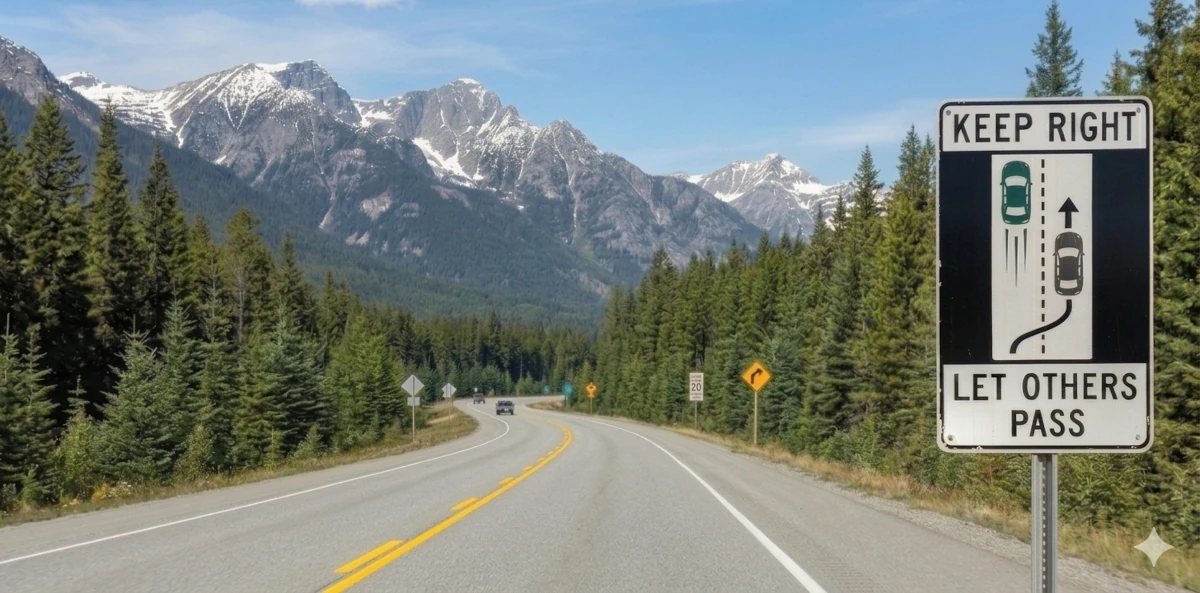
There are two keep-right rules
Section 150(2) of the Motor Vehicle Act says that a driver travelling at less than the normal speed of traffic, considering the time, place and existing conditions, must drive in the right-hand lane available for traffic.
There are exceptions. For example, a driver may use another lane when overtaking and passing another vehicle, preparing to turn left, or passing an official vehicle stopped on or beside the roadway.
This is the general keep-right rule. It does not say that the posted speed limit determines what "normal speed of traffic" is.
Section 151.1 deals specifically with the leftmost lane on certain higher-speed roads. It applies when:
- there are two or more marked lanes available for traffic travelling in the same direction;
- the posted speed limit is at least 80 km/h; and
- the actual speed of traffic is at least 50 km/h.
On a road where section 151.1 applies, a driver in the leftmost lane must exit that lane when another vehicle approaches from behind, if it is safe to do so.
There are exceptions. They include overtaking and passing another vehicle, allowing traffic to merge, preparing for a left turn, and passing an official vehicle stopped on or beside the roadway.
What does that mean when you are driving?
The simplest way to understand the rules is:
- Keep right when the law requires you to do so.
- Use the left lane when you need it for passing or another recognized exception.
- Move back to the right when you are finished passing and it is safe to do so.
- Never make a lane change that is unsafe just to accommodate another driver.
Keeping right does not require you to increase your speed simply because another driver wants to travel faster than you.
Nor does it give another driver permission to tailgate, flash headlights, intimidate you or otherwise pressure you into making an unsafe lane change.
What if I am already travelling at the speed limit?
This is one of the most common points of confusion.
On a road where section 151.1 applies, travelling at the posted speed limit does not automatically give you the right to remain in the leftmost lane when another vehicle approaches from behind.
If the requirements of section 151.1 are met, you must leave the leftmost lane when it is safe to do so, subject to the exceptions in the law.
That does not mean that the approaching driver is entitled to speed. The speed limit remains the speed limit. The two issues are separate: one concerns where you drive and the other concerns how fast you drive.
What does "normal speed of traffic" mean?
This wording in section 150(2) sometimes leads to confusion. The law does not say that the posted speed limit is the definition of the normal speed of traffic.
Instead, section 150(2) refers to the speed of traffic at the time and place and under the existing conditions. In other words, the circumstances around you matter.
This is different from section 151.1, which contains specific thresholds for the posted speed limit and the actual speed of traffic before the leftmost-lane requirement applies.
What if I am preparing to turn left?
Both keep-right provisions recognize an exception for a driver preparing to make a left turn at an intersection or into an exit, private road or driveway.
That does not mean that a driver should move into the left lane several kilometres before the turn. The exception allows you to position yourself appropriately for the turn.
Until you need the left lane for that purpose, the keep-right requirement continues to apply.
What about traffic merging?
Section 151.1 also recognizes that a driver may use the leftmost lane to allow traffic to merge.
Keeping right does not mean blindly remaining in the right lane regardless of what is happening around you. Safe driving sometimes requires temporarily using another lane.
The law also recognizes the importance of safety. Section 151.1 requires a driver to leave the leftmost lane only if it is safe to do so.
Why does keeping right matter?
A multi-lane highway works best when drivers use the lanes predictably. Keeping the leftmost lane available for vehicles that need to pass can reduce unnecessary bunching and the need for repeated lane changes.
When a vehicle remains unnecessarily in the left lane, traffic may accumulate behind it. Other drivers may then attempt to change lanes to get around it, sometimes creating additional conflicts.
This is one reason the Province uses the Keep Right, Let Others Pass message. The purpose is not to encourage speeding. It is to encourage drivers to use the roadway in a predictable way so that traffic can move efficiently.
Keeping right is not an excuse for aggressive driving
There is an important distinction between keeping right and getting out of the way of a speeding or aggressive driver.
A driver approaching from behind does not have the right to force another driver into an unsafe manoeuvre. Tailgating, intimidation and dangerous lane changes are not made acceptable simply because the approaching driver wants to go faster.
At the same time, a driver cannot necessarily justify remaining in the left lane simply by saying, "I'm doing the speed limit." Where the keep-right provisions apply, the obligation to use the appropriate lane still exists.
The two drivers can both be in the wrong. One driver may be failing to follow a keep-right requirement while the other is speeding, tailgating or driving aggressively.
The safest approach is straightforward: obey the speed limit, keep right when required, use the left lane appropriately, and make every lane change only when it is safe.
The bottom line
Keep Right, Let Others Pass is more than a suggestion to be courteous. B.C.'s Motor Vehicle Act contains specific requirements governing lane use.
Section 150 establishes the general requirement for a driver travelling at less than the normal speed of traffic to use the right-hand lane available, subject to exceptions. Section 151.1 specifically addresses use of the leftmost lane on qualifying higher-speed roads.
Neither rule gives anyone permission to speed or drive aggressively. They are rules about using the roadway properly.
When you are not passing, preparing for a left turn, allowing traffic to merge, or otherwise covered by an exception, the safest and simplest habit is the one the sign tells you: keep right and let others pass.
Learn More
- Log in to post comments
Comments
Some of the responses to this topic and other postings on this website and my own experience of driving on BC highways leave me baffled by what seems to be the majority of drivers attitude that if one is not driving in excess of the speed limit then one is impeding the flow of traffic.
Whenever I see speed limit signs, they read MAXIMUM 110 kph for example. Experience, common sense and simple logic tell me that no matter what I choose as my target speed, there will always be some variation in the actual speed of my vehicle. To me a posted MAXIMUM of say 110 kph means that I should NEVER exceed that speed. Hence experience, common sense and simple logic tell me that I should chose a target speed which is less than the posted MAXIMUM to ensure that I do not break the law by exceeding the maximum.
If I try to drive at exactly the speed limit and not break the law by exceeding it, then I will have to focus so much of my attention on my speedometer that I will, in effect, be guilty of distracted driving.
Also, of course, the posted MAXIMUM is the legal limit under ideal conditions. There are many ways in which the conditions can be less than ideal.
Yet, from what I see on the roads and from what I read in many drivers' forum postings, the majority of drivers feel they have a moral right to exceed the speed limit by an amount they unilaterally decide is reasonable and any one who chooses to obey the law is in the wrong.
- Log in to post comments
Today I was driving in the rain and there was water on the highway.
The posted speed limit was 90 and I was content to drive at 85 and in the right lane, until I caught up with a vehicle driving at 80 or less.
So I brake and when safe I signal to make a lane change into the left lane and speed up to 90 to make my pass.
Unfortunately I'm now in what has become the lane for speeders and before I can safely make my pass and safely change back into the right lane I have a vehicle dangerously close to me and flashing his headlights.
Would some of you have me stay in the right lane and drive at 80 or slower or am I allowed to make the maneuver that I made?
On the way home I was driving about 90 in a 90 speed zone on a piece of highway that merged from 2 lanes to 1 lane.
This time I stayed in the right lane until close to the end of the 2 lanes and I signaled to make the merge.
Unfortunately a faster vehicle decided that it was ok to pass me as I was attempting to merge, causing me to make a last second decision to decelerate and to drive in the curbe lane to avoid a collision. Thankfully the second vehicle kept a safe distance an allowed the merge to happen.
So what would the speeders have me do to correct this scary situation from happening next time?
- Log in to post comments
Island_Guy, thank you for your careful, considerate, attentive, law-abiding driving.
Sadly, I suspect it is an accurate answer to your question and that is why the hooded figure with the scythe and hour-glass will continue to frequent our roads. But here's a thought. If you had slowed from 85 kph to the speed of the 80 kph vehicle you were following, it would have taken you approximately 1 minute longer to complete a 20 km journey or 5 minutes longer to complete a 100 km journey.
Are those few minutes so important?
- Log in to post comments
My problem is, those impatient drivers don't give me enough time.
When I went to Chilliwack from Surrey last week, I had to change lanes 14 times. Vehicles on right are driving under the speed limit and when I move to right, within 5 seconds, and half of the time, I don't get chance to move to left for a while because of the volume, I have to move to left again and if I don't think I have enough room and stayed on left, then the driver behind me flashes his lights.
I don't feel comfortable changing lanes every few seconds and I don't feel safe. By the looks of the law, inconvenience to the speeders values much more than the average good drivers.
Due to this law, drivers on left coming on higher speed think I have to move over and they are taking advantage of this to intimidate drivers in left lanes. When I am on left and have left some safe room due to the condition of the road, the driver behind always thinks I leave too much room and looks for opportunity to pass me and come in front of me (not to mention, I also get middle finger).
Eventually I get to the point where I just have to follow what others does and don't leave enough room and but just have to be careful. At the same time, I think, if I get a ticket for being on left when I did not think I had enough room on right but police did (and most of the fast drivers does), I would like to contest because I don't think it is right.
Again the problem is, work where I earn my living. I loose my earning. It involves hassle and most of the people pay and I do too. But I haven't for long time.
- Log in to post comments
I think some consistent, clear signage would help. There are too many different signs: Keep right,
let others pass, slower traffic keep right, keep right except to pass, and I think there are a couple of
others out there as well. Keep right except to pass is clear and consistent and that works for me.
- Log in to post comments
I have been a passenger in a car driving in left lane for km after km. It is nerve wracking & said so
when we were being followed closer & closer. The driver chose to " make sure I can turn left down
the road."
- Log in to post comments
There are people who speed. There are people who enforce speeding laws. If you aren't one of
those people who is authorized to enforce speeding laws. Just do what you can to travel on our
highways yourself, within the law.
The law says if you are in an 80 kph zone or higher and the traffic is moving faster than 50 kph if
you are travelling in the left lane and you are approached from the rear by another vehicle, you must
pull into the right lane when safe. Plain and simple.
Yes, you may be travelling the speed limit, yes you may even be going over the speed limit. I invite
you to read the MVA, you will note that it doesn't say "Unless you are, yourself is at or exceeding
the speed limit you must pull into the right lane...."
No, it just says on the approach pull into the right lane.
Simple
Consider it this way, the person coming up on you may be the jerk that you think he/she is. They
could be an aggressive inconsiderate, discourteous, accident causing boob. So, where do you want
that driver to be in relation to your car ? Long ahead of you, certainly not tailgating getting madder
by the second.
- Log in to post comments
I spent the first several years of my working career enforcing provincial laws and regulations in the
resource industry.
Never once did I hear there is an exception if one is meeting this section of the code that allows one
to ignore the other. In plain simple English it makes no difference what else is involved if you are
breaking a section of the code you are breaking a section.
It is very common to see two or more cars pulled over at one time. Happens all the time when they
have radar traps, seatbelts and cell phone checks. So why is a guy that is impeding traffic and not
following the law of keep right except to pass not pulled over along with the tailgater? One could get a ticket for tailgating the other for impeding traffic. Plain simple and enforcing the laws of the
province.
Police Officers and Judges are all paid to uphold the law. They are not paid to only enforce the ones
they agree with.
By the way when I started working I swore an oath to enforce all regulations. Do police and judges
have anything similar? I know I would have been terminated if I started just enforcing what I
wanted to.
- Log in to post comments
"How does this new rule apply to a driver when there is little or no traffic on the highway?
When there is little traffic, and no one is approaching from behind, a driver can travel in the left-most lane. This allows drivers on four-lane highways in rural areas to keep a greater distance from the side of the road where there may be wildlife.
If the right lane contains debris, can the driver use the left lane?
Yes. If the left lane is clear and the right lane is not, the driver may remain in the left lane where it is safer to remain in the left lane."
https://www2.gov.bc.ca/gov/content/transportation/driving-and-cycling/r…
- Log in to post comments
A comment on passing lane drivers: HATE EM!!! I have taken exits off of the divided
highway (on the Island) to escape the drivers coming up behind me because someone is cruising in the outside lane, pacing a vehicle driving appropriately in the inside lane.
I drive in the right lane (unless I'm passing) and the last thing I want is to be jammed together with
other vehicles at highway speeds and that is what these drivers create. There are outrageous
speeders out there and we call them radar bait, let the police deal with them, the last thing you want
is them crowded in and looking to weave their way out of a mess caused by a left lane blocker.
It's simple: "Keep right except to pass", this is not rocket science. It's a safe, good driving habit.
- Log in to post comments
I have always thought MVA 150 was little to do with speeding. The section does not mention speed limits does it?
Section 152 says:
150 (2) The driver of a vehicle proceeding at less than normal speed of traffic at the time and place and under existing conditions must drive the vehicle in the right hand lane available for traffic, or as closely as practicable to the right hand curb or edge of the roadway, except when
(a) overtaking and passing another vehicle,
(b) preparing for a left hand turn at an intersection or into an exit, a private road or a driveway, or
(c) passing an official vehicle stopped on the side of or on the roadway.
I ask because an argument is being made on reddit that "existing conditions" means the posted speed limit. Is that the reason your Justice of the Peace thought there was no chance of conviction?
To my mind "existing conditions" means the road surface and weather conditions not the posted speed limit (you'd think the law would have mentioned the speed limit if that was the intent).
- Log in to post comments
Existing Conditions = What is going on around you at the time you are driving.
- Log in to post comments
Prevailing attitudes to speed limits are a mystery to me!