
Question: Is it legal to drive below the posted speed limit in British Columbia? How much below the limit can you drive before you are considered to be driving too slowly?
There is no specific speed that answers either question. The posted speed limit is not a minimum speed, but that does not mean you can drive as slowly as you wish without regard for the traffic behind you.
British Columbia's Motor Vehicle Act deals with slow driving in section 145. It says:
A person must not drive a motor vehicle at so slow a speed as to impede or block the normal and reasonable movement of traffic, except when reduced speed is necessary for safe operation or in compliance with law.
In other words, driving below the posted speed limit is not, by itself, an offence. The question is whether your speed is unnecessarily impeding or blocking the normal and reasonable movement of traffic.
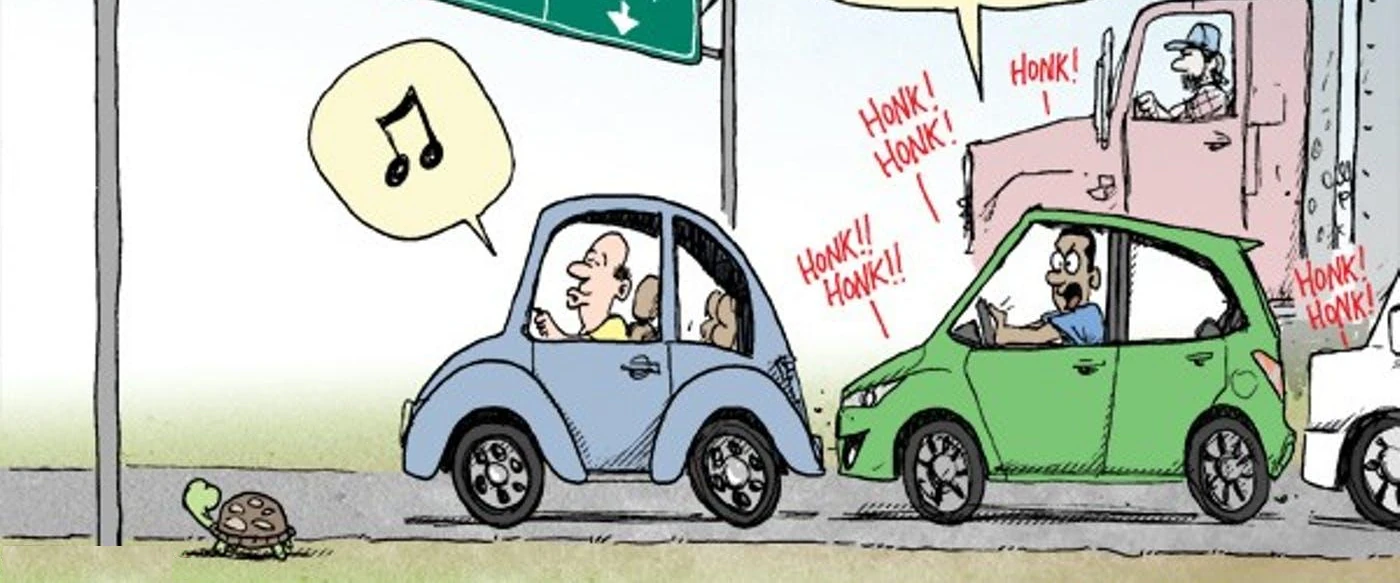
The speed limit is not a minimum
A posted speed limit tells you the maximum lawful speed for that road under normal circumstances. It does not require you to drive at exactly that speed regardless of conditions.
There are many legitimate reasons to drive below the posted limit. Rain, snow, ice, fog, darkness, road construction, poor visibility, heavy traffic, a mechanical problem or an unfamiliar road or situation can all justify reducing your speed.
You are also responsible for choosing a speed that allows you to remain in control of your vehicle. A speed that is reasonable for one driver, vehicle and set of conditions may not be reasonable for another.
That does not mean, however, that “below the speed limit” automatically means “safe” or “appropriate.”
When does slow driving become a problem?
Section 145 is concerned with the effect your speed has on traffic. If you are travelling substantially slower than other traffic for no good reason and vehicles are being impeded or blocked as a result, you may be driving too slowly.
There is no rule in British Columbia that says, for example, that driving 5, 10 or 15 km/h below the posted limit is automatically illegal. The circumstances and the effect on traffic matter.
Consider two drivers travelling at 40 km/h in a 50 km/h zone. One may be driving at that speed because of heavy rain and limited visibility. The other may simply be distracted or unaware that they are holding up a line of traffic.
Their speeds are identical, but the circumstances are not.
In practice, enforcement of this provision is about more than looking at the speedometer. During my enforcement career, I encountered relatively few situations where a driver was actually ticketed for driving too slowly. More often, the appropriate response was to explain the problem to the driver and, where necessary, suggest that they pull over and allow the traffic behind them to pass.
What if traffic is following you?
If you choose or need to travel more slowly than the traffic around you, pay attention to what is happening behind you.
Check your mirrors regularly. If a line of vehicles begins to form behind you, look for a safe opportunity to allow them to pass. On a multi-lane road, use the appropriate lane and avoid unnecessarily occupying a lane that other traffic needs to use.
On a two-lane highway, patience is important for everyone. The driver who is travelling slowly should not force a following driver to make a dangerous passing manoeuvre, and the following driver is responsible for making sure that any passing manoeuvre is legal and safe.
If there is a safe place to pull off the roadway and allow traffic to pass, doing so may be the courteous and safest choice when a long line of vehicles has accumulated behind you.
Don't let other drivers pressure you into speeding
There is an equally important point for the driver who is following a slow vehicle: someone else's impatience does not make speeding or an unsafe passing manoeuvre legal.
Being delayed by a slower vehicle can be frustrating, particularly on a highway where there are few opportunities to pass. It does not justify tailgating, honking repeatedly, passing where it is prohibited or exceeding the speed limit simply to get around the vehicle.
The safest response is to leave adequate following distance, wait for a legal opportunity to pass and remember that arriving a few minutes later is preferable to causing a collision.
What about an ICBC road test?
There is an important distinction between what the law requires and what is expected of someone taking an ICBC road test.
A driver taking a road test is expected to demonstrate that they can maintain an appropriate speed for the circumstances. In good conditions, driving noticeably below the posted speed limit without a good reason can result in a deduction for speed maintenance. The greater the difference from an appropriate speed for the circumstances, and the more that traffic is affected, the more serious the problem can become.
This does not mean that a road-test candidate must drive at exactly the posted speed limit. There is no rule that says, for example, that driving at 45 km/h in a 50 km/h zone automatically results in a failure. The examiner considers the circumstances and whether the driver's speed is reasonable and appropriate.
On the other hand, deliberately choosing a substantially lower speed in clear, normal conditions because you believe that driving below the limit is always safer can be a mistake. A driver who consistently travels well below the posted limit may demonstrate poor speed control or impede other traffic, neither of which is what ICBC expects from a competent driver.
The practical lesson for a new driver is simple: when conditions are good, drive at an appropriate speed and normally work toward the posted speed limit. When weather, traffic, road conditions or another legitimate reason requires a lower speed, slow down. Good driving is about choosing the appropriate speed, not simply choosing a number below the speed limit.
There may be a good reason
It is easy to become annoyed when you find yourself behind a vehicle travelling below the posted speed limit. Before assuming that the driver is careless or inconsiderate, consider that you may not know why they are travelling slowly.
They may be a new driver, an older driver who is adjusting to changing abilities, someone unfamiliar with the road, or someone dealing with a problem that is not immediately visible to you. They may simply be choosing a speed that they believe is appropriate for the circumstances.
That does not give a driver permission to ignore the traffic building behind them. A responsible driver considers both what is happening ahead and what is happening behind.
Slow driving and safe driving are not opposites
Good driving is not about travelling as fast as possible or as slowly as possible. It is about choosing an appropriate speed for the road, traffic and conditions while respecting the other people who are using the highway.
Driving below the speed limit can be exactly the right thing to do when conditions require it. Driving unnecessarily slowly and impeding normal traffic is another matter.
The speed limit is a maximum, not a target that must always be reached. But it is also not a suggestion that you may ignore without considering the traffic around you.
- Log in to post comments
Comments
Well policing again is at odds with what ICBC says and regulates during a driver exam. If a person on a road test is doing roughly 10+ km under the speed limit AND they are holding up traffic WHICH causes another vehicle to try to pass, honk or continually flash their lights (Make it apparent that they are annoyed and could precipitate a road rage incident or illegal manouever) then the examinee would fail the road test due to the dangerous action of impeding traffic. It happens frequently on road test (this is one of the common reasons that I would disqualify an examinee). The speed limit is just that...a set speedx for that road under normal driving conditions. Of course if the conditions are adverse then allowances are made to a reasonable amount.
- Log in to post comments
Interesting to know this, however, don't be so quick to say that policing is at odds with what ICBC says. ICBC policy and the law are two entirely different things. You are guided by ICBC policy when doing a road test. The police are guided by the law when they do enforcement. As you will see with you read the Motor Vehicle Act section on slow driving, the driver is allowed to travel at a speed slower than the limit if it is necessary to be safe.
- Log in to post comments
Nothing Gets to me more than Oblivious/Entitled Drivers. I say it like that because I sometimes wonder if people that live on a road drive slower because they think it's their road. People that drive on a thoroughfare road will drive slower as they think it helps control the flow of traffic on their road.
As this discussion touched on too the ones that don't pull over on a two lane blacktop with a train of 10+ cars behind them is simply mind boggling to me. Anyways, just wanted to add my 2 cents. Please pull over, slow drivers..
- Log in to post comments
When my Dad started teaching me how to drive, sitting beside him holding a steering wheel at about 8 years old, he always said to be courteous. On my 16th birthday, we were parked in front of a testing station when it opened at 9 AM and I aced the test, drove Dad's car and got my "DRIVER'S LICENSE". About 2 hours later, I was back, sitting behind a buddy on my motorcyce. The examiner took one look and asked why I was back. "To get my bike license ...". "Get out of here. I gave you your car license on your Birthday .... You're supposed to have a 'learning period', you know. Come back in 2 weeks." I did, got my M/C endorsement and later, upgraded to what is now a Class 1 & 6.
I also did some digging into the BC MVA and its Regs. Yes, there it was: "KEEP RIGHT EXCEPT TO PASS". Straightforward, simple and to me, obvious. Also, courteous.
How you want to drive your vehicle is not my concern. If I was a Police Officer, then yes, it is .... but I'm not. Although admittedly in our modern times, if I see you driving drunk, impaired or on the cell phone, I may note your license plate, pull over and report you to 911. Why? Because distracted idiots have killed too many of my friends over the years.
But back on track. If you want to treat speed limits as "suggested minimums", just a flick of the lights, I'm over and you're on your way. No "speed regulator" here. In fact, I've probably moved over before you got to me, unless I'm stuck in "Moonbeam's traffic" like you are. If you're prone to Road Rage, I'd far rather have you in front of me than behind. A little self preservation ....
But how about a bit of courtesy in return? Don't ride my bumper, shoot past and then slow down. If I'm in the car or on the bike, I'll probably get out of your way .... but in a 70 ton loaded semi, you could end up being a bit bent.
I'm busy enough driving my own vehicle and trying to pay attention to that job. Please do the same ..... If you want to go faster or slower, fine by me. If you're over the speed limit, not my problem .. and, because I'm not a cop, not my concern either.
JUST DRIVE YOUR OWN VEHICLE and let me drive mine, ok?
Yes, it was a word seldom heard now ..... COURTESY!
(Thanks Dad ....)
- Log in to post comments
I don't know how many times I heard that someone "had to get past" the bad driver behind them. Like you, I would rather have them in front of me so that I can keep an eye on them and have some control over how far away from me they were.
- Log in to post comments
I've probably said this before, but when I applied the same tolerance under the speed limit as I did for those driving over the speed limit and factored in the advisory signs for speed I seldom found a driver going slower. Having sat and considered for a minute, I cannot recall writing a ticket for impeding traffic during my enforcement career.
I do remember stopping the odd driver and suggesting that if they felt it was necessary to drive at a slower speed and they started impeding traffic, they should pull over, stop and let everyone go by. That courtesy might also be a lifesaver as the probability of an unsafe pass by an impatient follower can be quite high.
- Log in to post comments
As I used to be a Driver Examiner, I have the following observations on this topic:
- You will NOT be impeding traffic on the ICBC Road Test unless you deliberately choose to drive at a speed that is substantially lower than would be normal; and normal is what they're looking for.
- You should only drive as if it's Sunday at 5:00am if it is in fact Sunday at 5:00am - which it won't be, as Road Tests are conducted on weekdays during regular hours.
- There won't be any 'flashies, honkies and crazies' unless your behaviour as a driver triggers such a reaction in other road users.
- An Instructor is a person licensed to teach people how to drive. A Driver Examiner is a person licensed to conduct Road Tests. Don't confuse the two, their jobs are quite different. The person who conducts your Road Test will be a Driver Examiner, and in all likelihood will never have been an Instructor and wouldn't know how to do this.
- Driver Examiners are certainly very conscious of whether you shoulder-check but doing this 'on every turn and lane switch' won't cut it; the check must precede the lateral movement of the car or you're just going to be witnessing the collision with whatever was in your blind spot. It's like using turn signals; should you signal during every turn and lane change? NO, you should signal beforehand or it's a waste of time.
- So long as it's legal to be doing 50 km/h, and conditions allow it, then no Driver Examiner is going to mark it against you if you do this; and you certainly don't have to accelerate briskly to 49 km/h, nobody drives like that and it isn't expected. They're looking for logical, normal driving believe it or don't. That said, if you do choose to drive dead on the limit (posted or not) then you've left yourself zero margin for error so it may not be the wisest choice.
- Too much of the time, applicants do in fact drive more slowly than necessary. But the degree to which this happens is what will determine whether the Driver Examiner marks a 'C1 - Speed Maintenance' on the sheet. Quite often (though they probably won't admit it) when a driver marginally exceeds the limit (this happens pretty often in 30 km/h Playground zones, even with experienced Class 5 applicants) the D.E. will mark the C1 as a backslash. If the behaviour repeats, or the speed increases further beyond the limit, that backslash gets turned into a V for Violation. However, to get a Violation mark (automatic fail) for driving too slowly you would have to be crawling along a straight, open piece of roadway with traffic piling up behind you in frustration.
- Boredom has nothing to do with how a DE will be marking a Road Test, that's absurd.
- Trying to tell funny jokes during the Road Test, or maintain a conversation, will for the most part make the DE's job more difficult; they need to be able to direct you (with as much notice as possible) as to what the next maneuver required will be. Shut up and drive, paying attention to the task at hand. You can chat later.
- Don't even think about swerving toward the curb, for pity's sake. If the DE reacts by taking physical or verbal control then you have failed your Road Test right there. At a minimum you'll get marked under 'D1 - General Steering' or 'D2 - Other' for that kind of silly behaviour.
- You can count to three at - not on - every stopline if you want to I guess; but the only question in the Driver Examiner's mind is whether you really stopped. And you know what? DE's get REALLY TIRED of applicants who seem to think they have to make a hard stop to convince them you did so. Do you know how to tell if you've stopped? Answer: the vehicle has ceased to move. It's that simple; all the rest is play acting and that gets very tired.
- Driver Examiners are not stressed creatures, for the most part. It's what they do, day in day out. Remarkably, they spend a great number of their working hours accompanying somebody who hasn't actually learned to drive properly yet (fail rates are often around 50%) but for them that's simply what the job entails. You probably won't realize this, but the DE sitting casually beside you is mentally and visually so far ahead of where you're at it would make your head spin; they have to be, or they would not survive. In fact, accidents are rare, because they are so damn good at what they do.
- Missing a turn is not a good thing; routes are proscribed carefully for consistency between DE's and jurisdictions around the province in order to give every applicant an equal Road Test, so getting the applicant back on the route they're using wastes time and potentially skews the result as it provides more opportunity for error. For this reason, the DE will always attempt to give a one-block warning for a turn on residential streets, and a two-block warning on multi-lane streets (so that the applicant has the maximum time possible to get any necessary lane-changes done).
- There is absolutely no reason to acknowledge instructions unless requested; where you look, whether and when you signal, your change in vehicle speed - these are all the indications necessary to indicate to the DE that you comprehend what's required. But if you don't feel certain - then ask, for heaven's sake! Deaf people take driving tests. People with limited english comprehension take driving tests. Nervous people take driving tests. The DE knows this, and will want you to be comfortable and relaxed and able to do your best, while following the route that the DE has selected; they will give you as much time and opportunity as possible, and they will want you to understand what they wish you to do next with as much notice as possible.
- As for the vehicle, simply ensure that the brake lights, signals, and headlights are working and don't have cracked or missing lenses. The windshield should not be cracked, nor should windows be illegally tinted. The horn has to work, the seatbelts in good condition, as well as the tires. It needs to be properly licensed and insured with plates front and back; avoid rental cars unless you have checked the fine print on the rental agreement - because the DE will, to ensure that it's OK for you to be driving the car. Warning lights on the dash? Faulty exhaust? Driver's side and passenger side windows won't open? Unsafe or illegal vehicle modifications? Low on gas? The vehicle will be rejected and they'll refund your test fee.
A final thought about speed, driving slowly, and like that. Before your Road Test commences, during the preamble, the Driver Examiner will advise you that he/she wants you to drive as you would normally, obeying all signs, signals, and road markings; they will encourage you to ask questions if you're unclear on anything. They will hope for a nice, normal, smooth, logical driving performance from you; but they know you're nervous and will try to take that into account. And remember - the DE doesn't pass or fail you. You do.
- Log in to post comments
Slow Driving