
A long vehicle turning right can create a confusing situation for the driver following it. The vehicle may move to the left before beginning the turn, apparently leaving room to pass on the right. Is passing actually allowed?
The practical answer is simple: don't put your vehicle beside a long vehicle that is preparing to turn right. But the reasons why, and the responsibilities of both drivers, are worth understanding.
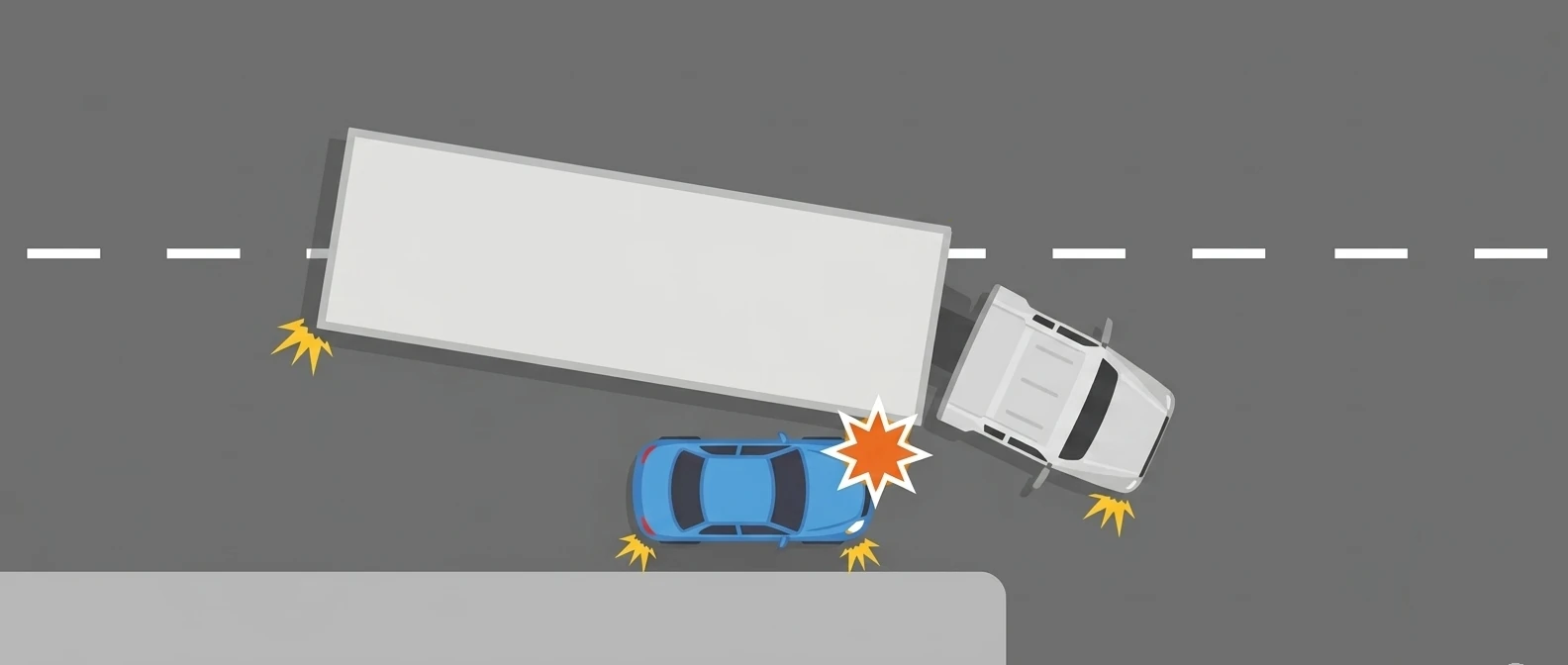
Why does a long vehicle move left to turn right?
A bus, truck or combination vehicle cannot always make a right turn from the same position that a passenger vehicle would use. Its length and the way the rear wheels track through a turn may require the front of the vehicle to move left before turning right.
This is particularly important with a tractor-trailer. As the tractor turns, the trailer follows a different path. The rear wheels can track significantly closer to the curb than the tractor did.
The ICBC Driving Commercial Vehicles guide tells commercial drivers to check for smaller vehicles, motorcycles and cyclists on the right before making a right turn. It also warns that the most dangerous point is when the tractor has made the turn but the trailer has not, because the right rear-view mirror is then almost useless.
The guide also explains that if a street is too narrow to make a right turn without swinging into another lane, a commercial driver may need to make a wide turn. It specifically advises the driver to keep the rear of the vehicle close to the curb to prevent other drivers from passing on the right.
Can you pass on the right?
Section 158 of the BC Motor Vehicle Act sets out when passing on the right is permitted. On a laned roadway, passing on the right can be permitted when there is an unobstructed lane on the right where the driver is permitted to travel.
There is an important qualification, however. Section 158(2) says that a driver must not overtake and pass another vehicle on the right when the movement cannot be made safely or by driving off the roadway.
That means the existence of pavement to the right of a long vehicle does not automatically make it safe or lawful to use that space to pass. The driver must consider what the vehicle ahead is doing and whether the entire passing movement can be completed safely.
What about the right-turning vehicle?
Section 165 of the Motor Vehicle Act requires a driver intending to turn right at an intersection to approach and make the turn as close as practicable to the right-hand curb or edge of the roadway.
For a long vehicle, however, following that rule does not necessarily mean keeping the entire vehicle in the same position as a passenger car. The dimensions and turning path of the vehicle may make additional space necessary to complete the turn.
This is where the responsibilities of the two drivers meet. The long-vehicle driver needs enough room to make the turn safely and must check for vehicles and other road users on the right. The driver approaching from behind must recognize that a large vehicle may need that space and must not move into a position where a collision is likely.
Two lanes in the same direction
The situation is particularly important when there are two lanes travelling in the same direction.
ICBC's current crash-responsibility guidance specifically addresses a commercial vehicle making a two-lane-wide right turn. It says that the commercial vehicle should signal and straddle both lanes to make the wide turn, and that drivers should not overtake a turning commercial vehicle.
ICBC gives an example in which the commercial vehicle makes a wide right turn without straddling both lanes and collides with a passenger vehicle in the right lane. In that example, ICBC assigns responsibility to both drivers. It also notes that responsibility can shift toward the passing vehicle if the commercial vehicle is properly signalling and straddling both lanes but the other driver attempts to pass.
This is an important distinction. A right-turn signal does not give the commercial driver permission to make an unsafe movement, but the presence of a lane beside the commercial vehicle does not give the passenger vehicle an automatic right to use it to pass.
Don't rely on the driver's mirrors
A driver approaching the right side of a long vehicle should also consider visibility.
If you cannot see the commercial driver's face in a mirror or through a window, the driver may not be able to see you either. As the vehicle begins its turn, the trailer or rear portion can move into the space beside it surprisingly quickly.
This is especially dangerous for a vehicle that has already moved alongside the truck or bus. Once the turn begins, there may be nowhere to go.
What commercial drivers are expected to do
Two experienced commercial-driving professionals commented on an earlier version of this article, offering practical observations about how commercial drivers can reduce the opportunity for a conflict with a vehicle approaching on the right.
CompetentDrivingBC, a former ICBC driver examiner, pointed out that a large vehicle should avoid leaving an obvious path for another vehicle to try to use, while still checking the right mirrors for conflicts.
Check Ride, a commercial vehicle driver trainer, described teaching drivers not to "show the driver behind them the prize"—a clear view of the road ahead between the trailer and the curb. His advice was to keep the vehicle close to the curb, at low speed, for as long as practical before moving out to complete the turn.
These comments are practical driving advice rather than statements of law. They do, however, illustrate an important point that is sometimes missed when this type of collision is discussed: both drivers have a role in preventing the conflict.
Wait for the turn to finish
A long vehicle moving left before making a right turn can make it look as though a gap has opened on the right. That gap may disappear quickly as the rear of the vehicle follows the turn.
If you are following a long vehicle and it signals a right turn, stay behind it. Do not assume that the space appearing on the right is an invitation to pass.
ICBC gives similar advice in its Learn to Drive Smart guide. Under “Make room for turns,” ICBC explains that large vehicles need a lot of room to turn and warns that a passenger vehicle may be squeezed between a large vehicle and the curb when the large vehicle turns right. Its driving tip is to avoid being on the right of a large vehicle if there is a chance it might turn right.
Give the long vehicle enough room to complete the turn before proceeding.
At the same time, the commercial driver must make the turn safely, check the right side for vehicles and vulnerable road users, and position the vehicle appropriately for the turn.
A few seconds of patience from the following driver, combined with careful observation and positioning by the commercial driver, can prevent a collision that neither driver intended.
Learn More
- Log in to post comments
Comments
... the bus driver left too much room on his right; the smart, and legal, way to execute the turn is to ensure that you haven't left room for a car to try and get beside you. Instead, you should go deep with the front end before commencing your turn.
That said, it's still incumbent on the driver of the large vehicle - whether it be a Garbage Truck or a Bus or whatever - to check the right mirrors for conflicts; cyclists are small, and narrow, and some of them are dumber than a bag full of hammers ...
- Log in to post comments
When I was teaching right turns with a trailer the first thing I taught my students was not to show the driver behind them the prize (a view of the road ahead of them between the trailer and the curb) because if they could see it they would go there. Keep as close to the curb, at a low speed, as possible until the last second before swinging the front end out into the second lane to set up for the turn. Slow truck, fast hands, this will restrict the view for the following driver. If there is too much traffic to do this slowly, straddle two lanes ahead of the intersection inhibiting traffic in both of them, just before the corner bring the front end as close to the curb as possible and quickly swing back out fully into lane two, this will keep the trailer as close as possible to the curb for as long as possible, not showing following drivers a clear path ahead.
Always watch out for bicycles as they will still be able to fit through the small space you have left and don't always pay attention to what is going on around them.
- Log in to post comments
In My Opinion...