
Have you noticed a recurring traffic safety problem in your neighbourhood? Perhaps drivers regularly speed along a residential street, fail to stop at an intersection, ignore pedestrians at a crosswalk, or use a quiet neighbourhood road as a shortcut.
It is tempting to respond with frustration, particularly when the problem seems obvious to everyone who lives nearby. However, getting the attention of the people responsible for road safety is more likely when you can describe the problem clearly and provide useful information about it.
The first step is to recognize that not every traffic problem has the same cause or requires the same response. Some involve driver behaviour and require police attention. Others involve road design, traffic volumes, signs, signals or pedestrian facilities and are better directed to municipal or provincial transportation authorities.
A little preparation before making a complaint can help ensure that it reaches the right people and gives them something useful to investigate.
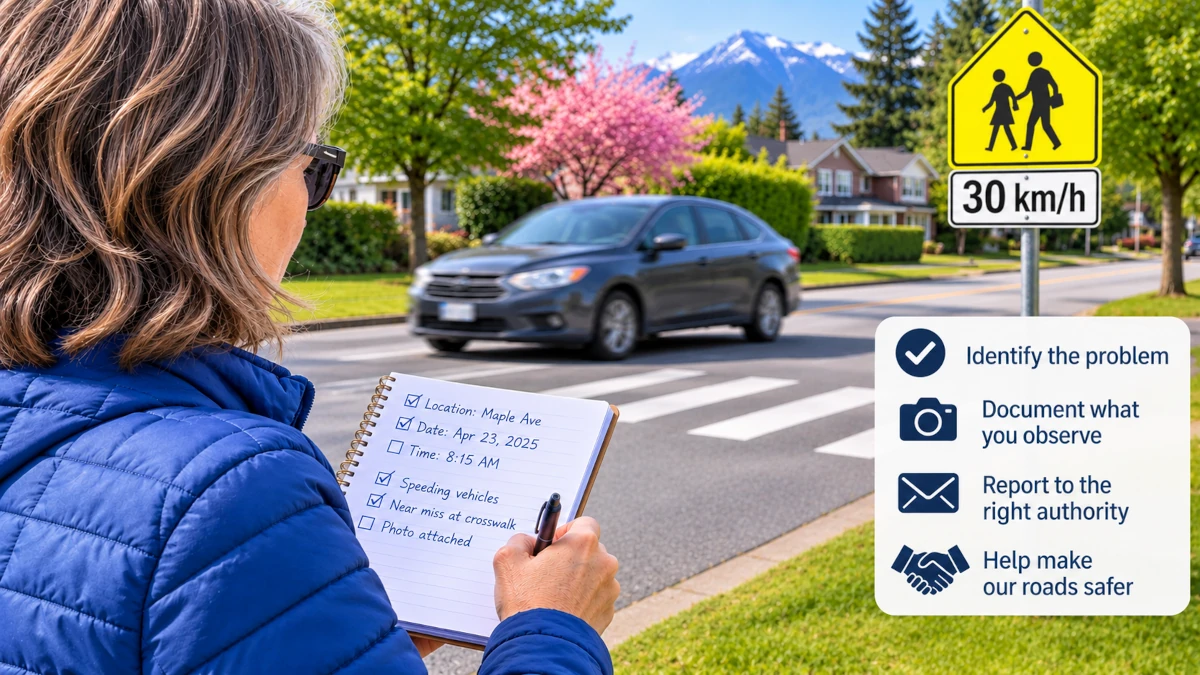
1. Identify the Problem
Begin by describing exactly what concerns you. Avoid general statements such as "the street is dangerous" or "everyone drives too fast." Identify the behaviour or condition that creates the risk.
For example:
- Drivers regularly exceed the posted speed limit on a residential street.
- Motorists fail to stop at a particular stop sign.
- Drivers do not yield to pedestrians at a marked crosswalk.
- Vehicles turning at an intersection create conflicts with pedestrians or cyclists.
- Heavy traffic uses a residential street to avoid congestion on a nearby arterial road.
- Parked vehicles, vegetation or road design restrict visibility at an intersection.
- A lack of sidewalks, lighting or suitable pedestrian crossings makes it difficult to travel safely.
These are different problems, and they may require different solutions. Identifying the specific concern will help determine who should receive your report.
2. Observe and Document What Is Happening
Your observations are often the most useful starting point. You do not need sophisticated equipment or formal traffic counts to explain what is happening, but specific details are much more helpful than impressions.
Consider keeping a simple written record for several days or longer. Record:
- Location: Identify the street, intersection or particular section of road. Include the direction of travel if it matters.
- Date and time: Note when the problem occurs. Is it concentrated around school arrival and dismissal times, during commuter periods or throughout the day?
- Frequency: Is this an occasional occurrence or something you observe repeatedly?
- Behaviour: Describe what drivers are actually doing rather than simply labelling them careless or dangerous.
- Road conditions: Note relevant features such as visibility, parked vehicles, road layout, weather or traffic congestion.
- Safety consequences: Describe any conflicts involving pedestrians, cyclists or other road users. Explain what happened without exaggerating the risk.
For example, instead of writing that vehicles always speed past the school, you might record that between 8:00 and 8:30 a.m. on three consecutive school days, you observed several vehicles travelling noticeably faster than surrounding traffic while children were walking along the roadside.
Be careful about estimating vehicle speeds by eye. Unless you are using suitable measuring equipment, describe the behaviour you observed rather than presenting an estimate as a measured speed.
Photographs can help illustrate a visibility problem, confusing road layout or missing pedestrian facility. Video may also be useful, provided it is obtained safely and lawfully. Never put yourself or another road user at risk to collect evidence.
3. Find Out Whether There Is Supporting Information
You may be able to supplement your observations with information already collected by transportation authorities.
ICBC makes collision information available to the public through interactive data tools. Its regional crash maps can help identify collision patterns and locations where crashes have occurred.
The maps are useful background information, but they have limitations. Collision records do not necessarily establish why a crash occurred, and an absence of recorded collisions does not prove that a location is safe. Near-misses and other conflicts that did not result in a reported collision will not appear in collision statistics.
You can explore ICBC's statistics and collision data, including its crash maps, on the ICBC statistics and crash maps.
You might also check whether your municipality has published a traffic calming policy, neighbourhood transportation plan or traffic study for the area. Some communities have established procedures for evaluating resident requests.
For eligible traffic-calming requests, the Town of Sidney's traffic calming request process considers vehicle speeds, traffic volumes, safety history, land use, pedestrian and cyclist activity, and shortcut traffic. It also requires neighbourhood participation.
These procedures vary between communities. Do not assume that a policy or application process used by one municipality applies to another.
4. Consider Whether Community Speed Watch Can Help
If speeding is the concern, ask whether a Community Speed Watch program operates in your area.
Speed Watch is an ICBC-sponsored educational program supported by police and community volunteers. Trained volunteers use portable radar equipment and electronic display boards to show approaching drivers their speed. They record traffic speeds and forward the information to police and ICBC.
According to the BC RCMP, areas with significant speeding problems may be considered for future enforcement. Speed Watch therefore provides more than a visual reminder to drivers: it can also provide information that helps police identify locations requiring attention.
The program is not a substitute for police enforcement, and its availability varies between communities. Contact your local police agency or consult the DriveSmartBC Speed Watch directory to find out whether a program operates in your area.
More information is available from the BC RCMP Speed Watch program.
5. Send Your Report to the Right Authority
One of the most important parts of making a useful complaint is determining who is responsible for the road or the behaviour you are reporting.
In British Columbia, responsibility is divided between municipalities, regional districts, the provincial government, police and other agencies.
- Driver behaviour: Report dangerous driving, repeated disregard for traffic controls and other driving offences to the local police agency. For an immediate threat to public safety, call 911. For a situation that does not require an immediate response, use the police non-emergency number.
- Municipal roads: Contact your municipality's engineering, transportation or public works department about traffic signals, signs, road design, pedestrian facilities, traffic volumes and requests for traffic calming.
- Provincial highways: Contact the Ministry of Transportation and Transit about highway signs, speed limits, road conditions and infrastructure on provincial roads. The responsible Ministry district office can direct your concern to the appropriate staff.
- Other road authorities: If the road is maintained by a regional district, private operator or another authority, contact the organization responsible for its operation and maintenance.
Road ownership and maintenance responsibility are not always obvious. If you are uncertain, ask your municipality or the Ministry to direct you to the appropriate authority.
The provincial government's Contact RoadSafetyBC page confirms that unsafe driving reports should go to local police, while enquiries about provincial road signs, conditions and infrastructure should go to the Ministry of Transportation and Transit.
6. Make Your Request Clear and Specific
A written report is useful because it allows you to organize your observations and gives the receiving authority something it can refer to when investigating the concern.
Include:
- The exact location of the problem.
- A clear description of the behaviour or road condition.
- When and how frequently it occurs.
- Any relevant observations, photographs or supporting information.
- An explanation of how the problem affects road users.
- Your contact information so that the authority can ask questions or provide a response.
Explain what you would like the authority to do. You might request a traffic study, a review of an intersection, a speed survey, an examination of pedestrian safety or consideration of additional enforcement.
You do not need to prescribe the engineering solution. For example, demanding that a stop sign be installed to address speeding may not be appropriate. Traffic control devices and road modifications must be selected with consideration for the function of the road, traffic conditions and the safety of all road users.
It is reasonable to ask the responsible authority to investigate the problem and explain what options are available.
7. Follow Up If Necessary
Do not assume that sending an email or making a telephone call will immediately result in a change. Transportation departments have competing priorities, limited resources and established procedures for evaluating requests.
Keep a copy of your correspondence and make a note of when you contacted the authority. If you do not receive a response within a reasonable period, follow up and ask whether your concern has been assigned for review.
If an investigation has been completed, you can ask:
- What information was considered?
- Were traffic speeds or volumes measured?
- Was the collision history reviewed?
- What criteria were used to evaluate the request?
- Is any further investigation or action planned?
If several residents share the concern, a joint submission can help demonstrate that the issue affects the wider neighbourhood. It is particularly useful when residents can provide independent observations of the same problem.
Some municipalities also provide opportunities to address council or submit a delegation. If you believe a significant safety concern has not received appropriate attention, find out what public participation procedures are available in your community.
A Practical Approach to Road Safety
Residents are often the first to notice a developing traffic safety problem. They see how their streets are used every day and may recognize patterns that are not immediately apparent to someone who visits the area occasionally.
That knowledge is valuable, but it becomes much more useful when it is communicated clearly. Identify the problem, record what you observe, determine who is responsible and make a specific request for investigation.
There is no guarantee that every complaint will result in a new sign, a speed limit change, traffic calming or additional police enforcement. However, a factual, well-directed report gives the responsible authority a much better opportunity to understand the concern and decide what, if anything, should be done about it.
Improving road safety in a neighbourhood begins with recognizing a problem and reporting it in a way that can be acted upon.
Learn More
- Traffic Calming in Your Neighbourhood – How road design can help address neighbourhood traffic problems.
- Speed Watch Groups in B.C. – Find a local volunteer group and learn how to request a neighbourhood deployment.
- Imposing a 30 km/h Speed Limit in Residential Areas – An examination of municipal approaches to managing speeds on residential streets.
- Log in to post comments