
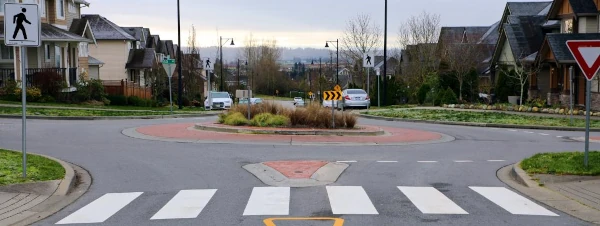
In Trytko v. Kafafi, 2006 BCPC 349, the British Columbia Provincial Court considered liability for a collision at the intersection of Jervis Street and Nelson Street in Vancouver. The judgment refers to the intersection as a roundabout, but there were no yield signs controlling the approaches. The court therefore considered the drivers' obligations at an uncontrolled intersection under section 173(1) of the Motor Vehicle Act.
The Collision
On November 26, 2004, Carrie Trytko was driving northbound on Jervis Street. She slowed as she approached the intersection and waited for traffic approaching from her left to clear. She then entered the intersection, believing the way was clear.
Mehrdad Kafafi was approaching from her right on Nelson Street. The vehicles collided near the northeastern portion of the intersection, with Mr. Kafafi's left front bumper striking the passenger-side door and wheel well of Ms. Trytko's vehicle.
Ms. Trytko testified that Mr. Kafafi was travelling quickly and that she saw his vehicle only when it was too late to avoid the collision. Mr. Kafafi testified that he was travelling at approximately 40 km/h and applied his brakes when he saw her vehicle.
The Law
Section 173(1) of the Motor Vehicle Act addresses the right of way at uncontrolled intersections. When two vehicles approach or enter an intersection from different highways at approximately the same time and there are no yield signs, the driver must yield to the vehicle on the right, subject to the exception in section 175.
The fact that an intersection is designed as a traffic circle does not, by itself, establish which driver has the right of way. The traffic controls in place matter. In this case, there were no yield signs, so the court applied the rules for an uncontrolled intersection. Drivers should not assume that the right-of-way arrangement in this judgment applies to every modern roundabout.
ICBC's Learn to Drive Smart distinguishes between traffic circles and roundabouts. For traffic circles, it instructs drivers to obey posted traffic-control signs and, where there are none, to treat the circle as an uncontrolled intersection. Drivers must yield to traffic already in the circle and, when another vehicle arrives at approximately the same time, to the vehicle on the right. The handbook provides separate guidance for roundabouts, including yielding to traffic already circulating. These distinctions are important because the right-of-way rules depend on the traffic controls in place, not simply on the circular design of an intersection.
Ms. Trytko acknowledged that she had treated roundabouts as though they were four-way stops. She believed that drivers took turns entering, with vehicles that arrived first proceeding before others. This was a misunderstanding of the applicable right-of-way rule.
Having the right of way does not relieve a driver of the obligation to exercise reasonable care. The court considered earlier decisions establishing that a driver with the right of way may still bear responsibility for a collision if there was a sufficient opportunity to recognize the other driver's mistake and avoid the collision.
The Court's Analysis
Judge W.F.W. Yee found that Ms. Trytko had failed to yield to Mr. Kafafi, who was approaching from her right. Although her vehicle may have entered the intersection first, the judge concluded that any lead amounted, at most, to a few feet or a fraction of a second. It did not constitute the substantial prior entry that might have affected the right-of-way analysis.
The judge also considered whether Mr. Kafafi could have avoided the collision. Ms. Trytko described his vehicle as approaching quickly, but the evidence did not establish that he was travelling at an excessive speed. His evidence was that he was approaching at approximately 40 km/h.
Nevertheless, the judge found that Mr. Kafafi's evidence about whether he had slowed down was inconclusive. The judge observed that the purpose of installing roundabouts on residential streets was to slow traffic and reduce the risk of collisions involving other road users, including pedestrians and cyclists. He concluded that the collision could have been avoided had Mr. Kafafi slowed as he approached.
Decision on Liability
The court apportioned liability as follows:
- Carrie Trytko: 75% liable. She failed to yield the right of way to the vehicle approaching from her right.
- Mehrdad Kafafi: 25% liable. The collision could have been avoided had he slowed as he approached the intersection.
The decision demonstrates that the right of way does not provide absolute protection from liability. Ms. Trytko's failure to yield made her primarily responsible for the collision, but Mr. Kafafi was also held partly liable because the collision could have been avoided had he slowed as he approached the intersection. Both drivers' actions mattered when the court apportioned responsibility.
Note
Google Maps imagery shows no yield signs at this intersection in 2022, while imagery from 2024 shows yield signs installed on the approaches. This change occurred long after the collision considered in the judgment.
Learn More
- Log in to post comments