
A driver preparing to pass a large commercial vehicle needs more than a clear passing lane. The driver also needs to be able to see far enough ahead to recognize hazards and complete the pass safely. A British Columbia Supreme Court decision illustrates how quickly that ability can disappear when a large vehicle blocks the sun and a driver moves out from behind it.
In Howell v. Strutt, 2021 BCSC 92, a collision on the Coquihalla Highway involved a passing driver, a semi-trailer and a stationary tow truck. The circumstances offer some important lessons about passing, sun glare and the limits of what a driver can see.
The Collision
On January 7, 2015, Brian Howell was driving south on the Coquihalla Highway from Kamloops toward Merritt. It was approximately 2:45 in the afternoon. The sky was clear, but the road surface was wet.
Howell came up behind a semi-trailer that was slowing as it climbed a hill. He was travelling about one vehicle length behind it. Before moving into the passing lane, he checked to make sure there was no traffic approaching from behind.
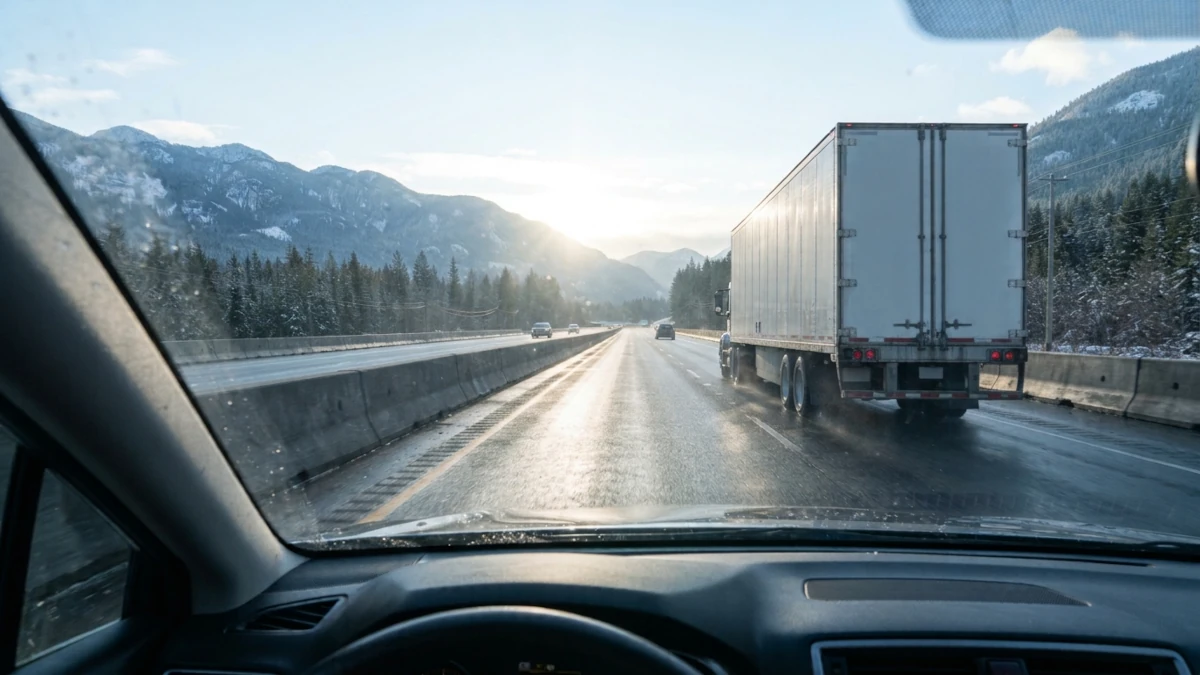
While following the semi, Howell was shielded from the low afternoon sun. When he moved left to pass, he emerged from that shadow and was suddenly exposed to direct sunlight. The sun was near the top of the hill, shining toward approaching southbound traffic. Its reflection from the wet pavement made visibility even worse.
What Howell could not see was a flat-deck tow truck parked ahead on the left side of the highway. It extended approximately 20 inches into the passing lane. The tow truck had been there for about 90 minutes after its operator stopped to investigate a separate collision on the northbound side of the highway.
The tow truck's orange warning lights were operating, but the judge accepted evidence that the combination of sunlight and road glare made them practically invisible to Howell.
Howell struck the tow truck almost immediately after moving into the sunlight. Accident reconstruction experts estimated that his vehicle was travelling between 52 and 74 km/h at impact. The posted speed limit was 120 km/h, indicating that he had slowed considerably from his earlier speed.
Passing a Large Vehicle
A large commercial vehicle can obstruct much more than the view of the road immediately ahead. It can conceal stationary vehicles, roadside activity, traffic conditions and other hazards that would otherwise be visible to a driver.
The problem changes when the driver moves into the passing lane. The view ahead may open up, but the driver can also be exposed to conditions that the larger vehicle had been shielding them from.
That was particularly important in Howell's case. The semi had blocked the sunlight, so Howell was not experiencing the glare while following it. Moving left to pass changed his visibility almost instantly.
There is another consideration. Howell was only about one semi-trailer length behind the truck when he began his pass. That left him relatively close to a large vehicle that restricted his view of the road ahead.
This does not mean that the court found his decision to pass negligent. It did not. The judge considered the semi's slowing on the hill, the fact that it was not moving into the slow lane and the circumstances Howell faced. The judge found that Howell was not negligent.
Nevertheless, the case demonstrates why a driver should consider more than whether the passing lane appears clear. Before beginning a pass, ask whether there is enough visible road ahead to complete it safely. If the vehicle being passed blocks the view beyond it, the driver may be committing to a manoeuvre without knowing what lies ahead.
Sun Glare Can Change Visibility Very Quickly
Sun glare is a familiar driving hazard, particularly during the winter months when the sun is lower in the sky. It can be especially troublesome when driving toward the sun on a wet road.
In this collision, several factors combined to make the problem unusually severe:
- The sun was low and almost directly ahead of southbound traffic.
- The semi-trailer shielded Howell from the sunlight while he followed it.
- Moving into the passing lane exposed him to direct sunlight without warning.
- The wet pavement reflected sunlight toward the driver, adding to the glare.
The judge found that the tow truck was practically invisible to Howell in the moments before impact. He had only a few seconds between emerging into the sunlight and striking it.
This is an important distinction. There is a difference between approaching a known area of sun glare and suddenly encountering severe glare after being shielded from it by another vehicle.
Drivers should anticipate low sun whenever possible. Sun visors and suitable sunglasses can help, but they cannot eliminate every visibility problem. When glare prevents you from seeing the road ahead clearly, reduce speed. If you cannot see well enough to continue safely, find a safe place to stop until visibility improves.
The important point is not to continue driving at a speed that assumes you can see hazards that are, in fact, hidden from view.
Warning Lights Do Not Guarantee Visibility
The tow truck's orange warning lights were switched on, yet they did not provide an effective warning to Howell.
Warning lights can attract attention, but their effectiveness depends on the circumstances. Sunlight, glare, the angle from which they are viewed and obstructions between the lights and approaching drivers can all affect how well they are seen.
A driver should never assume that a vehicle displaying warning lights will necessarily be visible in time to avoid it. Equally, anyone who must stop a vehicle near moving traffic should not assume that operating warning lights alone will make the location safe.
In this case, the tow truck was partly occupying a high-speed travel lane. Its operator had safety cones available but had not placed them. The judge found that the truck could have been parked farther away from the travelled portion of the highway.
Winter Road Markings Can Be Difficult to See
Another detail considered by the court was the condition of the pavement markings.
At the point of impact, Howell's left tires were approximately 10 inches beyond the fog line. They had not reached the rumble strip at the edge of the pavement.
The evidence before the court was that the road markings were degraded and partly obscured by accumulated abrasives. During winter, markings can be difficult to distinguish, particularly when the road is wet and sunlight is shining directly toward the driver.
Road markings are important visual references, but drivers should recognize that they are not always easy to see. Winter conditions, road spray, accumulated sand and gravel, water and glare can all reduce their usefulness.
This is another reason to reduce speed when visibility deteriorates and to avoid relying on a single visual reference to maintain lane position.
What Drivers Can Learn
Howell v. Strutt is a reminder that a seemingly routine passing manoeuvre can involve several hazards that are not immediately apparent.
- Leave enough following distance behind large vehicles to give yourself time and space to respond to changing conditions.
- Remember that a large vehicle can conceal hazards beyond it, even when the passing lane appears clear.
- Consider the effect of low sun before beginning a pass. Moving out from behind a vehicle can expose you to glare that was not previously affecting your vision.
- Be especially cautious when driving toward the sun on wet pavement, where reflected light can make visibility worse.
- Do not assume that warning lights make a stopped vehicle easy to see.
- Reduce speed when visibility or lane markings become difficult to distinguish.
The court found that Howell was not negligent in the circumstances of this particular collision. That finding should not be interpreted as permission to continue driving when glare prevents you from seeing the road ahead. Every situation is different, and a driver's decisions must take account of the conditions actually encountered.
The most useful lesson is to recognize how quickly the driving environment can change. A clear view in one lane does not necessarily mean that the road ahead will remain visible when you move into another.
- Log in to post comments