
 Have you ever found yourself trailing a large commercial transport truck on a British Columbia highway and felt an overwhelming urge to get around it? It is a common psychological reaction for passenger vehicle drivers. We don't like being slowed down but the maneuver that happens next is often one of the most dangerous actions on our roads: passing the truck, immediately cutting back into its lane, and then slowing down.
When you do this, you are stepping directly into a zone where the laws of physics are entirely stacked against you.
The View From the Cab: A Trucker’s Warning
This article was originally triggered by a direct warning from a professional truck driver within our DriveSmartBC community. They shared a perspective that everyday motorists need to hear:
"When a car cuts tightly in front of us and steps on the brakes, we are trapped. Light-vehicle drivers think because we have 18 wheels and massive air brakes, we can stop on a dime. They don't realize that our air brakes have a built-in lag time just for the air to travel through the lines. If you slam on your brakes right after cutting us off, you are essentially building a concrete wall in front of a rolling mountain. We cannot stop, and we are forced to make a split-second choice: rear-end you at full force, or jackknife our rig and risk killing ourselves or others to avoid you."
This professional reality is a stark reminder that truck drivers aren't just managing a vehicle; they are managing massive, unforgiving momentum.
The Physics of 63,500 Kilograms
To understand why cutting off a truck creates an immediate crisis of space, we have to look at the difference between a passenger vehicle and a commercial vehicle:
- The Weight Disparity: A standard passenger car or compact SUV weighs roughly 1,500 to 2,000 kg. A fully loaded commercial B-train configuration in British Columbia can weigh up to 63,500 kg. That is up to 40 times heavier than your car.
- The Stopping Distance: Traveling at 100 km/h, an average passenger car needs about 40 to 45 metres to come to a complete stop. A fully loaded semi-truck under the exact same conditions requires 90 to 100 metres—the length of an entire Canadian football field.
Sudden, aggressive braking can cause load shifts, trailer swing, or a catastrophic jackknife. When a truck driver sees a car pull tightly in front of them, they have to balance the risk of destroying the car ahead versus losing control of their entire 18-wheeled rig.
Modern commercial vehicles are increasingly equipped with Automatic Emergency Braking (AEB). While these radar-based systems save lives by initiating braking faster than humanly possible, they cannot rewrite the laws of physics. If the stopping distance required is 100 metres and you only leave them 20, a collision is inevitable.
A New Legal Era: B.C.’s Mandatory Commercial Dash Cam Law
For years, forward-facing dash cams were a voluntary security tool used by proactive fleets. That has completely changed. The B.C. Legislature unanimously passed Bill M217 (the Dashboard Cameras in Commercial Vehicles Act), making British Columbia the first jurisdiction in Canada to mandate dash cameras for heavy commercial trucks.
Once the bill receives Royal Assent, a six-month implementation clock begins for all commercial vehicles operating on B.C. highways with a gross vehicle weight rating over 11,793 kilograms. Under the new law:
- Rigid Technical Specs: Cameras must be forward-facing, feature night vision, record in at least 1080p high definition, and continuously store a minimum of 72 hours of rolling footage.
- Continuous Tracking: Operators are legally required to keep the camera recording at all times when the vehicle is in motion, and it is a violation to obstruct or disable the equipment.
- Driver Privacy: The mandate strictly requires outward-facing road cameras only—driver-facing in-cab cameras are not legally mandated.
The B.C. Trucking Association strongly endorsed this legislation, citing data proving that commercial drivers are not at fault in 75% to 80% of multi-vehicle collisions. This law ensures that when a passenger car makes an unsafe lane change and cuts off a semi, indisputable high-definition video evidence is preserved immediately. Under Section 151 of the BC Motor Vehicle Act, the courts and ICBC are increasingly laying 100% of the financial and legal liability squarely on the driver who cut into the truck's braking safety zone.
The "Three-Second Rule" and the "Headlight Rule"
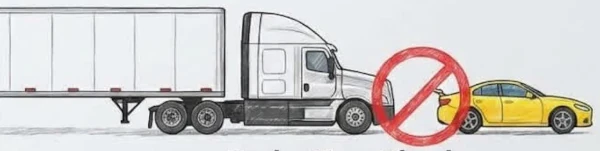
To share the road safely with commercial traffic, light-vehicle drivers should practice two simple, lifesaving habits:
- The Headlight Rule: When passing a semi-truck, do not pull back into their lane until you can see the entire front grille and both of the truck's headlights clearly in your center rearview mirror. If you can only see the top of the cab, you are still way too close to their bumper.
- The Three-Second Cushion: Once you have safely moved back into the lane, maintain a minimum of a three-to-four-second following distance ahead of the truck. If you have to slow down for traffic or a turning vehicle, that cushion gives the truck driver behind you the critical reaction space they need to bring 60,000+ kg down to a safe speed.
The next time you pass a commercial vehicle, give them the space they earn. It isn't just a matter of courtesy—it is a matter of pure survival for everyone on the asphalt.
A split-second bad habit can change lives forever. Use the buttons below to share this with the drivers in your family—you might just prevent a catastrophic crash on our highways today.
- Log in to post comments
Comments
I've had the same thing happen to me pulling our trailer, some driver will pull around you then jam on the brakes to make right hand turn!
- Log in to post comments
Vehicles Pulling RVs Too!