
A Social Contract for Road Users
 Why would a website that specializes in road safety and traffic law in British Columbia refer to the German Road Traffic Regulations? The German regulations start with what amounts to a social contract in contrast to our Motor Vehicle Act which only contains rules that people must obey. It sets a core philosophy, framing road use as a shared responsibility for everyone and then creates a framework to guide it.
The German Viewpoint: A Philosophical and Scaled Foundation
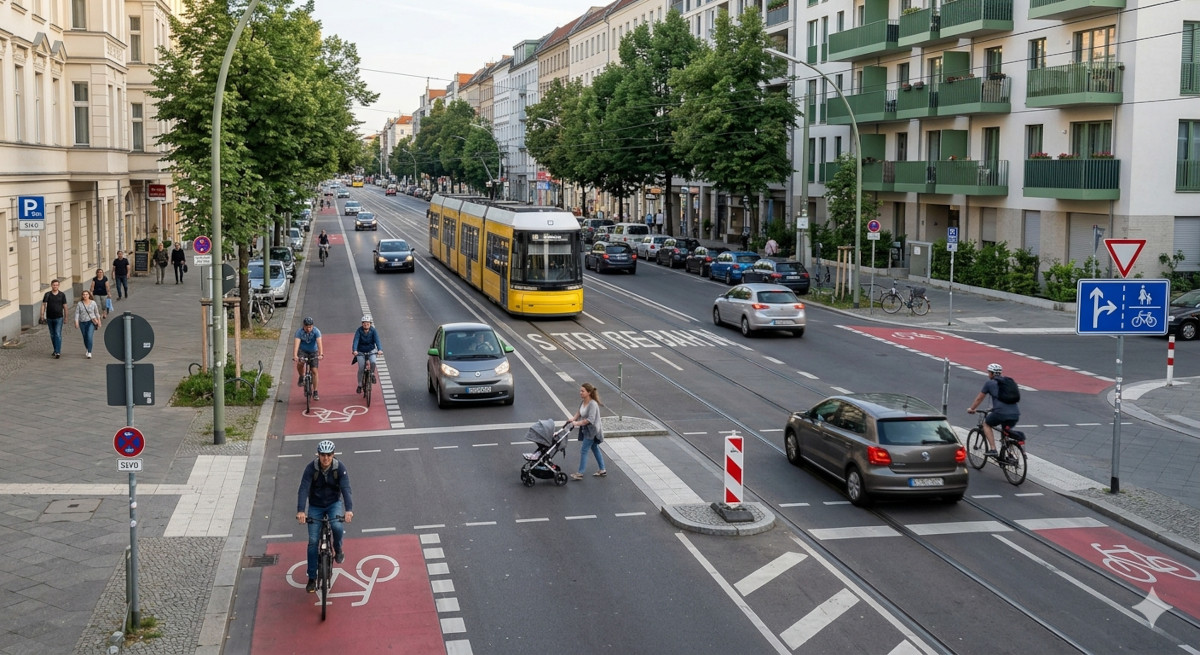
In Germany, the road is legally defined as a shared civic space built on proactive social responsibility.
The German Road Traffic Regulations (StVO) do not just list restrictions. By placing Section 1 at the very beginning, German law sets a clear thesis statement for the entire road system.
Section 1 Basic rules
(1) Use of the road requires constant care and mutual respect.
(2) A person using the road shall act in such a way as not to harm or endanger or, more than is unavoidable in the circumstances, to hinder or inconvenience any other person.
The language reads more like a community guidebook than a strict legal code:
- Constant Care: Road users must actively look out for others at all times.
- Mutual Respect: The road is a shared civic space, not an individual entitlement.
- No Avoidable Inconvenience: You cannot hinder or inconvenience others unless it is completely unavoidable.
Section 1 is used only when there is not a specific infraction for the person's action. If the action is already covered by a specific offence—such as speeding, tailgating, or running a red light—the police must charge you with that specific offence instead.
Authorities use the section because no specific rule applies and the penalty scales directly with the real-world consequences of your behaviour. Under the Federal Catalogue of Fines, these standard warning fines remain low and corrective:
- Avoidable Obstruction (€10 fine): Impeding another driver or pedestrian more than is necessary under the circumstances.
- Avoidable Nuisance (€10 fine): Distracting, annoying, or creating an unnecessary hassle for other road users.
- Endangerment (€30 fine): Behaving with a lack of care that creates an immediate, dangerous hazard for someone else.
- Property Damage / Accident (€35 fine): Causing a minor traffic collision or damaging property due to general carelessness.
In Germany, every specific traffic rule is an extension of this core philosophy. It assumes that public safety depends on mutual cooperation, framing road use as a shared civic responsibility that is policed at even the smallest level of courtesy when no other rule fits.
The BC Contrast: A Practical Baseline
British Columbia approaches road safety from a more technical angle. The BC Motor Vehicle Act (MVA) begins with administrative definitions, licensing, and bureaucratic procedures.
The Legal Application
Our closest equivalent to the German rule is found deep inside the act under Section 144: Driving without due care and attention. Unlike the German model—which uses Section 1 only when a specific rule is missing—BC uses Section 144 as a heavy-duty enforcement tool. To face a penalty here, a driver's actions must drop significantly below the standard of a prudent driver. It is designed to penalize clear careless actions, such as distracted driving or driving too fast for bad weather, rather than to police everyday politeness.
Crucially, Section 144 does not apply to the users of alternative transportation devices and pedestrians. If they behave carelessly or cause a nuisance, police cannot use Section 144 to intervene.
The Punitive Consequences
Because BC handles these standards through specific, major enforcement rather than minor, scaled warnings, a violation of Section 144 carries heavy practical and financial impacts:
- Section 144(1)(a) Violation (Drive without due care): Results in a $368 ticket and adds 6 penalty points to a license.
- Section 144(1)(b) Violation (Drive without consideration): Results in a $196 ticket and adds 6 penalty points to a license.
- Long-term Impacts: These heavy point penalties can lead to extra annual ICBC premiums and potential driving prohibitions for newer motorists.
By placing a concept like "reasonable consideration" in a long list of regulations rather than at the beginning, our legal framework treats courtesy as a legal boundary not to be crossed, rather than a low penalty, foundational starting point for how we share the road.
The Kindergarten Rules for the Road
If we were to rewrite our Motor Vehicle Act to start with the same spirit as the German regulations, it might look less like a complex legal manual and more like the basic lessons we learned in childhood. Here is a simple checklist of "Kindergarten Rules" that every new—and experienced—driver should live by on the road:
- Share everything: The lane is not yours alone; merge nicely and let others in.
- Play fair: Don't cut people off or speed up just to block someone from changing lanes.
- Don't hit people: Keep a safe following distance and always look twice for vulnerable road users.
- Put things back where you found them: Clear the intersection before the light changes so you don't block cross-traffic.
- Clean up your own mess: If you make a mistake or miss an exit, take the loss safely instead of making a dangerous, erratic correction.
- Don't take things that aren't yours: Respect space that belongs to others, including bike lanes, bus lanes, and crosswalks.
- Say you're sorry when you hurt somebody: A simple wave to acknowledge a mistake goes a long way in reducing road rage.
Do you think BC drivers need a refresher on the "Kindergarten rules"?
Help spark a shift from a "Me First" attitude to mutual respect on our roads. Share this article with a driver who needs to see it!
- Log in to post comments
Comments
We should start with this. So much would change if there was an understanding and commitment to it.
Everything I do on the road is about not only getting efficiently (quickly… I know this is a bone of contention), but making sure I do my part to keep everyone moving. This goes from occupying certain highway lanes (moving out of the way when I am not passing), to occupying as little space as possible when waiting to turn right (so that vehicles can continue traveling unhindered on my left), to making sure nothing I do is going to disrupt the flow.
I’ve always said teamwork should be the goal.
My big criticism of the way traffic safety is dictated in Canada, in particular BC, is that it has actually encouraged an us vs them mentality. Some officials took the position that if a driver could not legally drive faster then there was no need to enforce a left lane passing law. These people are absolutely enabling competitive driving attitudes.
- Log in to post comments
Most definitely and perhaps this point from the German manual:
No Avoidable Inconvenience: You cannot hinder or inconvenience others unless it is completely unavoidable.
In my opinion it would be much appreciated if traffic enforcement would enforce all the rules of the road rather than just a couple.
- Log in to post comments
I love your Kindergarten Rules for the Road! There’s even a level of irony in it, considering how many adults behave like children when they’re driving.
Thanks for including it!
- Log in to post comments
Love the Social Contract