
Question: When turning right at an intersection with a bicycle lane, should you merge into the bike lane before turning or turn across it?
Answer: It depends on the white line separating the bicycle lane from the traffic lane. A solid white line means stay out of the bicycle lane prior to turning. A broken white line means merge into the bicycle lane after yielding to cyclists, then complete your turn from the curb.
Many municipalities across British Columbia now use green pavement to highlight bicycle lanes near intersections. The green colour is intended to draw attention to an area where motorists and cyclists are likely to cross paths, but it does not change the rules for making a right turn. Drivers should follow the white lane markings and always yield to cyclists when required.
Drivers are encountering bicycle lanes more frequently than ever before, yet many remain uncertain about the correct way to turn right across them. Understanding the lane markings helps make these turns predictable and safer for everyone.
What the Learn to Drive Smart Manual Says
ICBC's Learn to Drive Smart manual explains:
Bicycle lanes are reserved for cyclists. Sometimes you will need to cross a bicycle lane to turn right, or to pull to the side of the road. Take extra care when you do this. The rules for bicycle lanes are:
- Don't drive, stop or park in a bicycle lane.
- You may only cross a bicycle lane if the white line is broken or to turn into or out of a driveway.
Why Some Bicycle Lanes Become Dashed
British Columbia's Active Transportation Design Guide explains why some bicycle lanes change from a solid white line to a dashed line before an intersection:
For bicycle lanes at unsignalized intersections, or where a protected bicycle signal phase cannot be implemented, the bicycle lane should become dashed approaching the intersection to allow motor vehicles to merge and turn right from the lane closest to the curb (see Figure G-96).
This configuration is the least preferred and is not considered comfortable for people of all ages and abilities because motorists and cyclists must share the conflict area approaching the intersection.
How to Turn Right Across a Bicycle Lane
The correct turning procedure is determined by the white line separating the bicycle lane from the traffic lane.
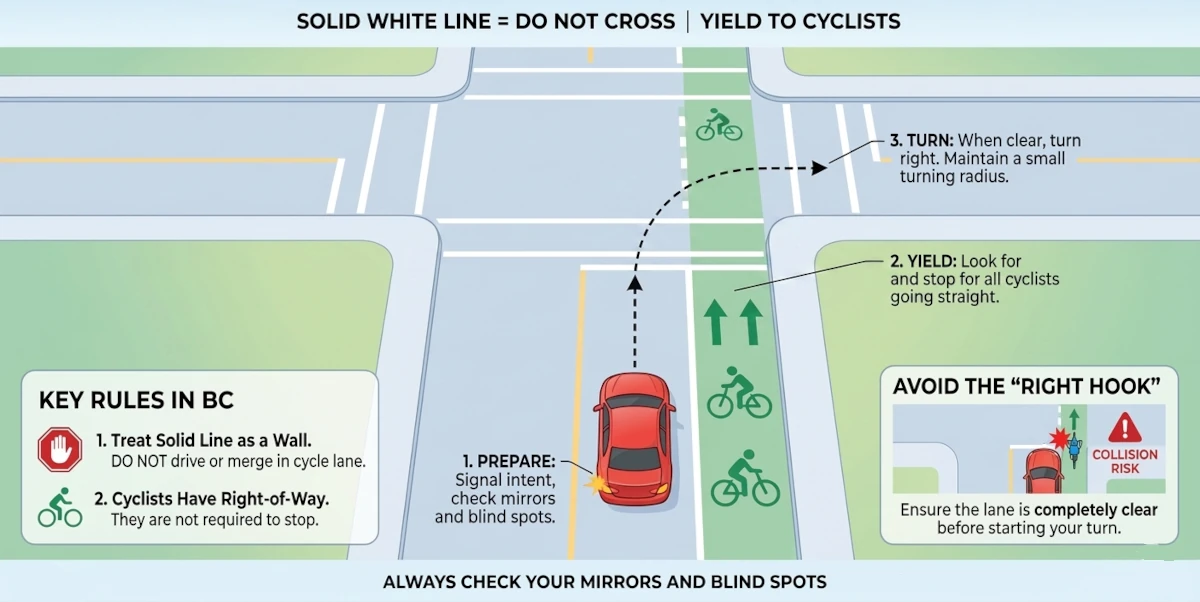
Solid White Line
If the white line remains solid to the intersection, stay entirely within your traffic lane until you begin the turn. Signal, check your mirrors, perform a right shoulder check, yield to any cyclist travelling through the intersection, then turn across the bicycle lane when it is safe.
Broken White Line
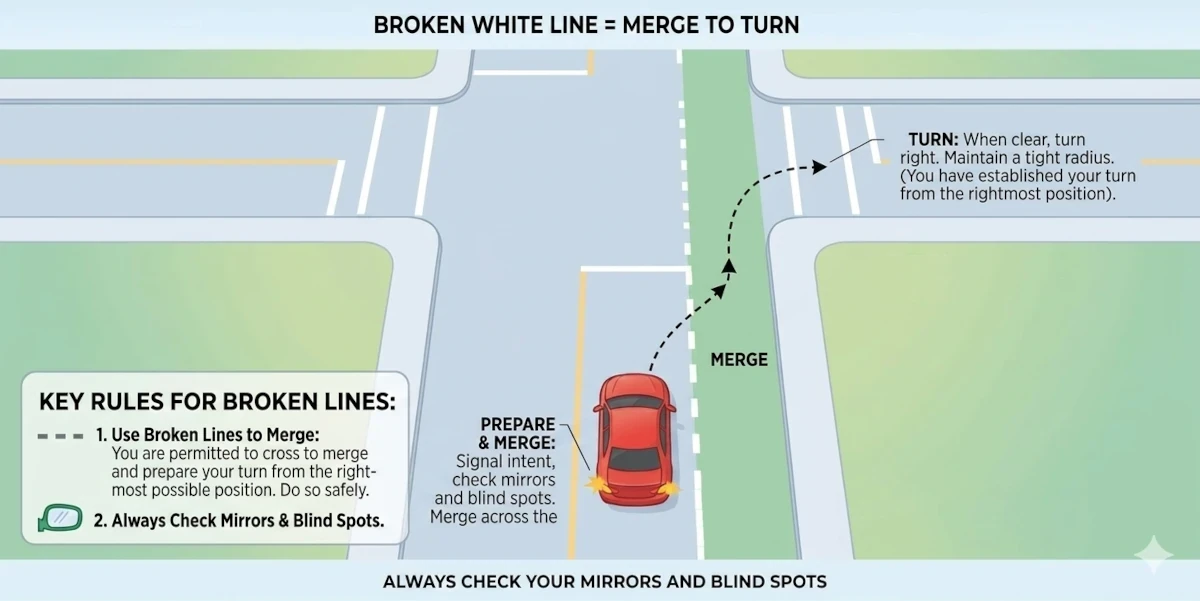
If the solid line changes to a broken or dashed line before the intersection, treat it as a normal lane change. Signal, check your mirrors, perform a right shoulder check, and yield to any cyclist already using the bicycle lane. When it is safe, merge into the bicycle lane near the curb before completing your right turn.
Merging into the bicycle lane reduces the possibility of a cyclist continuing along your right side while you are turning, helping to prevent a collision commonly known as a "right hook."
Can Cyclists Pass on the Right?
Yes. Cyclists travelling in a bicycle lane may legally pass on the right of a vehicle that is stopped or waiting to turn, provided there is sufficient room for them to do so safely.
This is why mirrors alone are not enough. Before every right turn, drivers should check their mirrors and perform a right shoulder check immediately before steering toward the curb or beginning the turn.
Key Points to Remember
- Green pavement highlights a potential conflict area but does not change the rules.
- A solid white line means remain out of the bicycle lane until turning.
- A broken white line allows you to merge into the bicycle lane after yielding.
- Always check mirrors and your right blind spot before turning.
- Yield to cyclists whenever required.
Learn More
Understanding how bicycle lanes are marked helps drivers and cyclists anticipate each other's movements, making intersections safer for everyone.
- Log in to post comments
Comments
My opinion, being a moderate cyclist and a constant driver, is that bikes and cars do not mix. On my bike, I do not feel safe in heavy traffic. I'm not always sure of what the rule is and loads of drivers around me clearly don't watch for bikes.
roads are for vehicles. Not long boarders, bikes, scooters etc. There's far too much to navigate around without bikes coming up on your side. If bikes are on the roads, they need to stay behind the vehicle always.
That poor, unfortunate woman who lost her life on Lions Gate Bridge is a good example. So sad. Separate bike lanes, with proper barriers with NO pedestrians allowed are the only way to go.
My experience, with this right turning over a bike lane is that both cyclists and drivers are not aware of the rules. We've put the bike lanes in without any real education to the public prior.
- Log in to post comments
This happens all too often. Cyclists are cut off because of impatient drivers. They will zip up past you in their lane and then make a right turn; causing the cyclist to hammer on their brakes in hopes that they don't collide with the offending car.
Drivers, please slow down and let the cyclists in their lane. I've started riding to work a few days here and there and Yes I don't feel safe like I use to. Even though I'm behind that white line or just riding beside the curb I still feel vulnerable.
All you can do is be visible! Lights, reflective gear and a helmet. Ride safe everyone!
- Log in to post comments
If bike riders insist on having the same rights on the road as all other vehicles then they should also be prepared to equally share the road at an intersection. When making a right hand turn at an intersection all motorized vehicles must use the right hand lane for safety and for facilitating the proper flow of traffic.
I am also a bike rider and for my safety I want vehicles making a right hand turn to be in the extreme right lane which often is a bike lane so that cars can quickly, efficiently and safely make their turn to clear the bike lane so that I do not have to worry about them crossing the bike lane in front of me or run over me because they did not see me come barreling down their right hand side!
This is an extremely dangerous situation and all road users should use the extreme right hand lane for safety.
One commenter claimed that it takes longer for a bike to stop than a car. This is not true since a car is much heavier compared to the friction area of their tires to a bike and therefore it takes just a little more time to stop. Test results show that good bikes can stop a bit quicker.
When a driver is trying to make a right hand turn at an intersection he has to watch the oncoming traffic for someone making a left hand turn in front of him. He also must check that the pedestrian walk way is clear, Furthermore he must check to make sure the light hasn't turned red yet and if it has now having to look to the left for green light right of way approaching traffic... All the while the driver must still be looking for some bike rider approaching his behind in the bike lane.
I have always been taught it is dangerous to pass in the right lane and now it is very dangerous to turn right across a bike lane for both the driver and bicyclist!
It is time to abolish the right of way for a bike rider close to an intersection since the bike lane is still part of the roadway and I would hate to see even more bike riders wear the passengers side of a vehicle. Change the law now to be safer and make your right hand turn from the extreme right side of the paved roadway for much better traffic flow and more importantly for the safety of the cars and bike riders using the road..
- Log in to post comments
As a cyclist and due to a previous encounter with a vehicle, I am painfully aware of the shortcomings of mixing bicycles and cars.
May I add the following for vehicles and cyclists:
- Do not pass a bike and then turn right directly in front of them. The bicycle doesn’t have the stopping power of a car and this dangerous manoeuver can lead to a collision.
- Cyclists, when approaching an intersection slow down and assume that there will be a driver of a vehicle that either cannot see you or will not know the traffic regulations well enough to yield to a bicycle.
- Even if the cyclist is in the wrong (real or perceived), please be courteous and yield as enforcing your perceived right of way can be fatal for the cyclist.
- Cyclists, use your signals for making a turn. Don’t frustrate other traffic.
- Log in to post comments
Without adequate education of both drivers and cyclists, laws and regulations create dangerous situations such as this.
Whether on foot or on a bike, I am constantly alert for cars that pose a danger. I assume that the driver has not seen me, and I assume that the driver is unaware of the rules of the road.
No law, no lane marking, no traffic signale can protect you. The only purpose of such things is to define blame when someone has an accident.
All the right-of-way in the world won't bring life back to the cyclist who does something so abysmally stupid as to pass a car on its blind side at an intersection -- especially if they KNOW that the driver is intending to turn right.
The skill level of drivers in BC is horrendously low.
The blame for this lies with ICBC, the governments that manage them, and with us for allowing it to happen
- Log in to post comments
Whether we like it or not, user's of BC's roadways are forced to share the roads with cars, trucks, motorcycles, bicycles, and sometimes pedestrians and wildlife. No matter what kind of user you are, perhaps many, it is key critical for your safety and sanity to understand all of the rules and how they apply to all types of users. We all have places to go, things to do, and time frames that we are trying to meet, but (to be trite), safety first. No one wants to be killed and no one needs to live with having killed someone. To that end, the better you can educate yourself on the rules and the better you can leave a margin for erros, the better off you will be.
Educating yourself is not as simple as it sounds. Too often the tools are difficult to locate (ie: Bike Sense or municipal bylaws), vague (ie: Learn To Drive Smart), or conflicting opinions that are not clear in law (many publications and websites). Municipalities with specific bylaws do not put up signs for people to see and learn. In example, Maple Ridge and New Westminster both have bylaws allowing cyclists to use the sidewalks. Elsewhere this is illegal. I have lived in Maple Ridge for 12 years and only found out about this 2009 bylaw by accident, a few weeks ago. Evertime I leave town and return, I pass the sign that isn't there, not learning this and other key facts at the same time (sarcasm).
The truth of the matter is that without ongoing education and testing, we do not know what we don't know, except when we see what is obviously wrong, out on the road, and potentially that is too late. Governments, municipal and provincial, do not do enough to educate (including making tools clearer and more readily available). Police do not do enough to prosecute (expensive is the best way to learn). If a ticket was given for every tenth occurence of drivers (cyclists included) failing to signal, failure to stop (not the 17 kph stop), speeding (not leading the flow of traffic), etc., the municipal coffers would fill to overflowing, but not for long. The media love to talk about tragedy and the sad human tales of death and destruction, but, fail in their ability and obligation to identify unsafe behaviours and educate oblivious drivers. Roadway users fail to educate themselves on the rights and the obligations they have on the roads, and fail to act in a safe and responsible manner, much of the time. Whenever that happens, someone is at risk, and we are all responsible. However, when you see two cars streaking down the highway with a car of a half distance between them, or the cyclist who is sneaking up past cars, on their right, up against the curb, or the driver who slams on the brakes for the pedestrian, in the crosswalk, with the walk light, as though he had the right of way (cyclists don't like to stop for stop signs or red lights either), or the cyclist drifting across the crosswalk, etc., it is easy to see what allowed (and encouraged?) apathy breeds.
Yes it is dangerous out there, and at the rate we are going it will continue to be, but, until everyone starts to be accountable for their own actions, voluntarily or force fed, the situation will not change. The answer is not to create expensive infrastructures to separate all the children, but, to teach the children and give them a good skite on the behind when they do not behave.
- Log in to post comments
Lots of good comments from previous to mine here, but the one I feel is missing, that needs to be addressed at a government level, is that cyclists are drivers.
They are operating a vehicle on the road.
The changes in the rules to the road should be communicated to drivers when they renew their license (at a minimum) and cyclists should be required to hold a license after age (12?) to operate on the road without a licensed adult.
Too many people (motorists and cyclists) have no idea how bike lanes work and it's further complicated by municipalities and their engineers adding lanes that simply aren't safe or clear in their use.
- Log in to post comments
Please provide the law or laws where it states the cyclist has the right of way - they are not required to stop? Thanks
- Log in to post comments
I have a good reference article for this: Who Has the Right of Way When Turning Across a Bike Lane?
- Log in to post comments
Bikes and Cars Don't Mix