
 Question: I'm flabbergasted that motorcycles with loud exhausts seem to be the "sacred cows" of our highways and byways. I recently spent about 18 hours working at a job site immediately adjacent to Harvey Avenue near Pandosy Street, during two sunny days of spring weather. The excessive noise from motorcycles and "jacked-up" diesel 4 x 4's trucks that constantly hammered their throttles was astonishing.
Last year I had a motorcycle that travelled up Boucherie Road at 4.35 am on weekdays, and woke me up most of the time. One day I was up real early to travel out of town and was on my sundeck drinking my coffee, and I could hear him coming from about 2-1/2 km away!
I have never understood why... in today's electronic era, there couldn't be a standard roadside test to ticket violators for excessive noise. Put a portable rpm detector on the engine, rev the engine to say... 3,000 rpm, and measure the decibels at a standard distance... 50 ft? Pass or fail. Anything like this on the horizon, or has it even been discussed by Authorities?
Automated enforcement of vehicle noise is moving toward becoming a legislative reality in British Columbia. The electronic roadside testing suggested by our reader is no longer just a concept; advanced "noise camera" networks are actively being pushed by B.C. municipalities to combat straight pipes, modified mufflers, and aggressive throttling.
The Rise of Noise Camera Technology
Modern acoustic camera systems have advanced far beyond the simple, handheld decibel meters historically used by police. Rather than relying on a manual, stationary officer to track down a single loud vehicle, these automated electronic systems handle the workload autonomously:
- Precision Sound Triangulation: The devices use a specialized array of highly sensitive microphones paired with an HD visual camera. By measuring sound wave delays, the camera isolates exactly which vehicle in a crowded line of traffic is generating the noise.
- Automated Mail-In Ticketing: Much like red-light or speed cameras, if a vehicle exceeds the legal decibel threshold, the system automatically captures the license plate and generates a ticket for the registered owner.
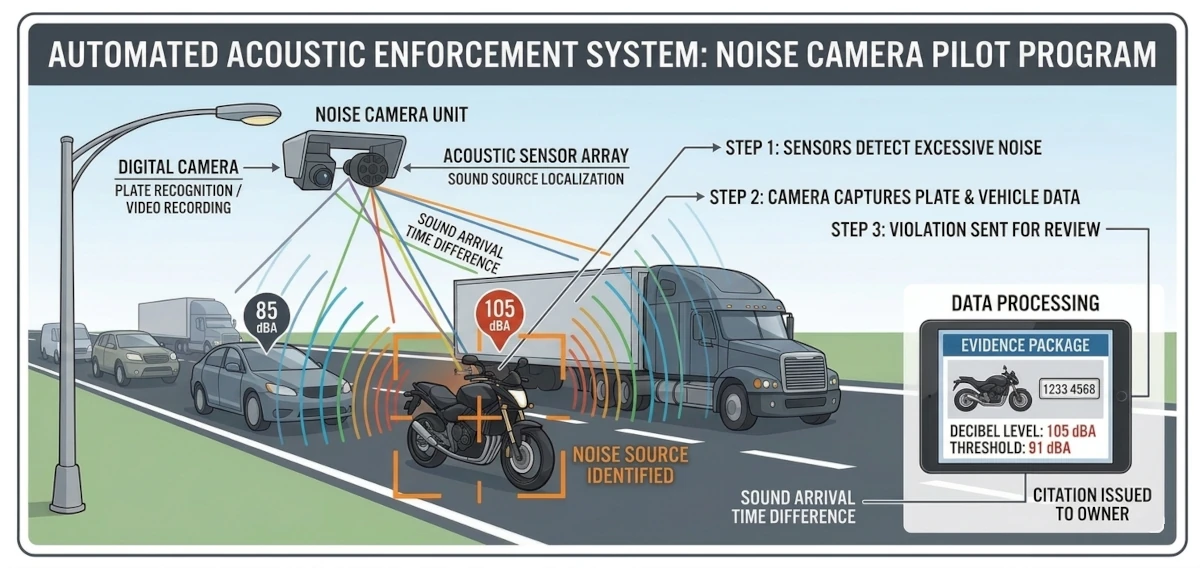
How an automated acoustic camera uses sound arrival time differences to pinpoint and log a specific noise offender in traffic.
The Push for a Provincial Pilot Program
While the technology exists, the current bottleneck in B.C. is legislative. Under the current B.C. Motor Vehicle Act (MVA), police can manually issue a $109 fine and three penalty points for "unnecessary noise," but the province does not yet legally permit automated camera enforcement for noise violations.
However, B.C. authorities are actively discussing solutions. The Union of B.C. Municipalities (UBCM) officially endorsed a resolution calling on the provincial government to establish a Noise Camera Pilot Project. Championed by communities like Port Moody, Saanich, and Kelowna, the pilot would give cities the legal framework to deploy automated sound enforcement. Local leaders are framing this as a public health issue rather than a simple nuisance, citing the physiological stress and sleep disruption caused by modified vehicles.
The Contrast: How Manual Testing Works Today
To understand why cities want automated solutions, look at what is required for current field testing. The video below outlines the meticulous steps required under the SAE J2825 standard to manually confirm a motorcycle exhaust violation at the roadside:
As the video demonstrates, manual checks require pull-overs, an open space clear of ambient sound reflections, and physical tachometer tools to test sound outputs at specific engine RPM values. It is a slow, single-vehicle resource drain. By contrast, an automated acoustic camera continuously monitors an entire multi-lane corridor without needing a physical police presence on the asphalt.
Current Decibel Limits in B.C.
For reference, the maximum allowable noise limits established under the B.C. Motor Vehicle Act regulations are:
| Vehicle Category | Maximum Allowable Noise Limit (MVA Regulations) |
|---|---|
| Light-Duty Vehicles | 83 dBA |
| Gas-Powered Heavy-Duty Vehicles | 88 dBA |
| Motorcycles | 91 dBA |
| Diesel Heavy-Duty Vehicles | 93 dBA |
Canadian Developments
B.C. is closely watching other Canadian municipalities that have bypassed provincial delays:
- Edmonton, AB: Edmonton has deployed pilot projects using automated camera-and-microphone technology to collect data on racing hotspots.
- Port Moody, B.C.: Tired of waiting for slow provincial regulatory changes, Port Moody voted to forge ahead with its own proactive pilot program using budget-friendly, streetlight-mounted sound sensors to log local vehicle noise spikes.
- Log in to post comments
Comments
I was pleased to read this morning that new legislation is being considered regarding the excessive motor noise issue in the Okanagan.
We live on a straight stretch of Glenmore Rd. (north) and have come to expect the extremely loud motorcycles that reappear each spring/summer, waking us and our children at all hours of the night and morning, and putting a damper on outside activities for the entire summer. Could you comment on this subject and give some insights as to how the RCMP deal with this in a practical way?
I understand new decibel meters will need to be purchased. How are these used?
Also, is there anything civilians can do to help track down the noisemakers, specifically when the motorcycles gear up and speed down Glenmore Valley at 3am, without a doubt waking many along the way? How are they ultimately caught?
- Log in to post comments
Decibel meters should be used as shown in the video I provided in my previous answer, unless the bylaw requires otherwise. Of course, we won't know if a different method is specified unless we read the bylaw. There doesn't appear to be anything about it on the City of Kelowna's web site, but you can read the current traffic bylaws here.
I would imagine that the RCMP deal with it by coming across violators in their daily patrols. When they do, they will investigate and apply the bylaw or the Motor Vehicle Act if the officer feels that there is a violation and it is likely that the court will convict. There are some other articles on this site that may help you understand the issues as they currently stand.
Can you help? Perhaps. It all depends on whether the Kelowna detachment will respond to your complaints or not. There is an article here on making an effective driving complaint.
- Log in to post comments
I’m glad I’m not the only person who finds this and issue. Funny, I thought mufflers were suppose to muffle noise. The after market for these automotive accoutrements she be monitored as well. What it boils down to is the citizenry having to police the issue and we know nothing positive will come from this.
- Log in to post comments
On the issue of loud bikes, I am reminded when we were kids (oh...SO long ago!) and the plan was to be the loudest kid on the block by attaching empty cigarrette packs or pieces of cardboard to the frame with clothespins, so the spokes would rap on them.
For all those who enjoy a good laugh, I suggest you watch "South Park" Season 13, episode 12.
Happy trails!
- Log in to post comments
I am cautiously optimistic about the consideration of new technology that may bring some sanity to the situation. Yes, when we were kids and we enhanced our fun by attaching cardboard and cloths pins to our wheels; it was considered harmless. I would say, “that was then, this is now” and cloths pins on a Saturday afternoon couldn’t compare to a motorcycle at 2 am in the high density housing cities we now live in. Let’s use this technology to change the behaviours that demonstrate inconsideration for others in our dense populations. I endorse automated Acoustic enforcement. We have it, use it.
- Log in to post comments
New Legislation