
 I received a detailed email recently from a local resident describing a terrifying experience on her morning walk. Before dawn, she was walking southbound beside Willingdon Road in North Saanich. Reaching the intersection where Canora Road diverges to the northeast, she did exactly what any cautious pedestrian would do: she paused, checked for traffic, and utilized a small concrete traffic island as a refuge to cross the single lane of traffic.
As she stepped into the roadway, a vehicle approaching from the south suddenly accelerated. Simultaneously, the driver switched from low-beam to high-beam headlights, blinding her. Fearing an imminent collision, she ran across the remaining stretch of asphalt, narrowly escaping the vehicle while receiving a sharp blast of the horn.
Generously, she wondered if the driver’s horn blast was merely a reaction to a bad scare. More importantly, she asked: “Was I to blame for this? And wouldn't a streetlight and a marked crosswalk make this intersection safer?”
The Blind Spot: Overcoming the Nighttime Visibility Illusion
A major factor in these close calls is what safety experts call the visibility illusion—pedestrians consistently and dangerously overestimate how visible they are to passing cars at night.
Because you can see a car’s headlights from kilometers away, your brain tricks you into thinking the driver can see you just as easily. In reality, a driver using standard low-beam headlights can generally only see a pedestrian in dark clothing from about 60 meters (200 feet) away. If a vehicle is traveling at 60 km/h, the driver needs roughly 45 to 50 meters just to perceive the hazard and brake to a complete stop—leaving a razor-thin margin for error.
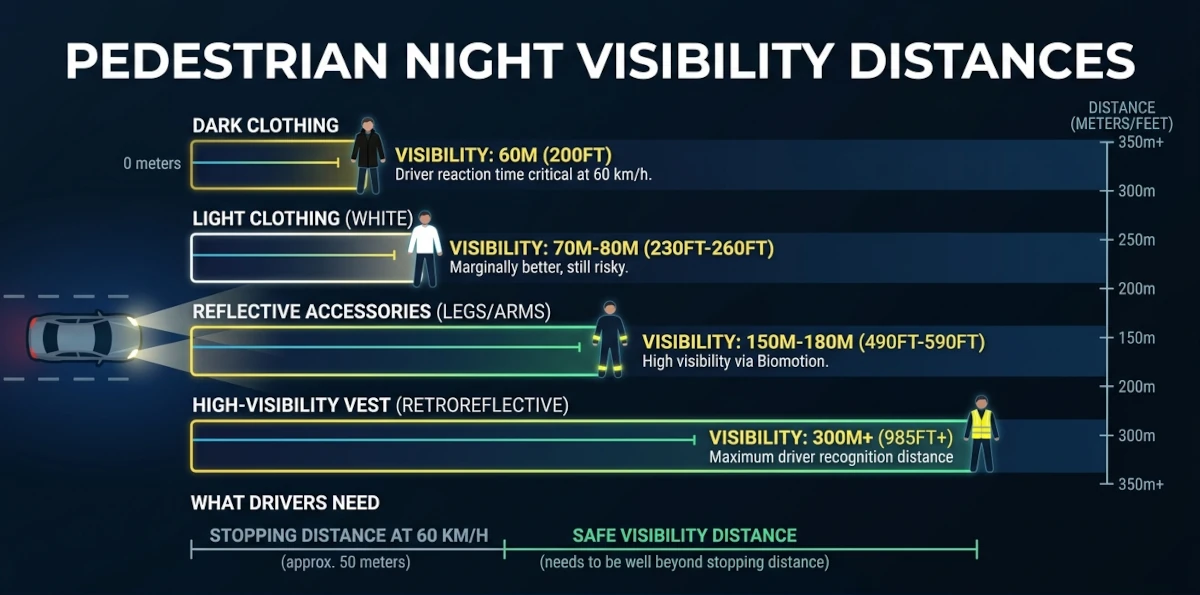
To bridge this safety gap before infrastructure catches up, pedestrians must use proactive visibility strategies:
- Fluorescent vs. Retroreflective Gear: Fluorescent colours (like neon pink or green) are incredibly effective during dusk or daylight, but they lose their effectiveness in total darkness because they require UV light to "glow". At night, you need retroreflective materials. These materials contain micro-prisms that bounce light directly back to the driver's eyes, extending your visibility to over 150 meters away.
- Highlight the Biological Form: Studies show that drivers recognize humans much faster when reflective tape or bands are placed on moving joints—such as wrists, ankles, and knees. An LED Arm Band or reflective ankle straps create "biomotion" that immediately signals to a driver that you are a walking human, not a static road sign.
- Active Lighting Tactics: Carrying a flashlight or using an active safety wand provides 360-degree illumination. However, never aim your flashlight directly into the eyes of oncoming drivers. Blinded drivers cannot steer or brake accurately. Instead, aim the beam down at the ground directly in front of you to create a visible, bouncing pool of light.
- Never Rely on Light Clothing Alone: Wearing a plain white t-shirt or jacket is not a substitute for safety gear. White fabric absorbs a massive amount of headlight beam energy and only provides marginally more visibility than dark colours, often failing to give drivers enough time to react.
For a deeper scientific dive into the biological factors behind night driving hazards, you can read the comprehensive human factors study on Seeing Pedestrians At Night by Marc Green, which details exactly how perception delay compromises a driver's peripheral vision in dark conflict zones.
Moving Past the "Cost-Benefit" Excuse
Historically, municipal engineers evaluated pedestrian safety requests through a strict financial lens. Traditional logic dictated that painted crosswalks and streetlights were expensive to maintain and only justified by a high volume of pedestrian traffic.
Today, that paradigm is fundamentally broken. Modern urban planning recognizes that infrastructure dictates behavior. Relying on old "cost-benefit" calculations creates a dangerous catch-22: people refuse to walk on dark, unpainted roads because they feel unsafe, and cities refuse to build sidewalks or crosswalks because "nobody is walking there".
Furthermore, under modern frameworks like Vision Zero, traffic safety is viewed as a systemic failure rather than individual blame. Human beings make mistakes, but a forgiving road system ensures those mistakes are not fatal.
A Shared and Unequal Responsibility
While pedestrians should protect themselves by wearing retroreflective gear, the primary burden of safety must shift to those operating heavy machinery.
Under British Columbia's Motor Vehicle Act, drivers hold a strict statutory duty to avoid colliding with pedestrians on a highway and must warn them using a horn if necessary. Drivers must learn to never "overdrive their headlights," meaning their travel speed must allow them to come to a complete stop within the actual distance illuminated by their beams. Flash-blinding a pedestrian with high beams and accelerating into an intersection removes a person's ability to navigate safely.
Smarter, Modern Solutions for North Saanich
We no longer live in a world where the only choices are a pitch-black road or an expensive, full-scale traffic signal. Municipalities are rapidly deploying high-yield, cost-effective infrastructure upgrades:
- Rectangular Rapid Flashing Beacons (RRFBs): Pedestrian-activated solar LED lights that flash rapidly when someone wishes to cross. These dramatically increase driver yield rates without requiring massive electrical overhauls.
- Targeted LED Streetlighting: Modern LED lamps focus light directly down onto conflict zones (like intersections and pedestrian refuges) without creating light pollution for neighboring homes.
- Active Transportation Integration: Cities are increasingly identifying key walking corridors to systematically fill network gaps, rather than waiting for an accident to occur before acting.
Road safety is inherently cooperative, but cooperation requires the proper tools. Expecting vulnerable road users to play a high-stakes game of chicken in the dark is no longer acceptable.
Make Your Voice Heard
If you regularly encounter dark, hazardous, or poorly marked crossing zones on your daily walks, do not wait for a near-miss to become a statistic.
You can actively advocate for safer infrastructure by logging an official ticket through the North Saanich Service Request System or reviewing current regional infrastructure goals outlined in the North Saanich Active Transportation Plan.
Help keep our roads safe—share this article!
A single conversation or safety tip could save a life on North Saanich roads tonight. Use the buttons below to pass this guide along to family, friends, and walking groups in our community.
- Log in to post comments
Comments
This is an important story. It is a relief to know that nobody was hurt. Years ago a police constable quoted in a Times-Colonist article suggested carrying a flashlight and wearing reflective gear for walks after dusk. I do. At mid-day I also wore it while changing a flat tire on 4th Street in Cumberland. The officer didn't blame motorists, but suggested ways of just making yourself more visible. While changing the tire I used the four-ways and opened the bonnet and the trunk.
In Courtenay, BC a few years back a woman walking along Dyke Rd. was hit by a motorist. In Courtenay in August a 90 year-old-man in a pedestrian cross-walk was killed by vehicle. Still in August along Dyke Rd. a middle-aged-man walking between parked cars was struck by a motorist. He was sent to St. Joseph's Hospital. I could have been 'that driver' and try operate my car with more attention actively searching out a pedestrian at a cross-walk. Soon as I see a pedestrian I check my rear view mirror then decide to stop with 4-ways flashing. I flip through ICBC's "Learn to Drive Smart" guidebook. I make mistakes driving, but think I'm improving.
Before my 15 year-old daughter was born I wore lots of reflective gear while cycling. Her seeing me with it it did not encourage her to wear it. When she hit double digits I said it was her a choice. And she chose not to.
"Dad, why do you wear reflective stuff?"
"I'm too lazy to be super vigilant with cars and I can't stand having a headache or toothache: so why should I volunteer to be traffic victim?"
She does wear some reflective gear now. My daughter lives with her mom in Manitoba and is happily enrolled in driver training through her high school.
- Log in to post comments
Hi, I am old enough to remember when this duty was imposed.
It was hailed at the time as a giant step forward in safety, but I can't trust it. If I get hit by a car it matters little if I'm in the right if I'm dead right.
I'm a frequent pedestrian, and I never feel safe around cars. Drivers can have all sorts of things interfering with their ability to see and react to my presence, and I cannot therefore trust them to "do their duty".
Thus, I make sure that I am absolutely certain that I *cannot* be hit by a car when crossing a street whether at a controlled intersection or any other point. If there is a moving car that is physically capable of hitting me, I let it pass rather than step into its path. If a car stops to let me by, I still walk behind it.
To do this I must look both ways (all 4 at intersections). My daily commute takes me past a high school.
Every day, students cross the road without looking at all. They expect that drivers will see them and stop.
On a side note, I wear a high-viz vest when walking in twilight or darker, and just from my own experience it seems to make a huge difference in the number of near misses.
I've commented here before on how unsafe intersections are for pedestrians, despite "pedestrian signals" and their new countdown provisions.
- Log in to post comments
Why do You Wear Reflective Stuff?