
Some intersections are easy to understand. You approach, stop or yield as required, look for conflicting traffic and proceed when it is safe to do so.
Others require a little more study.
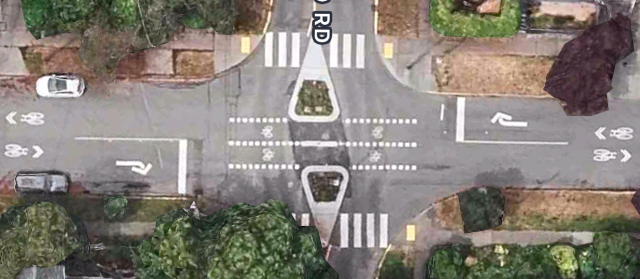
The intersection of Fernwood Road and Haultain Street in Victoria was one of those places. Its design combined traffic islands, stop signs, stop lines, crosswalks, bicycle markings, sharrows, a crossride and a right-in/right-out restriction for motor vehicles on Haultain.
So, who goes where?
Why was it designed this way?
The unusual arrangement was intentional. It was designed as a right-in/right-out (RIRO) intersection to discourage motor vehicle traffic from travelling through the residential neighbourhood on Haultain Street while making the route more attractive for cycling.
The traffic islands and centre bollard prevent motor vehicles from travelling straight through Haultain, diverting that traffic onto Fernwood Road while allowing the through route to remain available to cyclists.
Understanding that intent helps explain why so many different signs, markings and physical features were needed at this intersection.
What are all those markings?
There is a lot going on in a relatively small space.
The stop signs and stop lines control the approaches. The traffic islands and centre bollard control motor vehicle movements. Sharrows show the intended position and route for cyclists approaching the intersection. The rows of small white squares are elephant's feet, also known as a crossride or cross-bike.
Pedestrians have their own marked crossings.
Each feature has a purpose, but the challenge is understanding how all of them work together.
A crossride is a guideway
The B.C. Active Transportation Design Guide describes a crossride as the bicycle equivalent of a crosswalk. Its purpose is to alert road users to a bicycle crossing and provide a marked route for bicycle movement across the roadway.
A crossride is not a bicycle lane, and the marking itself does not give the cyclist the right of way.
A crossride tells a cyclist where to cross. Traffic control determines who must yield.
Crossrides are not defined in the B.C. Motor Vehicle Act. The provincial design guide notes that they do not, on their own, provide legal right of way.
What does the cyclist do?
A cyclist approaching Fernwood on Haultain was still approaching a stop sign. The bicycle markings did not exempt the rider from the stop requirement.
The cyclist stopped at the marked stop line, assessed conflicting traffic and proceeded when permitted to do so. The crossride then provided the guideway for crossing Fernwood.
In other words, the cyclist first deals with the traffic control and then uses the crossride to make the intended crossing.
Victoria's Streets and Traffic Bylaw specifically recognizes elephant's-feet markings. It permits a cyclist to ride on a crosswalk where that crosswalk is bordered by, adjacent to, or marked with elephant's feet.
And what about pedestrians?
The intersection also includes conventional pedestrian crosswalk markings. A crosswalk and a crossride can be beside each other or combined in the same crossing area, but their functions are not identical.
The Motor Vehicle Act specifically establishes when a driver must yield the right of way to a pedestrian crossing in a crosswalk. There is no equivalent general provision saying that a cyclist has the right of way merely because the cyclist is using a crossride.
This is another reason that crossride and crosswalk should not simply be used interchangeably.
Why did it seem so complicated?
The design was trying to accomplish several things at once: discourage motor vehicle through traffic on Haultain, maintain a route for cyclists and accommodate pedestrians while controlling motor vehicle movements through the intersection.
That required several different messages in a relatively small space: stop signs, traffic islands, a centre bollard, sharrows, bicycle markings, a crossride and pedestrian crossings.
A road user has to interpret those features while also watching for people approaching from several directions. It is understandable that different people could look at the same intersection and come away with different ideas about who should do what.
The comments on the original article illustrated that difference of opinion. Some readers considered the design unnecessarily complicated, while others saw it as a reasonable way to accommodate cycling in a residential neighbourhood. The disagreement is less important than the underlying lesson: traffic control works best when its intended operation is readily understood by everyone using it.
Design intent is not traffic law
This intersection is a useful example of why road design and traffic law need to be considered separately.
Islands, pavement markings and signs can show people where they are expected to travel and help organize different movements, but they do not all have the same legal effect.
A sharrow communicates an intended cycling route. A crossride marks the intended bicycle crossing. A crosswalk identifies a pedestrian crossing. A stop sign requires a stop. A yield sign establishes a yielding obligation.
The important point is not to assume that every pavement marking creates a right of way. The crossride provides the guideway; the applicable traffic control determines priority.
The intersection changed
The intersection was modified in 2024, when it was changed to a four-way stop.
The physical RIRO arrangement did not disappear. Motor vehicles are still prevented from travelling straight through Haultain by the traffic islands and centre bollard, while right turns remain permitted. Cyclists can still travel through the intersection.
The significant change was the traffic control. The four-way stop altered who must stop before entering the intersection.
That makes the earlier arrangement particularly interesting. Motor vehicles on Haultain were already prevented from travelling straight through, while cyclists approaching on Haultain were required to stop before crossing Fernwood. The crossride provided the guideway for cyclists who had stopped and were permitted to continue; it did not give them an independent right of way.
Who goes where?
The most useful lesson from Fernwood Road and Haultain Street is not that motorists, cyclists or pedestrians were to blame.
It is that every road user should be able to answer four questions:
- Where am I supposed to go?
- Where must I stop or yield?
- Who has priority over my movement?
- What are the other road users likely to do?
A crossride helps answer the first question for a cyclist. It does not, by itself, answer the third.
The crossride provides the guideway. Traffic control determines priority.
That is the distinction worth remembering whenever you encounter elephant's-feet markings. Look beyond the paint for the signs, signals and other traffic-control rules that tell you when it is actually your turn to go.
Learn More
OOPS! - Elephant's Feet and Crosswalks
Who Goes First at a 4-Way Stop in BC?
- Log in to post comments