
A rear-end collision usually puts the focus on the driver who struck the vehicle ahead, but that does not necessarily mean the following driver is entirely responsible. A 2009 decision of the British Columbia Supreme Court provides a good example of why both drivers' actions may have to be considered.
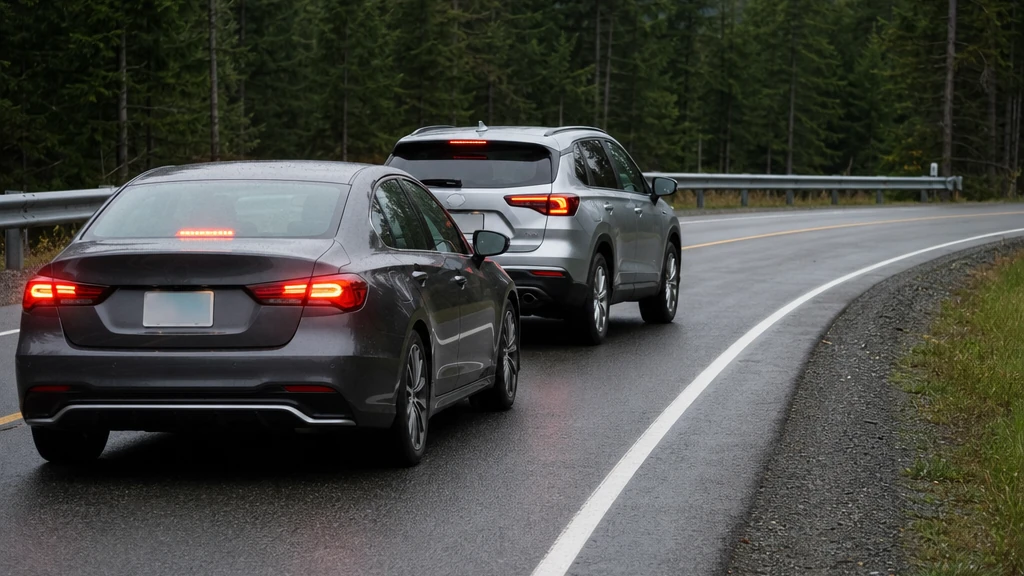
In Saffari v. Lopez, 2009 BCSC 699, a vehicle driven by Mona Saffari collided with the rear of a Jeep driven by Martin Lopez and owned by Stephanie Pfeifer. Both vehicles were travelling from North Vancouver toward Vancouver and had entered the on-ramp leading to the Lions Gate Bridge.
The court ultimately found both drivers equally at fault.
What Happened?
The collision occurred at about 10:00 p.m. on May 23, 2005. Traffic was sparse, the roadway was well lit, weather was not a factor and the speed limit was 50 km/h.
Saffari was following Lopez's Jeep. The Jeep had been travelling faster than the Mitsubishi Lancer behind it, so the distance between the two vehicles had been increasing. As the vehicles entered the curved on-ramp, Saffari momentarily lost sight of the Jeep.
Lopez then applied his brakes and slowed suddenly. His reason for doing so was to look for a cigarette that had fallen in the vehicle. He acknowledged that it was a "fairly sudden slowdown" and that he had his foot on the brake when the collision occurred.
Lopez could have taken other steps. The court noted that there was a bus lane farther up the on-ramp where he could have stopped without impeding traffic. He could also have signalled before moving toward a safer place to stop or used his four-way flashers to warn following traffic.
Instead, he slowed or stopped in the traffic lane where a following driver would not have expected him to do so.
Was Lopez Allowed to Stop There?
An interesting part of the case concerned section 189(1)(m) of the Motor Vehicle Act, which generally prohibits stopping on a bridge or other elevated structure on a highway except where permitted.
The court rejected the argument that this provision applied. The collision occurred on the inclined roadway leading toward the overpass and Lions Gate Bridge, not on the bridge or elevated structure itself. Lopez's decision to slow or stop there was therefore not illegal under that provision.
That did not mean, however, that his driving was reasonable.
Stopping Legally Does Not Always Mean Stopping Safely
Justice Harvey considered section 144(1)(b) of the Motor Vehicle Act, which prohibits driving without reasonable consideration for other people using the highway.
The judge found that this included considering the circumstances in which a driver suddenly slows or stops in the flow of traffic when other reasonable options are available.
Lopez knew that the location was not one where a following vehicle would expect him to slow or stop. The reason for his sudden deceleration was also self-created: he wanted to retrieve a cigarette. He could have continued to a safer place to stop rather than creating an unexpected hazard for traffic behind him.
The court therefore found Lopez negligent in suddenly slowing or stopping his vehicle on the roadway approaching the Lions Gate Bridge.
But What About the Driver Who Hit Him?
Finding Lopez negligent did not end the matter. The court also had to consider Saffari's driving.
The evidence about exactly what happened immediately before the collision was inconsistent. Saffari testified that she was travelling at approximately 40 to 50 km/h and was slowing as she entered the curve. Her husband gave a higher estimate of her speed.
Saffari testified that she saw the Jeep's brake lights come on when she was two or three car lengths behind it. She attempted to avoid the collision by moving to the right, but another vehicle was passing there. She then steered back and applied the brakes, but could not stop before striking the Jeep.
Importantly, she did not describe the Jeep as making a panic stop or slamming on its brakes.
Justice Harvey also rejected much of the evidence given by Saffari's husband and found that aspects of Saffari's own evidence were inconsistent. The judge concluded that if she was travelling at the speed and following at the distance she described, she should have been able to stop when she saw the Jeep's brake lights.
The court's conclusion was that she was either travelling too fast for the circumstances or following too closely to stop in time once the Jeep became a hazard.
50/50 Responsibility
The result was not what either driver wanted. Justice Harvey found the plaintiff and defendant equally at fault for the collision.
In other words, this was a rear-end collision in which the lead driver was negligent for creating an unexpected hazard, but the following driver was also negligent because she should have been able to respond to that hazard.
The vehicle owner, Stephanie Pfeifer, was held liable in the same proportion as Lopez.
What Can Drivers Learn From This?
There are two lessons here, one for each driver.
If you are following: You have a responsibility to leave enough space and drive at a speed that allows you to stop when the vehicle ahead slows or stops. You cannot assume that the driver ahead will always brake gradually or for a reason that you consider reasonable.
If you are leading: You also have a responsibility to consider the traffic around you. An unexpected stop in a traffic lane can create a hazard for following drivers. If you need to stop for a non-emergency reason, look for a safe place to get out of the flow of traffic rather than simply stopping where you happen to be.
The important point is that being struck from behind does not automatically make the lead driver blameless, just as being the driver who strikes another vehicle from behind does not automatically mean you will bear all of the responsibility.
Every collision has to be considered in the circumstances that led to it. In this case, the court found that both drivers contributed to the result.
Read the complete reasons for judgment: Saffari v. Lopez, 2009 BCSC 699
Learn More
- Log in to post comments