
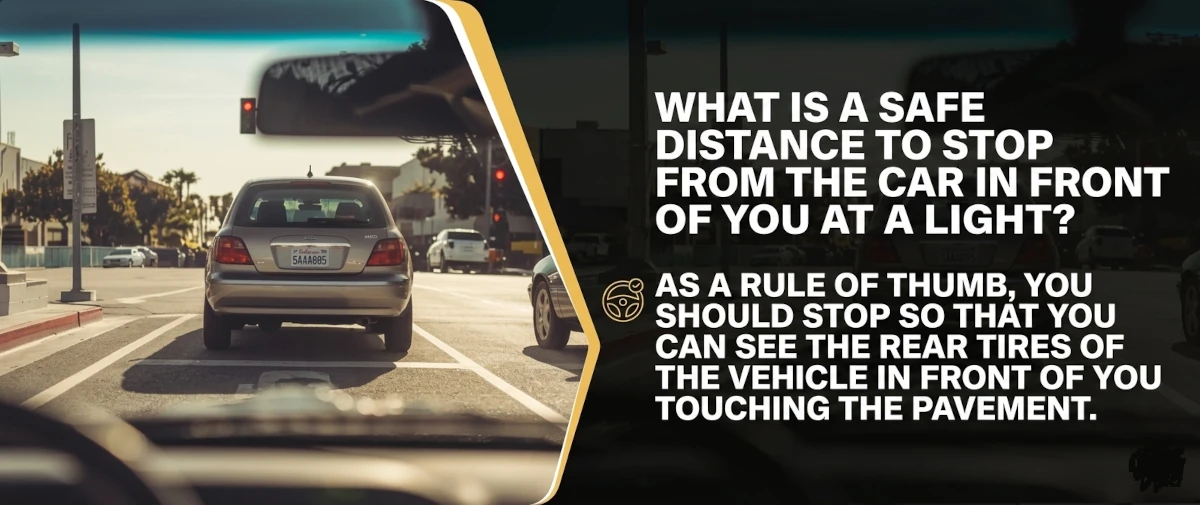
 When waiting at a red light, how much space should you leave between your vehicle and the car ahead? A common rule of thumb is to ensure you can see the rear tires of the leading vehicle touching the pavement. However, when a multi-vehicle chain-reaction accident occurs, failing to leave a wide gap does not automatically make you legally liable for the damage.
The British Columbia Supreme Court addressed this specific issue in the case of Danks v. Middelveen, 2024 BCSC 174. The ruling provides crucial insight into legal liability, the standard of care for drivers, and what truly constitutes a safe stopping distance under the law.
The Incident: A Three-Vehicle Chain Reaction
The accident occurred at the intersection of Lougheed Highway and Harris Road in Pitt Meadows, B.C. The sequence of events unfolded as follows:
- The Lead Vehicle: The Danks family stopped their pickup truck in the left-turn lane, waiting for the traffic signal to change.
- The Middle Vehicle: Mr. Middelveen came to a complete stop directly behind the Danks vehicle.
- The Impact: A third driver, Ming Zhang, approached the stopped queue and struck the rear of Mr. Middelveen’s truck.
The force of this initial impact propelled Mr. Middelveen’s truck forward, causing a secondary collision with the rear of the Danks vehicle.
The Legal Dispute: Is the Middle Driver Blameless?
The court easily determined that Ms. Zhang was entirely at fault for initiating the crash, and that the front driver, Mr. Danks, bore no responsibility.
Leaning on the principles of contributory negligence, the plaintiffs argued that Mr. Middelveen should share liability. They contended that as an experienced driver, he failed to exercise reasonable care because he stopped too close to their vehicle—estimating the gap to be roughly three feet. The plaintiffs asserted that if Mr. Middelveen had left a larger gap, his truck would not have been pushed into theirs.
The Ruling: Standard of Care vs. Exact Measurements
Justice Kirchner rejected the argument for contributory negligence and cleared Mr. Middelveen of liability.
In the judgment, the court highlighted that an experienced driver's real-time assessment of a "safe distance" is often more reliable than post-incident estimates of exact footage. Justice Kirchner noted:
"Counsel has provided no authority indicating that a driver in Mr. Middelveen’s position is negligent and liable in the circumstances. It may well be that a driver who stops too close to the car in front puts the occupants of that car in danger but I am not persuaded that is what Mr. Middelveen did."
Because Mr. Middelveen had brought his vehicle to a safe, controlled stop before the impact, the sole proximate cause of the secondary crash was the high-velocity impact from behind.
Best Practices for Defensive Driving
While Mr. Middelveen was cleared of legal liability, the case highlights why maintaining a buffer zone is a fundamental principle of defensive driving. Leaving adequate space when stopped serves two vital functions:
- Cushioning Impacts: It minimizes the risk of your vehicle being forced into another car if you are rear-ended.
- Evasive Maneuvers: It ensures you have enough clearance to pull out and clear the lane if an emergency vehicle needs to pass.
To optimize safety, professional driving instructors recommend stopping far enough back to clearly see the rear tires of the vehicle ahead meeting the asphalt.
If you want to review the full details of the liability assessment, you can read the complete judgment on the BC Courts website.
Help keep your network safe on the road.
If you found this case analysis helpful, please share it using the buttons below!
- Log in to post comments