
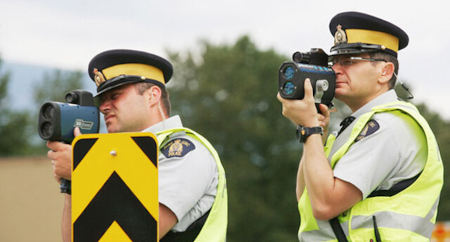
 My highway patrol unit was issued its first laser speed measuring device back in the early 1990s. It quickly became a popular enforcement tool due to its precision in targeting specific vehicles and measuring speed accurately. Just like radar before it, laser technology required time for case law to mature in the courtroom.
Shift in Court Standards
- The Early Days: When laser cases first went to traffic court, officers had to testify that they compared the laser's results against radar to prove its reliability.
- The Modern Standard: Fast forward 30 years—courts now fully accept laser speed measurement as inherently accurate. Today, an officer only needs to state that they are qualified to use the device, and that it was tested according to the manufacturer's guidelines.
Dropping the Visual Estimate Requirement
In the past, officers were expected to corroborate the laser reading with a personal visual estimate of the vehicle's speed.
Key Legal Takeaway: This is no longer required. B.C. courts have ruled that a visual estimate is not necessary to validate a laser device's mechanical measurement.
The Burden of Proof Lies on the Accused
Because the court accepts the technology as reliable, a driver cannot simply argue that the device might be wrong. The accused must actively introduce "evidence to the contrary" to challenge the device's accuracy.
To support the device's reliability, the Crown may choose to introduce the manufacturer's operating manual showing its accuracy tolerance (typically ± 1 km/h at 50 km/h). Under Section 15.1 of the B.C. Offence Act, the court has explicit authority to recognize this documentation. However, doing so is rarely necessary for routine speeding ticket trials.
What Actually Counts as "Evidence to the Contrary"?
Because the courts legally presume a laser device is accurate once basic operational testing is proven, the defense cannot win by simply asking, "But what if it glitched?" To successfully raise a reasonable doubt, the accused must present concrete, factual evidence that directly undermines either the specific device's integrity or the environment in which it was used.
In British Columbia, successful "evidence to the contrary" generally falls into three narrow categories:
- Proof of Device Malfunction: Documented proof that the specific device used was faulty, missed its scheduled factory calibration, or failed its mandatory pre-and-post-shift manufacturer testing.
- Environmental/Obstruction Interference: Photographic or video evidence (such as dashcam footage) establishing that heavy rain, thick fog, snow, or physical obstructions (like trees or other vehicles) blocked a clean, direct line of sight between the laser gun and the targeted vehicle.
- Target Misidentification: Evidence showing the officer inadvertently targeted a different, nearby vehicle rather than the defendant's car. This typically requires proving traffic was dense enough that the laser's narrow beam could have hit another vehicle in an adjacent lane.
What DOES NOT Count
Following the R. v. Thachuk decision, a discrepancy between the officer's visual estimate and the laser reading no longer constitutes "evidence to the contrary." Even if an officer guesses a vehicle is traveling at 80 km/h but the laser registers 110 km/h, the court will rely entirely on the mechanical data from the laser device rather than throwing out the ticket.
Solidified by Case Law: R. v. Thachuk
This framework was heavily tested and affirmed in the landmark case R. v. Thachuk. The driver attempted to appeal the restrictions on challenging laser data, but on April 24, 2025, Justice Abrioux of the Court of Appeal officially denied the appeal. This failed appeal solidifies the reality that beating a laser-based speeding ticket in British Columbia requires concrete, technical proof rather than simple skepticism.
Help your friends drive smart. Share this article to let them know how B.C. speeding laws are changing.
- Log in to post comments