
 Receiving a letter from RoadSafetyBC requesting an Enhanced Road Assessment (ERA) can be a stressful experience, but it is a standard part of ensuring everyone stays safe on our roads. Unlike a traditional "pass or fail" road test, the ERA is a professional evaluation of your current driving skills and cognitive health.
This guide is designed to remove the guesswork by explaining exactly what happens during the 90-minute appointment, how to prepare your vehicle, and what to expect from the ICBC examiner.
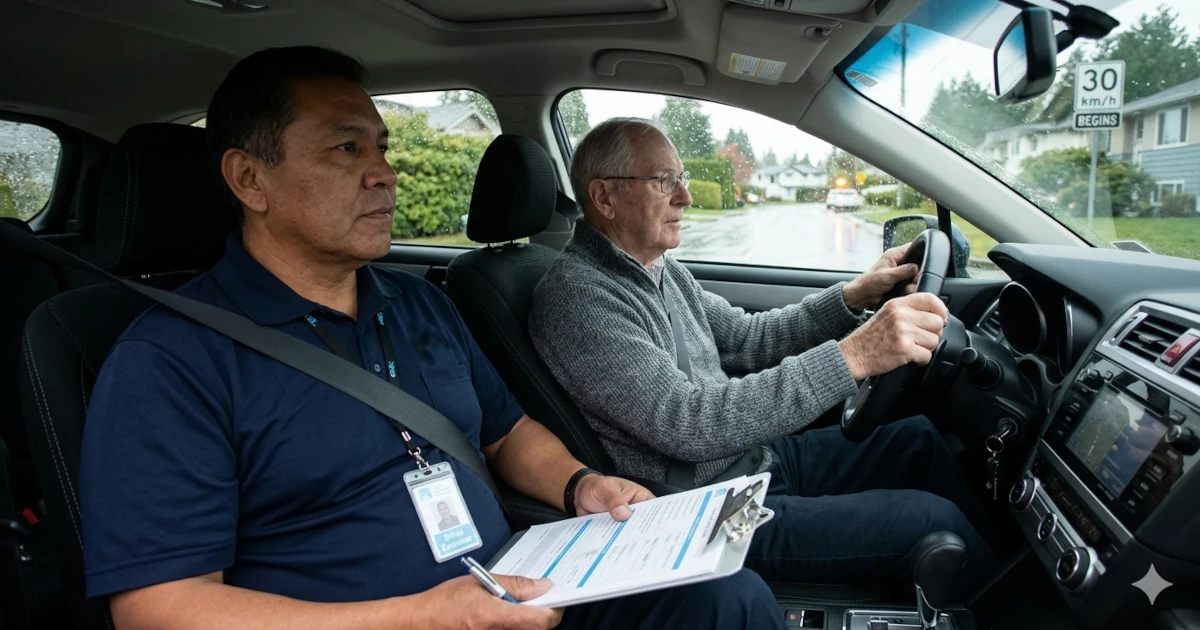
The ERA has been developed by RoadSafetyBC after surveying driver re-testing in other jurisdictions and is aimed at providing greater transparency for participants.
Reasons for an Enhanced Road Assessment
Some of the most common reasons for an ERA are:
- A doctor reports a medical condition that may affect a person’s fitness or ability to drive safely
- Results of a previous on-road assessment suggest a follow-up is necessary
- A collision report, police report or other report indicates a driver may be unable or unsure how to handle a common driving situation
Preparing for an Enhanced Road Assessment
Suggestions in preparation for an ERA include honest self assessment, constructive criticism from family or a friend, reading both Learn to Drive Smart and Tuning Up for Drivers, as well as taking a refesher with a driving school.
If a driver decides not to take the ERA, they may retire from driving by exchanging their driver's licence for a British Columbia Identification Card (BCID).
What to Bring to the Test
- Valid Driver's Licence.
- Vehicle Registration and Insurance (must be current).
- Corrective Lenses (if your licence says you need them).
- A Licensed Supervisor (Just in case a learner driver's licence is issued during the assessment).
What to Expect on Test Day
-
The 90-Minute Breakdown:
- Pre-Trip (15 mins): Identifying vehicle controls (wipers, signals, defroster) and a basic safety check.
- mandatory feedback break in the middle.
- Post-Trip (30 mins): Discussion of results—you don't usually find out "pass/fail" instantly because RoadSafetyBC makes the final call.
-
The "Cognitive" Tasks:
- Multi-Step Directions: The examiner gives 3 directions at once (e.g., "Turn left at the light, right on Oak St, then left at the stop sign") to test memory while driving.
- The Reverse Route: You drive a few blocks away, and then have to find your way back to the start point without directions.
- Secondary Controls: You may be asked to turn on your wipers or lights while the car is moving.
-
Crucial "Must-Haves":
- Bring a Companion: If you commit a "dangerous action" during the test, you might be issued a Learner’s Licence on the spot. You’ll need a licensed driver (25+) to drive you home.
- Your Own Vehicle: Ensure it’s clean, has a full tank of gas, and all lights/signals work perfectly.
Basic Driving Skills and Cognition Tested
Drivers will be asked to complete basic driving maneuvers similar to the class 5 road test, show that they can properly adjust and use vehicle controls, follow multi-step directions and reverse a driving route. To reverse a route, drivers will be asked to drive a few blocks from a location and then return to the starting point following that same route in reverse.
The Testing Outcome
- Best Case: You keep your current license. RoadSafetyBC reviews the examiner's report and sends a letter confirming you're good to go.
- Common Outcome: You keep your license but with new restrictions (e.g., "no highway driving" or "daylight only").
- The Safety Net: If you make a major mistake, you are issued a Learner’s Licence (LDL). This isn't a "fail"—it just means you need a supervisor with you while RoadSafetyBC does a final review.
Only in rare cases will the driver's licence be cancelled at the end of an ERA.
RoadSafetyBC Makes the Decision
The results of the ERA will be forwarded to RoadSafetyBC by ICBC where it will be considered along with all the other information in the driver's file. The result will be a final decision on whether to maintain, re-issue or cancel the driver's licence. That decision will be explained to the driver, in writing, by RoadSafetyBC.
RoadSafetyBC may consider imposing restrictions on a driver's licence. The restrictions are to insure that the driver can safely operate their vehicle within their ability.
Top 3 Tips for a Successful ERA
1. Master the "Multi-Step" Memory Task
One of the biggest differences in the ERA is the cognitive challenge. The examiner will give you three directions at once (e.g., "Turn left at the next light, right on Oak Street, then take your first left into the parking lot").
The Pro Tip: Don't be afraid to ask the examiner to repeat the instructions! They aren't testing if you have perfect hearing—they are testing if your brain can process and execute a plan while moving. If you realize you've missed a turn, stay calm and keep driving safely; getting lost isn't an automatic "fail," but making a dangerous last-second turn is.
2. Exaggerate Your Observation
Many experienced drivers "glance" with their eyes, but examiners need to see your head move.
The Pro Tip: Physically turn your head for every shoulder check and mirror scan. When you are stopped at an intersection, perform a clear "Left-Center-Right-Left" scan. If you are reversing, you must physically turn your body and look out the back window rather than relying solely on your mirrors or backup camera.
3. Use Your Feedback Break Wisely
The ERA includes a mandatory 5-minute break at the halfway point. This is your most valuable tool.
The Pro Tip: Listen closely to the examiner’s coaching during this break. They will tell you exactly what they’ve noticed so far (like "you're braking too late" or "watch your speed in school zones"). The second half of the assessment is your chance to show you can self-correct. Being receptive to feedback and immediately applying it is a huge "plus" in the final report.
Learn More
Share This Article
- Log in to post comments
Comments
What if a driver does not own a vehicle? Will a vehicle be supplied? Or do they have to get a suitable vehicle for the testing?
- Log in to post comments
It's always been expected by whoever is the licensing authority at the time, that a license applicant would provide the vehicle, for any class of license, and this was the case from long before ICBC became that licensing authority. Generally speaking, a family car, Driving School car, or vehicle provided by a prospective employer (read the fine print if it's a rental vehicle as it may be refused).
In the case of the ERA, although it's a RSBC initiative and designed to replace the DriveABLE model, they're using ICBC Driver Examiners based out of ICBC offices - and so they don't have any cars available for this purpose, to the best of my knowledge.
I doubt this will be an issue - few seniors who don't actually own a vehicle have the motivation to maintain their driver license, I would have thought; if they need BCID they can get it for free by handing over their driver license.
- Log in to post comments
From the news about this Enhanced Road Assessment that I've been following, a couple of things stand out.
For one thing, although the assessment (like 'evaluation', a term that manages to avoid using the Pass/Fail determination) will be conducted by an ICBC Driver Examiner, the end result will be completed by another party - probably some expert from RSBC in Victoria who is conversant with the design of the ERA and how to determine the appropriate outcome.
This is the same kind of process that DriveABLE use, so no essential difference there, except that (unless they're totally dangerous to themselves and other road users) the Applicant will get to leave with some kind of valid driver license in their pocket - however long they may get to keep it.
Notably, though, should the Applicant commit a Dangerous Action or Traffic Violation (examining terminology that has long been used by our licensing authorities) then the license they leave with will be a Class 5 Learner License, subject to the inherent conditions and restrictions - notably, the requirement that they be accompanied when behind the wheel by a suitably licensed driver in the front passenger seat; so the smart thing to do if you don't want to use a tow truck to get your vehicle home would be to have a suitable friend or relative along with you.
As for the terminology? Basically, a Dangerous Action has occurred either when the DE takes control - verbal or physical or another road user takes evasive action to prevent a collision.
- Log in to post comments
If ICBC WOULD APPLY THAT VERY FIRST SENTENCE, to EVERYONE, especially class 1, it would be a lot safer place.
i think their time would be much better spent on retesting, than dealing with accident claims. (Accidents DO happen, but usually due to driver error)
so we have a graduated system for a learners and 5, but anybody with 1200 bucks and 5 days of free time can haul super b trains through the mountains.
Dont get me started.
- Log in to post comments
- 152,774 medical exams for drivers of all ages were requested
- 44,947 of those were aged 80+
- 1,936 were referred for the ERA
- 1,102 did not respond
- 54 turned in their licence
- Driver medical fitness decisions in 2023
- 8,005 were found fit to drive
- 1,485 were found unfit to drive
- 34,138 cases remain open
- Log in to post comments
It would appear that 60% of those who took the ERA passed. That's a better percentage than Class 7 Learner Applicants, for instance.
This is quite an improvement, compared to C5 Re-Examinations or DriveABLE evaluations.
- Log in to post comments
What If...