
Question: A while ago you wrote about the test that new drivers have to take to get their licence. I took the practice test and there were at least two road signs in it that I had never seen before. I'm worried that there are other signs I wouldn't recognize and wonder if there is a reference I can use to look them up.
It's important to me to keep up good driving habits and make sure I'm well informed.
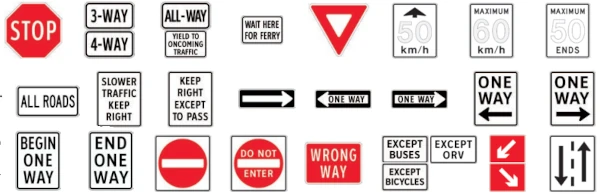
That's a good question. There are many more traffic signs in British Columbia than most drivers will ever need to recognize from memory.
Finding an unfamiliar sign doesn't necessarily mean you missed something when you learned to drive. Some signs are used frequently, while others apply only to particular situations, locations, road users or types of traffic.
The good news is that you don't have to memorize a catalogue of hundreds of signs. There are several reliable resources you can use to learn about the signs you are most likely to encounter or to identify one you don't recognize.
Start with the ICBC Road Signs Practice Test
If you are studying for your first driver's licence, or simply want to test your knowledge of BC road signs, ICBC has a road signs practice test on its website.
The practice test is particularly useful if you are preparing for your first driver's licence, but it can also be an eye-opener for experienced drivers. In teaching road safety to seniors through ElderCollege, I've found that years of driving experience don't necessarily mean that a driver remembers what every sign means. We tend to remember the signs we see regularly and forget the ones we encounter only occasionally.
That's not surprising. Driving experience teaches us a great deal about operating a vehicle and dealing with traffic, but it doesn't guarantee that we retain everything we learned when we first got our licence. A quick test can reveal gaps in our knowledge that we didn't know were there.
Learn the Signs You Are Most Likely to See
For most drivers, the best place to learn about road signs is Learn to Drive Smart, ICBC's provincial driving guide.
Chapter 3 — Signs, signals and road markings provides an overview of the signs, signals and pavement markings that drivers need to know. It covers warning signs, regulatory signs, information signs, traffic signals and road markings.
This is probably the most useful reference for the average driver because it concentrates on the signs and markings you need to understand while driving rather than trying to document every sign that might be installed somewhere in the province.
What If You Find a Sign You Don't Recognize?
That's where the BC Catalogue of Traffic Signs becomes useful.
The catalogue is the province's detailed reference for standard traffic signs. It is organized into sections that include regulatory signs, parking and stopping signs, pedestrian and school signs, bicycle signs, roundabout signs, commercial vehicle signs, warning signs, construction signs, information signs and guide signs.
If you see a sign and wonder, "What is that supposed to mean?", this is the place to look.
You may be surprised at how many signs are in the catalogue. That's because it isn't written just for drivers. It is also a technical reference for the people who select, order, install and maintain traffic signs.
The catalogue is also a living document. The Ministry of Transportation and Transit continues to add, remove and revise signs as traffic-control needs change. Several sections of the catalogue were updated during 2026.
The Technical Reference
If you want to go deeper, the province also publishes the Manual of Standard Traffic Signs and Pavement Markings.
This is a much more technical document. It deals not just with what a sign looks like, but with the standards for designing and using traffic signs and pavement markings.
The purpose of standardization is important. Drivers should be able to recognize a sign and understand what it means without having to figure out a different meaning every time they encounter one.
In other words, traffic signs aren't a collection of random pictures. There is a system behind them.
You Don't Have to Memorize Them All
So what should you do if you encounter a sign you don't recognize?
First, don't panic. Pay attention to the shape, colour, symbol and wording of the sign and consider what it is telling you to do or be prepared for. If you are driving, your first priority is to respond safely to the situation in front of you.
Once you have the opportunity, look the sign up. The Learn to Drive Smart guide is a good place to start. If you can't find it there, try the provincial Catalogue of Traffic Signs.
And don't assume that an unfamiliar sign is unimportant simply because you have never seen it before. Traffic signs communicate information, warn of hazards, regulate traffic and provide directions. If a sign is posted for you, it deserves your attention.
A Good Driver Never Stops Learning
We tend to think of learning the rules of the road as something that happens when we first get our driver's licence. It shouldn't be.
Roads change. Traffic-control practices change. New signs are introduced and existing signs are revised. More importantly, our own driving habits can change over time.
Taking a few minutes to refresh your knowledge from time to time is a simple way to make sure you understand what the signs around you are telling you.
You don't have to memorize every sign in the provincial catalogue. But when you see one that you don't recognize, take the time to find out what it means.
Learn More
- Give Me a Sign — Why experienced drivers can still have gaps in their knowledge of road signs.
- Didn't See a New Traffic Sign? What You Need to Know — What happens when a familiar route gets a new traffic sign.
- Painted Lines, Arrows and Symbols — Understanding the pavement markings that control how we use the road.
- Congestion Ahead Warning Signs — An example of an uncommon warning sign that drivers may not immediately recognize.
- Log in to post comments