
When school starts, the road itself doesn't change. The signs are the same, the traffic laws are the same and your vehicle still works exactly as it did during summer.
What changes is what you have to watch for.
For a few minutes before and after school, an otherwise ordinary street can become a complicated mix of children walking and cycling, parents dropping off passengers, parked vehicles, school buses, crossing guards and drivers trying to get somewhere on time.
That means back-to-school safety isn't just about slowing down. It means changing the way you look at the road.
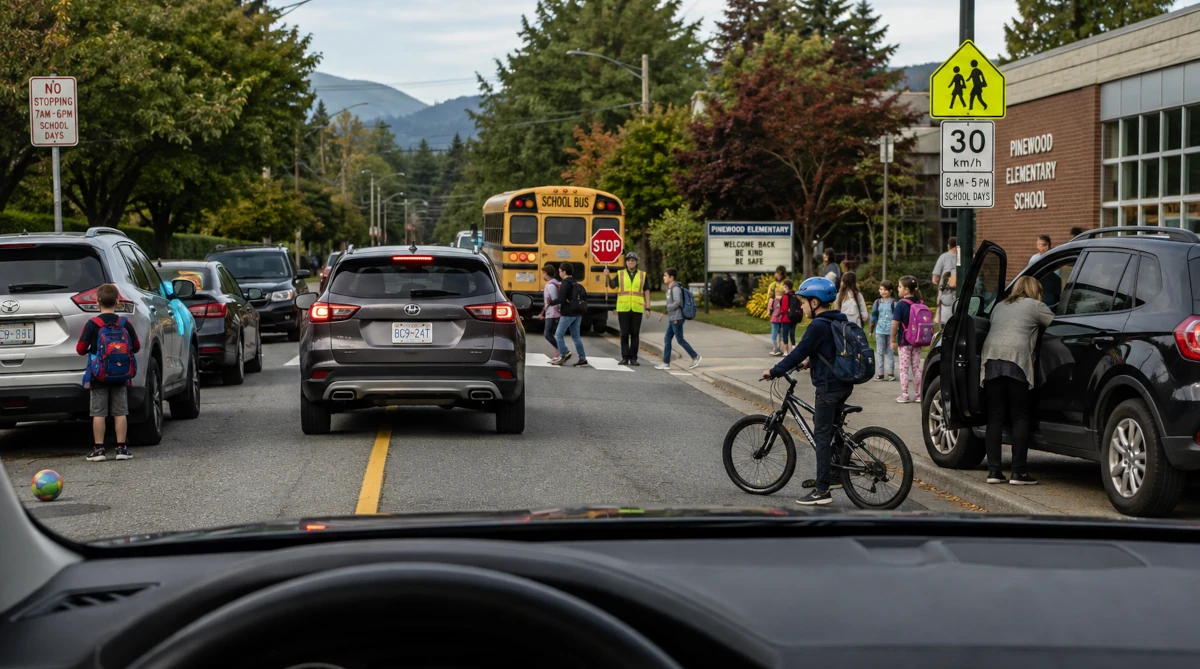
How many potential hazards can you see?
Before reading any further, take another look at the picture above.
Don't just count the children or look for something obviously dangerous. Instead, ask yourself:
What could happen next?
That question is at the heart of active hazard perception. A good driver isn't simply waiting for a hazard to appear and then reacting to it. The driver is constantly looking for clues that something could develop into a hazard and preparing for it before it happens.
If you identified several possible problems in the picture, you're already thinking the right way. If you saw only the school bus, the children and the crossing guard, take another look.
Look for clues, not just hazards
The stopped vehicle in front of you is one example. You could simply think, "That car is stopped." A better question is, "Why is it stopped?"
Perhaps the driver is dropping off a child. Perhaps someone is crossing the road. Perhaps another child is about to appear from behind a parked vehicle. You don't know yet, so the safe response is to be prepared for the possibility that the stopped vehicle is giving you information about something you cannot see.
The same principle applies to parked vehicles. They aren't necessarily hazards by themselves, but they can hide pedestrians, cyclists and children from your view.
A child standing beside a parked vehicle is another clue. So is an open vehicle door. So is a bicycle approaching the roadway. Even a ball near the edge of the street can be a warning that a child may follow it.
The hazard may not have happened yet. The clues tell you that it could.
Don't let the speed limit do all the thinking
A school zone speed limit is important, but driving at the posted speed does not make every situation safe automatically.
You can still approach a school zone too quickly for the circumstances. You can follow a stopped vehicle too closely. You can pass a vehicle without considering why it stopped. You can look directly at a child without recognizing that the child may suddenly change direction.
The speed limit is one part of the safety system. What you do with the time that the lower speed gives you is another.
At a lower speed, you have more time to see, understand and respond to what is happening around you. Use that extra time to scan rather than simply continuing along the same path you would have taken on an ordinary summer morning.
Parked cars become walls
One of the biggest changes during school drop-off and pickup is the number of vehicles parked or stopped along the road.
Think of those vehicles as temporary walls.
You may be able to see that there is a child somewhere on the other side of a parked SUV, but you cannot know what that child will do next. The child may stay on the sidewalk, cross at the marked crossing or suddenly move into the road.
You don't need to predict exactly what will happen. You need to recognize that you cannot see everything that could happen.
That should change how you approach the area. Slow down as necessary, increase your following distance and be prepared to stop rather than assuming that what you cannot see is not there.
When one driver stops, pay attention
A vehicle stopped in front of you or in the lane beside you deserves special attention in a school area.
The driver may have stopped for a pedestrian that you cannot see. They may be waiting for a child to cross. They may be allowing another vehicle to enter or leave the school property.
Don't let impatience turn somebody else's caution into your hazard.
If another driver is doing something that seems unusual, ask yourself why before you decide how to respond.
Everyone is watching something different
There is another complication during the school run: everyone around you has a different objective.
A child may be thinking about getting to class. A parent may be watching their child rather than approaching traffic. A cyclist may be trying to get around a stopped vehicle. A school bus driver is concentrating on loading or unloading passengers. A crossing guard is watching pedestrians and traffic.
You cannot assume that everyone else is watching for you.
This is why eye contact, appropriate speed, extra space and a willingness to wait are so valuable around schools. Give other road users the opportunity to make a mistake without turning that mistake into a collision.
Change the way you drive
The safest driver approaching a school doesn't simply think, "School zone. Thirty kilometres per hour."
The thought process is more like this:
- What can I see?
- What can't I see?
- Why is that vehicle stopped?
- Could someone emerge from behind that parked vehicle?
- What is that cyclist likely to do next?
- Is that child approaching the road?
- Do I have enough space and time to stop?
This is active hazard perception applied to a familiar situation. You don't have to be frightened or suspicious of every child and every vehicle. You simply have to remain actively engaged in the driving task.
Try it on your next school run
The next time you drive through a school area, don't make your goal simply to obey the speed limit and get through it.
Instead, spend the entire trip asking yourself one question:
What could happen next?
That question changes where you look, what you notice and how much time and space you leave yourself to respond.
School may be starting again, but the lesson for drivers is not really about children. It's about seeing the developing hazard before it becomes an emergency.
Learn More
- Active Hazard Perception Skills — Learn how to scan, predict and react to developing hazards before they become dangerous.
- School Zones — Understand the rules and responsibilities that apply when driving near schools in B.C.
- School Crosswalk Safety for Parents — A closer look at the traffic problems created around school crosswalks during drop-off and pickup.
- The Ideal Elementary School Crosswalk: Blueprint for a 30 km/h Two-Lane Road — Explore what a high-safety school crossing could look like when visibility and predictable behaviour are the design priorities.
- Log in to post comments
Comments
I had an experience that this article reminded me of. In Regina, Victoria Avenue in the area just East of the downtown area, has two lanes in each direction separated by a grassed boulevard with no left turning lane. This means to turn left you need to signal, stop in the left lane and wait for the traffic coming the other way to clear. Most drivers pull slightly left into the intersection to wait.
I was in the left lane following a pickup truck who appeared to have stopped to turn left but didn't pull into the intersection. Prior, I saw there was a child walking across in front of him. I saw a car driving in the right lane not noticing why we stopped. He couldn’t see the child crossing as the truck hid the child from view. He went whizzing past us in total bliss. I saw him not slowing down and applied my horn to get his attention but to no avail.
The only thing that saved that child was he wasn’t running across the street.
I hope that I would have noticed the vehicles stopped and suspected it just wasn’t to wait for the truck, who wasn’t signalling, to turn.
- Log in to post comments
I decided recently to observe the 30 km/h speed zone around schools even during holidays and breaks. It's a school but it's also a park and a playground. What's an extra 13 seconds?
- Log in to post comments
One thing to mention regarding the school zones that most people do not consider. That is re-routing yourself to stay out of active school zones. Traffic density in of itself creates undo hazards. If you don't need to be in a school zone, best to just drive around it.
- Log in to post comments
Local governments should send out fliers to all of their citizens as a friendly reminder about the increased amount of children hitting the streets especially near schools and playgrounds this time of year.
I observe several idiots weaving through traffic with no concern for the hidden potential of awful collisions hiding behind the traffic in front of them. Many of these idiots are driving low profile vehicles that can see nothing past the cars in front of them. They see a car slowing to a stop in their lane in front of them and never consider why, so they swerve into the vacant lane to their left and run over the pedestrians coming out from behind the stopped car.
All these selfish people think about is driving fast and passing other cars while enjoying the thrill of it all until they find themselves in prison for manslaughter!
- Log in to post comments
Scary Experience