Q&A - Handicap Equipment Security in Taxi
Question:  I often travel in a taxi with my mother, who is in a wheelchair, and the safety straps let go twice. What should I do about this?

Information regarding driver & vehicle safety systems and equipment.
Question: I often travel in a taxi with my mother, who is in a wheelchair, and the safety straps let go twice. What should I do about this?
 What can I write about seatbelts today? They were around when I started driving (1974). Canada's Road Safety Strategy 2025 is joined by B.C.'s Road Safety Strategy 2025 to continue to encourage seatbelt use today.
 An American Automobile Association (AAA) study in 2018 found that over the course of 4,000 miles of real-world driving, vehicles equipped with active driving assistance systems (ADAS) experienced some type of issue every 8 miles, on average. Drivers are reminded that ADAS is not a replacement for paying full attention at all times when you drive.
About 92% of front seat passengers wore their seatbelt in 2024. We need to worry about the other 8% because over half of the crash deaths in 2023 involve vehicle occupants that were not wearing a seatbelt. People in rural areas are less likely to wear a seatbelt compared to their municipal neighbours.
 This video from the Danish Road Safety Council teaches that wearing a bicycle helmet has always been a good idea. From Ads of the World:
The Danes love their bikes, and the Danish capital of Copenhagen is the world’s most cycle-friendly city. One problem, helmets have never become as popular as cycling itself. To combat this, the Danish Road Safety Council launches a campaign which pokes gentle fun at those who are too vain to wear a helmet, by recruiting a group that wore theirs with pride - the Vikings.
 The US National Safety Council in partnership with Toyota and the University of Iowa has created the "My Car Does What?" website in response to the finding that many drivers do not know how to use the safety features that are found in the modern vehicle. The site is meant to be a simple answer to: how do safety features work? When should they be used? Do I have them in my car? and How can I find answers to these questions?
 The third week in September marked the official start of fall and noticeably shorter days. That means many of us will driving in the dark more often. Here are some bright ideas for driving at night.
 On August 28, 2014 a tour bus crash occurred on the Coquihalla Highway south of Merritt. 56 people were injured, 15 of them seriously. A civil action was taken against a number of parties involved in the tour that included Prevost, the manufacturer of the bus. Jie Ding and the other plaintiffs involved claim that their injuries were made worse by the lack of seatbelts on the bus.
 Anti-lock brakes (ABS) have gone from being a novelty to being present on most vehicles today. Have you read and understood the section of your vehicle owner's manual on this vital safety system? Contrary to popular belief, ABS does not always mean shorter stopping distances.
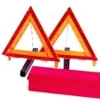 What kind of warning devices do you have stored in your vehicle to protect yourself in the event of a breakdown or collision? Most of us will probably reply that they don't have anything prepared for this eventuality. In fact, with the reliability of vehicles today and perhaps not having been involved in a significant collision before, we may be lulled into thinking that we don't really need it.