
Question: Is there a section in the Motor Vehicle Act that states that, in the absence of speed signage on a highway, a driver must use common sense to judge what a safe speed would be?
This question arose from a newly constructed section of Highway 33 near Kelowna. The road had been completed, but the speed-limit signage had not yet been fully installed when the driver received a speeding ticket.
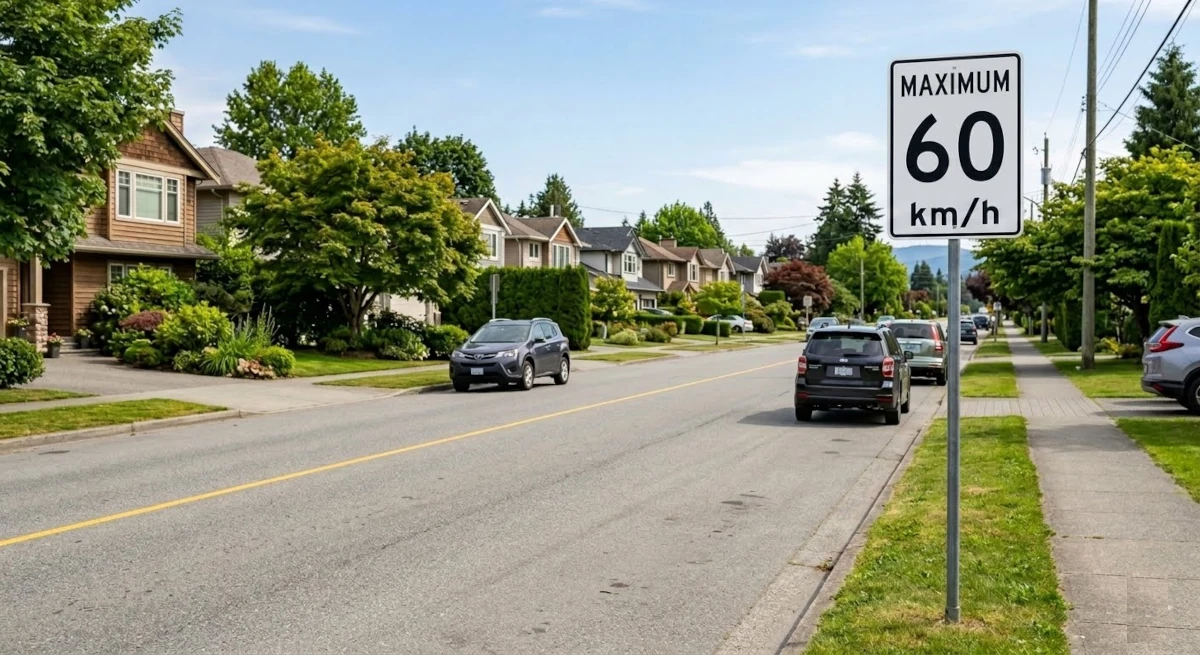
What is the speed limit when there is no sign?
British Columbia has default speed limits that apply when a different speed has not been established by a traffic sign or other legal authority. Under section 146(1) of the Motor Vehicle Act, the maximum speed is 50 km/h on a highway in a municipality and 80 km/h on a highway outside a municipality.
In other words, you do not have to see a speed-limit sign in order for a speed limit to exist. The Act itself establishes the default speed limit.
What if a speed-limit sign was posted?
This is where the answer to the original question becomes more complicated.
Section 146(2) allows the minister responsible for the administration of the Transportation Act to increase or decrease the rate of speed at which a person may drive on a highway by causing a speed-limit sign to be erected or placed. When that sign is in place, section 146(3) prohibits a driver from exceeding the speed shown on the sign on that portion of highway.
That means that if you pass a 60 km/h sign, you cannot assume that the speed limit becomes 80 km/h simply because you do not see another 60 km/h sign for several kilometres.
The important question is not simply whether you can see a sign at the location where you were stopped. It is whether a valid speed limit had been established for the portion of highway where you were driving.
What if the sign was missing or unreadable?
The Motor Vehicle Act does provide some protection where a driver could not see or read a speed-limit sign.
Section 148.2 says that, in a prosecution involving a speed limit indicated on a highway sign, it is a defence if the driver proves that the sign was obstructed so that no driver could see its front, or that the sign was in place but no driver could read it.
This is different from simply saying, "I didn't notice the sign." The legislation specifically addresses situations where the sign could not be seen or read.
Does common sense determine the speed limit?
No. A driver cannot choose a higher speed limit simply by deciding that it seems reasonable for the road.
However, "common sense" does have an important role in determining how fast you should actually drive.
Section 144(1)(c) of the Motor Vehicle Act prohibits driving at a speed that is excessive relative to the road, traffic, visibility or weather conditions. This means that the posted speed limit is a maximum, not a target that must always be reached.
For example, a driver travelling on an 80 km/h highway may need to slow down considerably because of snow, fog, heavy traffic, a sharp curve or another hazard. The driver is permitted—and sometimes required—to travel below the posted limit when conditions make that necessary.
What about a newly constructed highway?
The fact that a highway is newly constructed or designed for a particular speed does not, by itself, establish the legal speed limit.
The legal limit comes from the Motor Vehicle Act, a municipal bylaw where applicable, or a speed limit established by the appropriate authority.
So if a newly constructed highway outside a municipality has no sign establishing a lower speed limit, the statutory maximum is 80 km/h. If a 60 km/h speed-limit sign has been properly established, however, the fact that the road was designed for 80 km/h does not allow a driver to disregard the 60 km/h limit.
What about an advance-warning flasher?
An advance-warning flasher at an intersection does not establish a speed limit. It is a warning device intended to alert drivers to an approaching traffic signal or intersection.
The fact that a particular warning system may normally be used on roads with higher speed limits does not override a posted speed limit. A speed-limit sign and a warning flasher serve different purposes.
The bottom line
If there is no sign establishing a different limit, the Motor Vehicle Act provides the default speed limit: 80 km/h outside a municipality and 50 km/h inside one.
If you have passed a sign establishing a lower speed limit, however, you cannot replace that limit with your own judgment about what speed seems appropriate for the road. Your judgment is relevant to deciding when you should drive below the maximum speed, not to creating a higher legal maximum.
If a speed-limit sign was missing, obstructed or unreadable, that can be a different question. The circumstances surrounding the sign and the location where the alleged offence occurred may then become important evidence in court.
Related Articles
You may also wish to read Minimum Speed Sign Spacing for a discussion of speed-limit signs and what must be established when a driver is accused of exceeding a posted limit.
See also Slow Driving for more about when it is appropriate to drive below the posted speed limit.
- Log in to post comments