
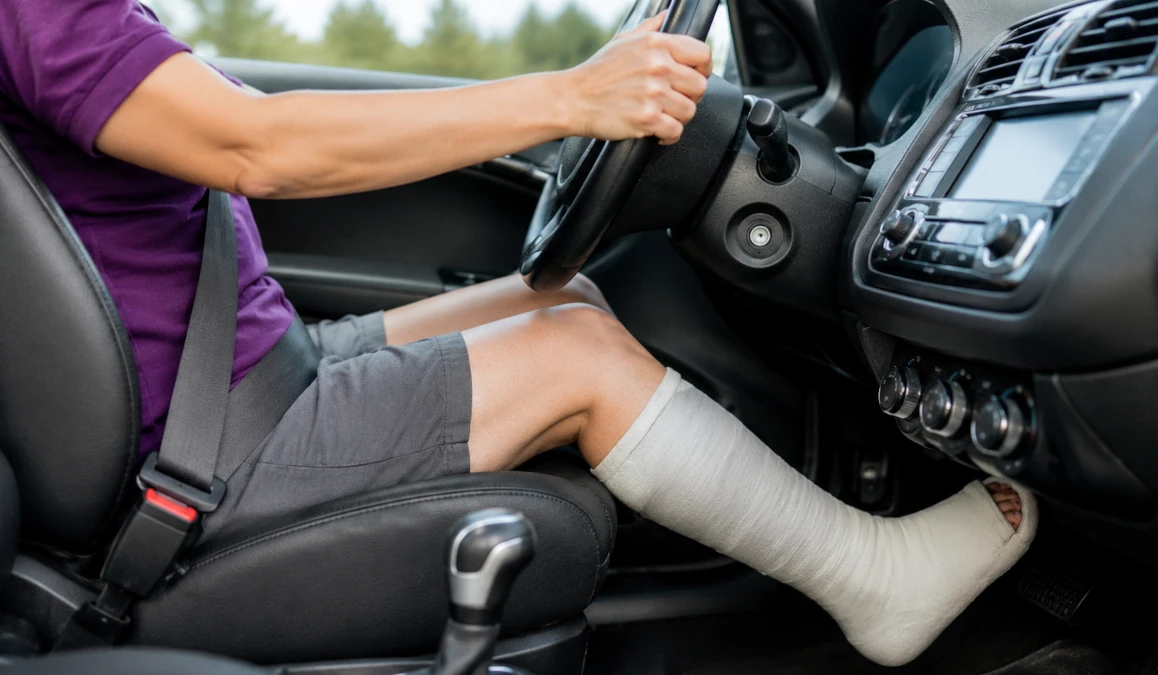
Please let me know if it is legal to drive with a walking cast. Does it matter whether it is on your right or left foot? Could it affect your braking time, cause your foot to slip off the pedals, or create problems if you are involved in a crash?
Medical Standards
The first advice you should consider is your doctor's recommendation. If your physician tells you not to drive while recovering from your injury, you should follow that advice.
The Canadian Council of Motor Transport Administrators (CCMTA) Medical Standards, which are used by British Columbia physicians when assessing medical fitness to drive, state the following about musculoskeletal conditions:
Drivers operating motor vehicles of any class must be able to carry out many complex muscular movements swiftly, accurately and repeatedly in order to control a vehicle properly. Truck and bus drivers must also have good muscular strength and functional range of motion in both their arms and legs in order to handle these heavier vehicles.
Motor Vehicle Act Requirements
The Motor Vehicle Act does not specifically prohibit driving with a walking cast or walking boot. However, two sections of the Act may apply if your condition prevents you from safely controlling your vehicle.
Requirements for Moving Vehicle
195 (1) A person must not cause a vehicle to move on a highway if
(a) the control of the driver over the driving mechanism of the vehicle, or
(b) the view of the driver to the front or sides of the vehicle
is obstructed.
If your walking cast prevents you from reliably operating the accelerator, brake or clutch, you should not drive. Whether the cast is on your right or left foot is less important than whether you can maintain full control of the vehicle at all times.
If you were involved in a crash and it was determined that your cast affected your ability to drive safely, you could also face a charge of driving without due care and attention or driving without reasonable consideration for others using the highway.
Careless Driving Prohibited
144 (1) A person must not drive a motor vehicle on a highway
(a) without due care and attention,
(b) without reasonable consideration for other persons using the highway, or
(c) at a speed that is excessive relative to the road, traffic, visibility or weather conditions.
(2) A person who contravenes subsection (1)(a) or (b) is liable on conviction to a fine of not less than $100 and, subject to this minimum fine, section 4 of the Offence Act applies.
What About Crash Liability?
ICBC publishes examples that explain how responsibility for crashes is assessed. While they do not specifically discuss drivers wearing a walking cast, your ability to safely control your vehicle would likely be considered if your condition contributed to a collision.
After a crash, investigators may consider factors such as witness statements, vehicle damage, medical information and your ability to operate the controls when determining whether your condition contributed to the collision.
Should You Drive?
Testing your ability to move your foot between the pedals and apply firm braking while your vehicle is safely parked may reveal obvious problems. However, being able to do this does not guarantee that you can react quickly and safely in traffic.
If you have a question about traffic law or safe driving in British Columbia, send it to DriveSmartBC and it may become the subject of a future article.
Learn More
- Log in to post comments