
Motorcycle lane filtering is the practice of riding between lanes of stopped or slow-moving traffic travelling in the same direction. Supporters argue that it can reduce delays and help motorcyclists avoid being struck from behind. Critics worry that drivers may not expect a motorcycle to pass between vehicles and could move into its path while changing lanes or turning.
Research from several countries has examined lane filtering and the related practice of lane splitting. The findings are mixed, and understanding what each study actually measured is essential when considering whether the practice should be permitted in British Columbia.
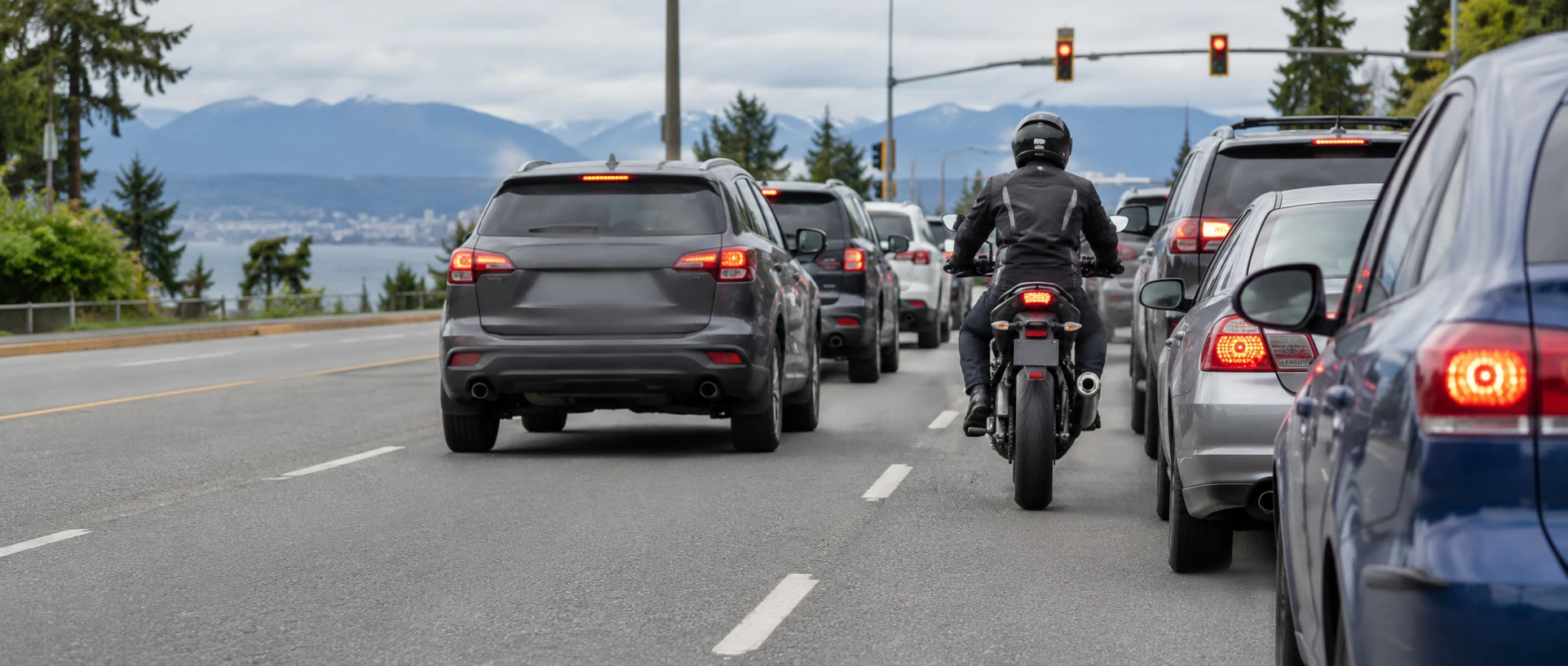
Lane filtering and lane splitting
The terms are sometimes used interchangeably. Generally, lane filtering describes moving between lanes of stopped or slow-moving traffic, while lane splitting often refers to riding between lanes of moving traffic. Definitions vary between jurisdictions, so the distinction matters when comparing research or legislation.
What does the research tell us?
California: Injury outcomes depend on speed
A 2015 University of California, Berkeley study examined 5,969 motorcyclists involved in collisions in California between June 2012 and August 2013. Of these, 997 were lane splitting when their collision occurred.
The researchers found that lane-splitting motorcyclists were less likely to suffer certain injuries. The speed difference between the motorcycle and surrounding traffic was particularly important: injury likelihood increased when motorcycles travelled substantially faster than other vehicles.
The researchers concluded that lane splitting appeared relatively safe when traffic was travelling at 80 km/h or less and the motorcycle was travelling no more than about 24 km/h faster than surrounding traffic.
There is an important limitation, however. The study examined collisions that had already occurred. It could not establish whether lane splitting increased or decreased a motorcyclist's overall likelihood of being involved in a collision. The researchers also identified changing lanes by another driver as a common collision scenario when a motorcyclist was lane splitting at a high speed difference.
Read the California lane-splitting safety study.
France: Different findings from different studies
A 2017 study of 14 urban road sections in Marseille compared injury collisions with observations of motorcycle traffic to estimate collision risk per kilometre travelled. Researchers estimated that the risk of an injury collision was 3.94 times higher while filtering than while riding in the normal traffic stream.
This finding differs from the California study, but the studies measured different outcomes under different conditions. The Marseille research examined particular urban roads, while the California study focused on the injuries suffered by motorcyclists involved in collisions. Neither result should automatically be applied to every road or form of filtering.
Read the Marseille study of motorcycle filtering risk.
France also evaluated a lane-filtering experiment conducted from 2016 to January 2021 on selected major roads in 11 departments. The evaluation reported that motorcycle collisions increased by 12% on the road networks covered by the experiment and a comparison area, while collisions across the departments as a whole decreased by 10%.
The report noted that the number of collisions was relatively small and that the results required careful interpretation. The figures do not, by themselves, prove that filtering caused an increase in collisions. Nevertheless, the evaluation did not provide sufficiently convincing safety results to justify simply incorporating the practice into the rules at that time.
Read the official French evaluation of the 2016–2020 experiment.
Australia: Experience with regulated filtering
New South Wales conducted a lane-filtering trial in a defined area of Sydney in 2013 and later introduced rules permitting filtering under specified conditions. Western Australia also legalized filtering and subsequently reviewed its implementation.
These experiences offer useful information about regulation, rider behaviour and public awareness. However, the findings are specific to the conditions and data available in each jurisdiction. They do not establish that introducing the same practice would produce the same safety outcomes in British Columbia.
See the New South Wales trial summary and the Western Australian post-implementation review.
Potential benefits and risks
One argument for filtering is that a motorcyclist who moves ahead of a queue may avoid being struck from behind by a driver who fails to stop in time. Filtering may also reduce travel time in congested traffic.
These are plausible benefits, but they do not establish how many collisions filtering might prevent or whether the benefits would outweigh other risks. Travel-time savings and safety outcomes must be assessed separately.
One of the main concerns is that drivers may not expect a motorcycle to approach between lanes. A driver might check mirrors and begin changing lanes without recognizing a motorcycle coming through the gap. A driver preparing to turn could similarly move across its path.
Other hazards include:
- Speed differences: A motorcycle approaching quickly gives both the rider and surrounding drivers less time to recognize a developing conflict and respond.
- Vehicles moving within their lanes: Drivers may adjust their position to avoid a hazard, make room for another vehicle or prepare to turn. A narrow gap can disappear quickly.
- Large vehicles: Trucks and buses have blind spots and need room to manoeuvre. A rider passing beside one may have little space to escape if its position changes.
- Intersections and access points: Vehicles may turn across a motorcycle's path, and pedestrians or cyclists may not anticipate a motorcycle travelling between lanes.
These hazards do not mean every filtering manoeuvre will result in a collision. They explain why speed, visibility, available space and the actions of other road users are central to assessing its safety.
What about British Columbia?
Motorcycle lane filtering and lane splitting are illegal in British Columbia. ICBC explicitly identifies both practices as illegal in its motorcycle safety guidance.
Any proposal to permit filtering would need to consider the conditions under which it could occur, including speed limits, suitable locations, restrictions around large vehicles and intersections, rider education, public awareness and enforcement. The experience of other jurisdictions suggests that defining the practice and setting clear rules would be important, but regulation alone cannot guarantee a safety benefit.
What drivers and motorcyclists should know
The research does not support a simple conclusion that lane filtering is always safe or always unsafe. Some findings concern injury severity after a collision; others estimate collision risk or evaluate the results of a trial. Those differences matter.
For drivers, the practical lesson is to check mirrors and blind spots carefully before changing lanes, signal in advance and look again before moving. Take particular care in slow or stopped traffic, where a motorcyclist might be approaching between lanes. Never deliberately move into a motorcyclist's path.
For motorcyclists, a gap between vehicles is not a guarantee of safe passage. Other drivers may not expect a motorcycle there, and the available space can disappear quickly. Speed differences, visibility, intersections and the presence of large vehicles all affect the risk.
For policymakers, the question is whether a clearly defined and enforceable system could improve overall road safety under British Columbia's conditions, and how that outcome would be measured. Evidence from elsewhere can inform that decision, but it cannot settle it on its own.
Learn More
- Log in to post comments