
Utility trucks parked facing the wrong way, maintenance vehicles travelling slowly along a highway, and workers standing beside traffic are common sights in British Columbia. Are these activities permitted? What authority allows workers and their vehicles to operate in ways that would normally be against the rules of the road?
The answer is found in the Motor Vehicle Act and the occupational health and safety requirements that apply to work performed on or beside highways. The rules recognize that some work cannot be done without interfering with normal traffic, but that does not mean workers have unrestricted authority to do as they please.
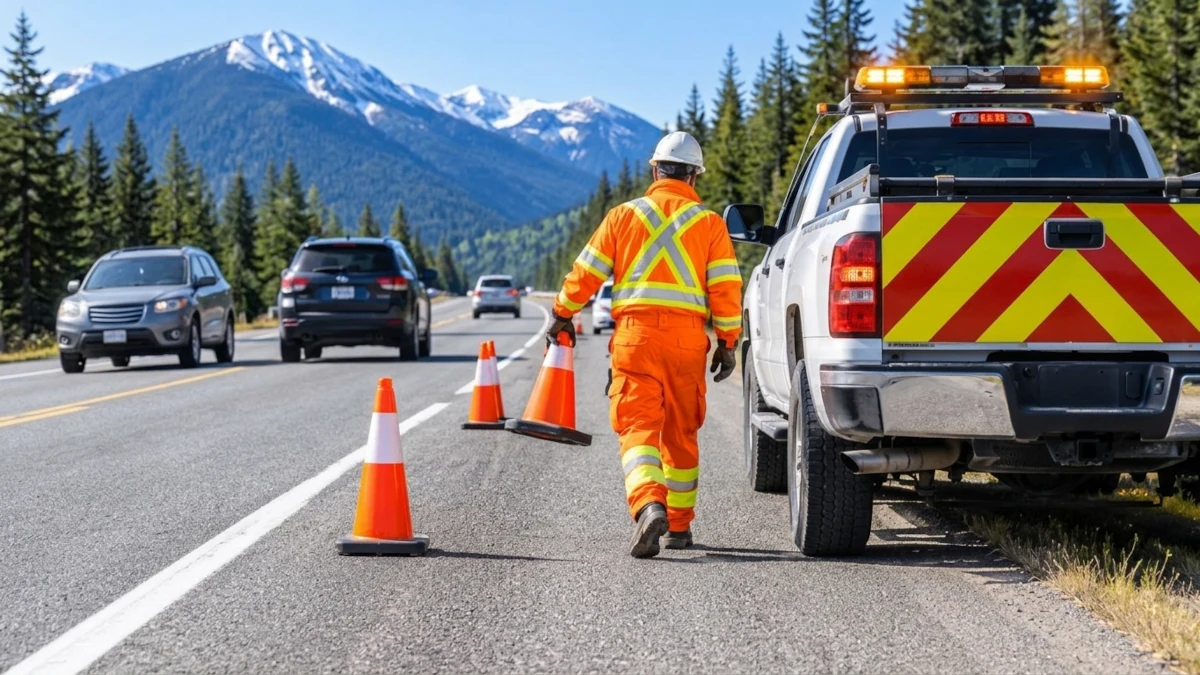
Exemptions for Highway Work
Section 120 of the Motor Vehicle Act exempts people, vehicles and equipment actually engaged in highway or public utility construction or maintenance work from the provisions of Part 3 of the Act while they are at the work site.
This exemption allows workers and equipment to perform tasks that would otherwise be prohibited by the normal rules of the road. For example, a maintenance vehicle may need to travel in the opposite direction of traffic, stop in a traffic lane or operate in an unusual position to carry out its work.
The exemption is limited. It applies only while actually engaged in the work at the site. It does not apply when travelling to or from the work site, and simply being a work vehicle does not qualify a driver for the exemption. This is an exemption from the rules contained in Part 3 of the Act, not a general exemption from all motor vehicle legislation or occupational health and safety requirements.
Section 121 places an important condition on this privilege. Drivers of vehicles using the exemption must exercise due regard for safety, taking into account the nature, condition and use of the highway and the amount of traffic that is or may reasonably be expected to be there.
Traffic Control at Work Sites
Section 138 of the Motor Vehicle Act requires traffic control devices to be erected on a highway where construction, reconstruction, widening, repair, marking or other work is being carried out. These devices must indicate that people or equipment are working on the highway.
Section 139 requires additional traffic control devices to limit vehicle speeds or restrict the manner in which traffic proceeds through the work area. Drivers must obey the posted restrictions under section 140 and follow the directions of a flagger under section 141 or a traffic control person under section 141.1.
Temporary traffic control devices must be removed when the reason for having them in place no longer exists. Leaving them in place unnecessarily is prohibited by section 142.
These requirements establish the legal framework for traffic control around highway work. The WorkSafeBC Occupational Health and Safety Regulation, Part 18, and the Ministry's Traffic Management Manual for Work on Roadways provide more detailed requirements and guidance about how traffic is to be managed.
Employer Responsibilities
Protecting workers from passing traffic is an important occupational health and safety responsibility. Section 18.2 of the WorkSafeBC Regulation requires employers to ensure that effective traffic control is provided whenever traffic could be hazardous to a worker.
Before workers undertake activities that may expose them to traffic, the employer must ensure that a risk assessment has been completed by a qualified person. It considers factors such as traffic volume, sight distance, posted speeds, the configuration of the work area, equipment movement and environmental conditions.
The requirements recognize different types of work:
- Emergent work: An unanticipated occurrence requiring a quick response, with the work taking less than five minutes.
- Brief-duration work: Planned work requiring 15 minutes or less to complete.
- Short-duration work: Planned work requiring more than 15 minutes during a single daylight period.
- Long-duration work: Work extending beyond one daylight period, work performed at night, or mobile work.
Emergency Work
WorkSafeBC distinguishes an emergency from emergent work. An emergency is an incident requiring immediate action to protect lives or prevent serious injury. Emergent work, by comparison, is an unanticipated occurrence requiring a quick response that is not an emergency and takes less than five minutes to complete.
Section 18.6.1 of the Occupational Health and Safety Regulation permits emergency responders who are present at an emergency scene in a work zone, including firefighters, paramedics, highway rescue workers, search and rescue workers, tow truck workers, utility owners' workers, road authority workers and road maintenance workers, to be assigned to direct traffic during an emergency. Responders other than peace officers must complete specific emergency traffic-control training. They may direct traffic for up to two hours after the emergency begins without completing the full traffic control person training required by section 18.6.2.
Emergency vehicle drivers also have separate privileges under section 122 of the Motor Vehicle Act. These include exemptions from certain rules of the road, subject to prescribed conditions and the requirement to exercise due regard for safety.
Even emergent and brief-duration work requires appropriate risk assessment and written work procedures. Short- and long-duration work also requires a written risk assessment and traffic control plan.
The regulation requires owners and employers to eliminate worker exposure to traffic by isolating the work zone wherever practicable, using constructed detours, alternative routes, barriers or other effective measures. If this is not practicable, worker exposure must be minimized through temporary traffic control devices and arrangements, followed by administrative controls such as scheduling work during off-peak hours. Traffic control persons are used only when these other measures are insufficient.
Warning Lights on Work Vehicles
Flashing amber warning lights are useful for alerting approaching motorists to vehicles and workers on or beside the highway. However, not every work vehicle is automatically entitled to use them.
Division 4.28 of the Motor Vehicle Act Regulations permits two amber flashing lamps on snow removal equipment, sand spreading equipment and other highway maintenance equipment while being used on a highway for highway maintenance or construction.
The regulation also permits their use on tow cars in specified circumstances. Other vehicles may only be equipped with flashing lamps when the Director has given written permission, and the lamps must be operated according to the conditions specified.
Having amber warning lights does not, by itself, give a vehicle permission to disregard the rules of the road or establish a safe work zone.
Slow Down and Move Over
British Columbia's Slow Down, Move Over law provides additional protection for roadside workers when they are working beside a stopped vehicle displaying flashing red, blue, white or amber warning lights.
Drivers approaching a stopped vehicle displaying flashing red, blue, white or amber warning lights must reduce their speed to:
- 70 km/h when the posted speed limit is 80 km/h or higher.
- 40 km/h when the posted speed limit is less than 80 km/h but at least 40 km/h.
- The posted speed limit when it is less than 40 km/h.
Drivers travelling in the lane adjacent to the stopped vehicle, or in the same lane as the stopped vehicle, must move into another lane of the laned roadway, if one exists and it is safe to do so, unless otherwise directed by a peace officer.
These requirements apply to roadside workers, including highway maintenance personnel, utility workers and tow truck operators. They do not replace the need for employers to provide appropriate traffic control at a work site.
The Responsibility is Shared
Working on a highway is inherently hazardous. Employers must assess the risks and provide effective traffic control, workers must follow established safety procedures, and drivers must recognize that people and equipment may be operating in unexpected places.
The legal exemptions provided to highway workers exist so that necessary work can be performed. They are not a licence to create unnecessary hazards. The overriding consideration for everyone involved must be the safety of workers and other highway users.
Learn More
- Log in to post comments