
Quick Answer: Yes. Regenerative braking can increase the risk of a collision on slippery roads because lifting off the accelerator may apply braking force to the drive wheels before the driver applies the brake pedal. If that braking demand exceeds the available traction, the drive wheels can lose grip. Modern vehicles use ABS, traction control and electronic stability control to reduce this risk, but drivers should still adjust their driving to road conditions.
What Is Regenerative Braking?
Regenerative braking allows an electric or hybrid vehicle to recover energy that would otherwise be lost as heat during braking. Instead of relying solely on conventional friction brakes, the electric motor acts as a generator when the driver lifts off the accelerator or applies the brake pedal, converting some of the vehicle's motion into electricity to recharge the battery.
Besides improving efficiency and extending driving range, many vehicles provide enough regenerative braking that they can often be driven using only the accelerator pedal. This is commonly called One-Pedal Driving.
Does Regenerative Braking Apply Equal Force to All Four Wheels?
No. Regenerative braking is applied through the electric drive motor, so it normally acts primarily on the wheels driven by that motor.
For example, the Chevrolet Bolt is a front-wheel-drive vehicle. When regenerative braking is active, braking force is applied primarily through the front wheels. A rear-wheel-drive electric vehicle applies regenerative braking primarily at the rear wheels, while vehicles with electric motors on both axles may distribute regenerative braking between the front and rear depending on driving conditions and the manufacturer's programming.
Conventional friction brakes work differently. They use hydraulic pressure to apply braking force at all four wheels, with the brake system automatically adjusting braking force to maximize stability and stopping performance.
Why Can Regenerative Braking Increase Collision Risk?
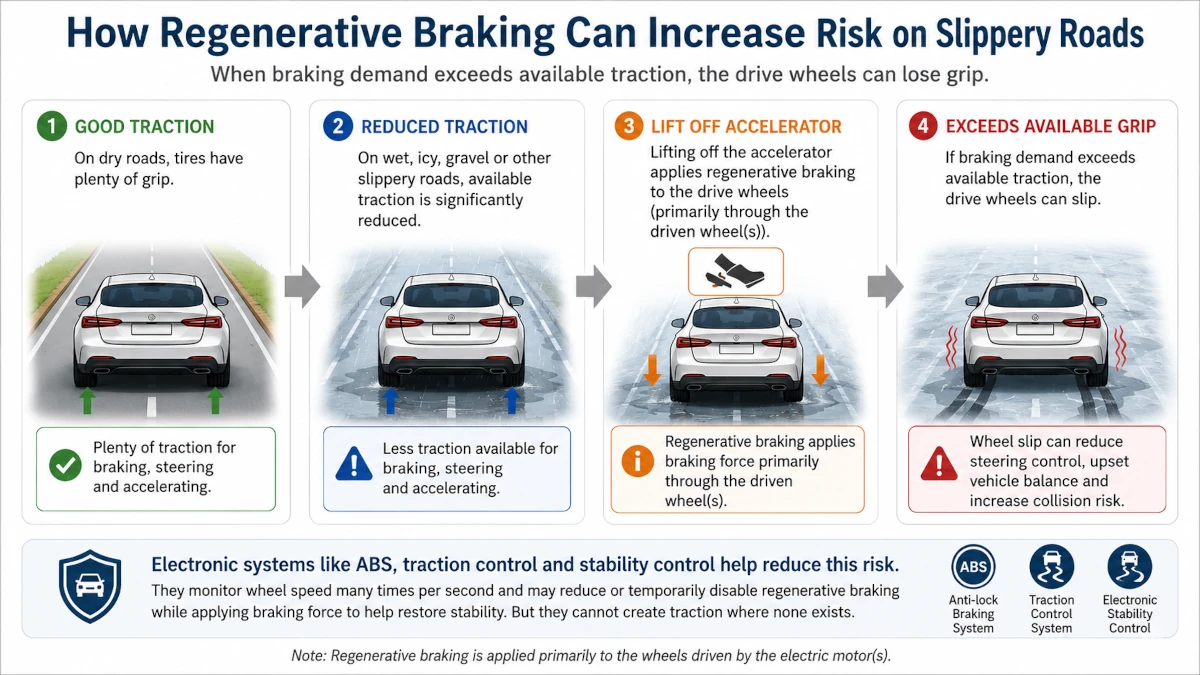
Because regenerative braking is applied through the drive wheels rather than being distributed hydraulically to all four wheels, it can affect vehicle balance differently than conventional braking. On dry pavement this difference may be barely noticeable, but on slippery roads it becomes much more important.
Every tire has a limited amount of traction available. That traction must be shared between accelerating, braking and steering. When the road surface is wet, icy, covered with loose gravel, muddy, or otherwise slippery, the available traction is significantly reduced.
Strong regenerative braking applies braking force as soon as the driver eases off the accelerator. If that braking demand exceeds the available grip at the drive wheels, those tires can begin to slip. A brief loss of traction may be enough to reduce steering control or upset the vehicle's balance, particularly while cornering or descending a hill.
Any loss of control increases the risk of a collision.
Does This Happen Only on Snow and Ice?
No.
Any surface with reduced traction can increase the likelihood of wheel slip. Examples include:
- Wet pavement, especially during the first rainfall after a dry spell.
- Standing water.
- Snow and slush.
- Ice and black ice.
- Gravel roads.
- Loose sand.
- Mud.
- Wet leaves.
- Painted road markings.
- Steel bridge decks.
The common factor is reduced tire grip, not the weather itself.
What Do Vehicle Manufacturers Recommend?
Manufacturers recognize that strong regenerative braking can affect how a vehicle behaves when traction is limited.
"Besides slowing down, other wet weather driving tips include: Turn off One-Pedal Driving mode."
The quotation above appears in the 2026 Chevrolet Bolt Owner's Manual under the heading Rainy Weather Tips.
The manual does not elaborate on the recommendation, but reducing one-pedal driving can make vehicle deceleration smoother when traction is limited. Not every manufacturer provides the same recommendation or uses the same terminology. Some vehicles allow drivers to adjust the level of regenerative braking, while others manage it automatically.
The important point is to understand how your particular vehicle responds in low-traction conditions and to follow the guidance provided in its owner's manual.
Should You Turn Off One-Pedal Driving in the Rain?
It depends on your vehicle and the conditions. If your owner's manual recommends disabling One-Pedal Driving when roads are wet or slippery, follow that advice. Even where no specific recommendation exists, reducing regenerative braking can make vehicle deceleration smoother and easier to manage when traction is limited.
Don't Electronic Safety Systems Prevent This?
Modern electric and hybrid vehicles are equipped with sophisticated electronic safety systems that monitor wheel speed many times every second.
If wheel slip is detected, the vehicle may reduce or temporarily disable regenerative braking while using traction control, ABS, or electronic stability control to help restore stability.
These systems are remarkably effective, but they have limits. They cannot create traction where the road surface provides none. If the available grip is very low, no electronic system can completely prevent a skid.
Should You Reduce Regenerative Braking?
Many manufacturers allow drivers to choose different levels of regenerative braking.
When road conditions are poor, selecting a lower regeneration setting—if your vehicle offers one—can produce smoother deceleration and reduce the likelihood of upsetting the vehicle when you lift off the accelerator.
Whether you change the setting or not, smooth driving remains the best defence. Gentle acceleration, gradual steering inputs and early, progressive braking all help keep the tires within their available grip.
The Human Side of the Story
One of the biggest adjustments for drivers new to electric vehicles is realizing that slowing down often begins by lifting off the accelerator instead of pressing the brake pedal. After a few days behind the wheel, that behaviour becomes second nature.
Unfortunately, the road doesn't know where the braking force comes from. Whether your vehicle slows because friction brakes are applied or because the electric motor is recovering energy, your tires still have only a limited amount of grip available.
That's why experienced drivers adapt to the road, not just to the vehicle. On a dry highway, strong regenerative braking may feel perfectly natural. On a rain-soaked street, a gravel road, or an icy hill, smoother control inputs and a little extra patience can make the difference between maintaining traction and losing it.
Technology can help you maintain control, but it cannot overcome the laws of physics.
Good drivers constantly adapt to changing conditions. Rain, snow, gravel and ice all reduce the safety margin available between the tires and the road. Understanding when to rely less on strong regenerative braking is simply another driving skill—much like increasing your following distance or reducing speed when traction is poor.
What Does BC Law Say?
British Columbia's Motor Vehicle Act does not contain provisions that specifically regulate regenerative braking or One-Pedal Driving.
Drivers remain responsible for maintaining control of their vehicle and operating it safely for the road, traffic, visibility, and weather conditions. Understanding how your vehicle responds when traction is reduced is simply part of driving with reasonable care. That responsibility applies regardless of whether the vehicle is powered by gasoline, diesel, electricity or a hybrid drivetrain.
Found this article useful for understanding regenerative braking and traction in slippery conditions?
Share it using the social media buttons below so other drivers can benefit from the same safety information.
- Log in to post comments