
 The transition to micromobility is reshaping B.C. roads, but riding legally requires navigating a complex patchwork of provincial regulations and municipal pilot projects. Whether you are commuting on an e-bike, exploring a pilot community on an electric kick scooter, or relying on a mobility scooter for daily independence, the rules of the road are not one-size-fits-all. This guide breaks down the essential technical requirements, mandatory movements like the "hook turn," and the specific equipment standards you need to stay safe and legal under the latest B.C. laws.
Motor-Assisted Cycles (E-Bikes)
E-bikes are generally legal on all public roads where bicycles are allowed, provided they meet B.C. Provincial Standards:
- Speed & Power: Motors must not exceed 500 watts and must stop providing power once the bike reaches 32 km/h. Light E-Bikes are limited to 25 km/h and 250 watts.
- Pedals: The bike must have fully functional pedals.
- Age: You must be at least 16 years old to ride a standard e-bike (14 for light e-bikes).
- Equipment: A bicycle helmet is mandatory. No driver’s licence, insurance, or registration is required.
- Braking Distance: A standard e-bike must stop within 9 metres and a light e-bike must be able to stop within 7.5 metres.
- Wheel Size Requirement: The wheels of a motor-assisted cycle must be 350 mm (approx. 14 inches) or more in diameter.
- Passenger Age Restriction: Riders under 16 years of age are strictly prohibited from carrying or towing any passengers on an e-bike.
Electric Kick Scooters (E-Scooters)
E-scooters are currently only legal on public roads under the Provincial Pilot Project. BC E-Scooter Pilot Project: Participating Communities List.
- Where to Ride: You can only ride on roads in communities that are taking part in the pilot project. On roads with speed limits over 50 km/h, you must stay in a designated cycle lane.
- Age: Riders must be 16 or older.
- Speed: Devices must be limited to 25 km/h.
- No Sidewalks: Riding on sidewalks is generally prohibited unless local signs specifically allow it.
- Equipment: Must have a bell/horn.
- Braking Distance: For e-scooters in the pilot program, the device must be able to come to a full stop within 7.5 metres when travelling at top speed on a dry, level surface.
- Wheel Size: An electric kick scooter must have wheels that are no more than 430 mm (approximately 17 inches) in diameter.
- Motor Cut-off: Explicitly state that the motor must disengage when the rider stops accelerating or applies the brakes.
- Miscellaneous: Passengers and towing are not allowed. The rider must stand upright and cannot be seated.
- Lighting Specs: Between sunset and sunrise, devices must have a white or amber light on the front and a red light on the rear. If the device itself lacks integrated lights, the operator is permitted to wear the lights on their person.
- Maximum Weight: The regulation specifies a maximum weight of 45 kg (including batteries).
- Collisions: The operator must share information concerning themselves and the owner.
Rules of the Road
A few operational rules from the Electric Kick Scooter Pilot Project Regulation are often missed by riders:
- Single File: E-scooters and e-bikes must be operated in single file only (no riding side-by-side).
- Handlebars: The operator must keep at least one hand on the handlebars at all times.
- Safe Distance: When passing a pedestrian, a rider must maintain a "safe distance" and, if possible, give an audible signal (bell/horn).
- Hook Turns: The rider must make a hook turn in order turn left at an intersection.
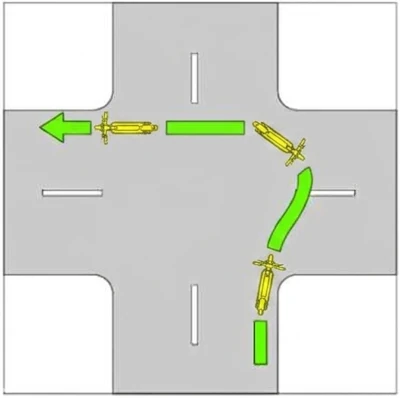
To perform a hook turn: 1) Cross the intersection straight, 2) Stop at the far right corner and re-orient your device to the left, 3) Proceed when the cross-street light turns green.
Electric Wheelchairs & Mobility Scooters
These devices are specifically designed for people with limited mobility.
- Pedestrian Status: Operators are legally considered pedestrians and must follow the same rules as people on foot.
- Where to Ride: You can use them on sidewalks and in crosswalks, but they are not allowed in bicycle lanes unless specifically signed.
- Requirements: Must have a maximum speed of 25 km/h.
- Licensing: No driver’s licence, insurance, or registration is required.
Illegal Devices & Fines
Operating any device not authorized by the MVA on public roads or sidewalks is a serious offence.
- Illegal Everywhere: Electric unicycles (One-Wheels), hoverboards, and electric skateboards are currently illegal on BC roads.
- Fines: You can be fined $598 for operating an "uninsured motor vehicle" if caught using an unauthorized device.
- Sidewalk Infractions: Riding e-scooters or e-bikes on sidewalks where prohibited carries a fine of $109.
- The "Unlock" Trap: Operating an e-bike or e-scooter in an "off-road" or "unlocked" mode that exceeds the speed cut-offs (32 km/h for e-bikes, 25 km/h for e-scooters) instantly reclassifies the device as a motor vehicle.
Municipal Bylaws
Local governments may set bylaws allowing or restricting micromobility device use on multi-use paths or trails in municipal areas like parks. Check with them to find out about the rules in your community.
Impaired Driving
Micromobility device users are covered by provincial impaired driving legislation.
Liability Insurance
- Personal Liability: ICBC does not provide insurance for these devices. If a rider causes an collision or hits a pedestrian, they are personally liable for damages.
- Homeowner's Insurance: Many standard home/tenant insurance policies exclude motorized vehicles, so riders should check their specific coverage.
Learn More
- Electric Kick Scooter Pilot Project Regulation
- Electric kick scooter rules and safety
- Electric wheelchair and mobility scooter rules and safety
- Bike and e-bike rules and safety
Share This Article
- Log in to post comments