
Parking too close to a driveway, crosswalk, fire hydrant, or other roadside feature can result in a parking ticket and, in some situations, your vehicle may also be towed. It can also create unnecessary hazards for other road users. One DriveSmartBC reader asked for a reminder of the minimum parking distances required in British Columbia after repeatedly finding vehicles blocking access to the end of his driveway. Knowing these distances before you park can help you avoid enforcement action and inconvenience.
Know the Required Parking Distances
Parking regulations are not usually marked with signs at every location. Drivers are expected to know the minimum legal distances and apply them whenever they park. If you are unsure whether you have enough room, leave more space rather than less.
Think About Visibility
Many parking restrictions exist to preserve sight lines for drivers, cyclists, and pedestrians. If your vehicle blocks the view of someone entering the roadway or approaching an intersection, you are probably parked too close.
Places Where You Cannot Stop, Stand or Park
Section 189 of the Motor Vehicle Act prohibits stopping, standing, or parking in a number of locations, including:
- on a sidewalk or boulevard
- in front of a driveway
- within an intersection unless permitted by a sign
- on a crosswalk, bridge, elevated roadway, or in a tunnel
- where prohibited by a traffic control device
- beside a vehicle already parked on the roadway (double parking)
- on a highway for the purpose of advertising or selling
- where the vehicle would obstruct a traffic sign
Minimum Parking Distances
Within 5 Metres
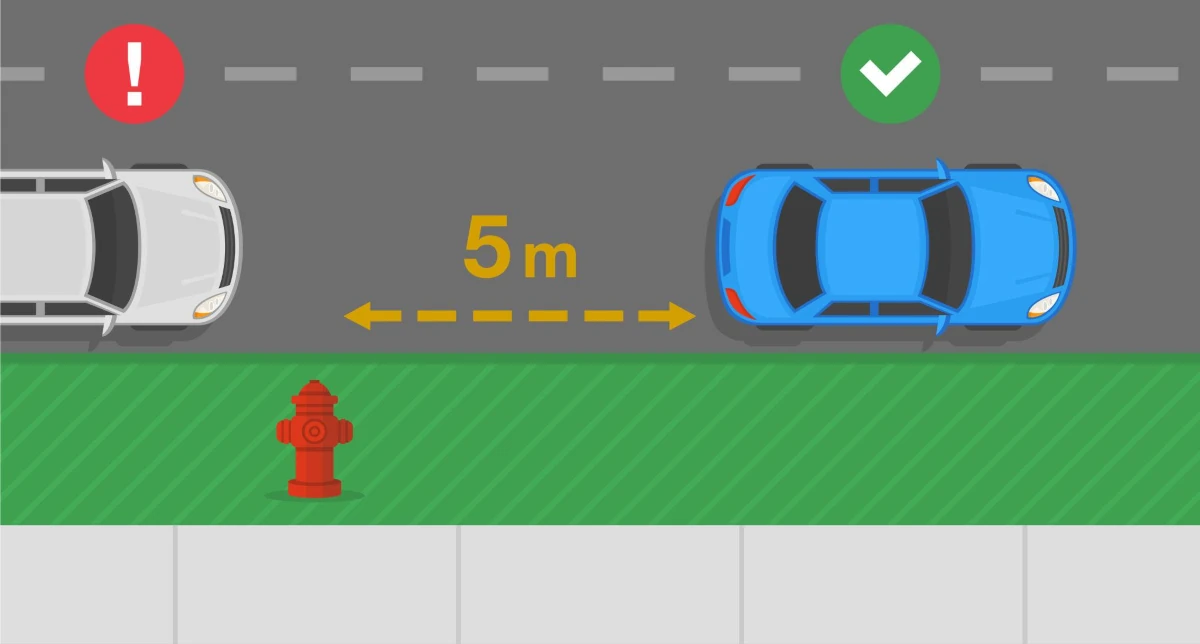
You must not stop, stand, or park within 5 metres of a fire hydrant.
Within 6 Metres
You must not stop, stand, or park within 6 metres of:
- the approach side of a crosswalk
- the approach to a flashing beacon, stop sign, or traffic control signal
- the entrance or exit of a hotel, theatre, public meeting place, dance hall, or fire hall
- a playground in a rural area
Within 15 Metres
You must not stop, stand, or park within 15 metres of a railway crossing.
What Do Stop, Stand and Park Mean?
- Stop means the wheels of your vehicle have ceased turning.
- Stand means a stopped vehicle is being loaded, unloaded, or passengers are entering or leaving.
- Park applies to all other situations where a vehicle is left stopped.
Provincial Rules and Local Bylaws
These minimum parking requirements come from British Columbia's Motor Vehicle Act. Municipal governments may establish additional parking restrictions through local bylaws, so drivers should always obey posted signs even where provincial minimum distances would otherwise allow parking.
If Your Vehicle Breaks Down
A mechanical breakdown may make it impossible to avoid stopping in a prohibited location. If this happens, move the vehicle as soon as it is safe to do so. Advising nearby property owners or authorities of the situation may also help avoid unnecessary misunderstandings while assistance is arranged.
Learn More
Many parking restrictions exist to preserve sight lines for drivers, cyclists, and pedestrians. If your vehicle blocks the view of someone entering the roadway or approaching an intersection, you are probably parked too close, even if no sign prohibits parking
- Log in to post comments
Comments
I'm glad you have addressed this issue.
There are several landscaping companies in Qualicum Beach that park their trucks on the roadway blocking the lane almost completely. One in particular does this just after (or before depending on travel) a sharp corner on Hoy Lake road.
This morning i had to pull out into the left side of the road just before the corner to get by this truck and trailer. I'm thinking there must be a law against parking right on the roadway and in particular in such a dangerous location.
THe other issue that comes to mind is the sidewalk which in our area is a painted white line. Along the old highway by the beach in Qualicum, traffic will block this sidewalk completely forcing cyclists (like me) to be on the road between the parked vehicles and traffic and always very much on the lookout for someone opening their doors.
Last but not least, due to the neighbourhood and area we have an elderly population and for some it is difficult for them to walk to the mailbox. They park on the roadway in front of the mailbox, again blocking traffic and not putting on a signal or hazard light. I don't mind waiting for a few moments but that is not always the case and waiting on the roadway always leaves one open to someone not paying attention to run into the rear end.
- Log in to post comments
When you quote the law on locations at which it is illegal to park, you referred to the Motor Vehicle Act. Don't forget that many municipalities have further laws restricting parking.
If the violation results in your car being towed away, it's little comfort that it was towed under the authority of a city by-law verses the Motor Vehicle Act.
For example Vancouver has a by-law, making it illegal to park on a street in front of property used for residential or commercial purposes between 8:00 AM and 6:00 PM for more than three hours, except for the resident or employee of the resident. (by complaint only)
The Street and Traffic By-Law (By-Law 2849) is quite extensive and is the "tool" mostly used by authorities to enforce parking violations inside the city of Vancouver (the fines go straight to the city :) )
Contained in that legislation in addition to parking restrictions are many laws restricting vehicle movement in Vancouver.
U-Turns are restricted with additional prohibited maneuvers to those contained in the MVA. Between the By-Law and the MVA, the only place you can execute a U-Turn in Vancouver is at a completely uncontrolled intersection not obstructed by a hill, in a residential area, without backing or affecting other traffic.
On the other side, "double parking", covered very nicely in the MVA, as you've outlined, "parked on the road side of a parked or stopped vehicle", is not covered in Vancouver's By-Law, the only offence being "parked more than 30 cm from the curb".
Some cities need work on their by-laws. The City of Kelowna does not have a by-law prohibiting "Jay Walking". (Jay walking is crossing the roadway, not at an intersection within one block of a traffic control device) It removes the loop hole of, instead of waiting at the intersection for the red traffic light to walk 10 feet from the intersection and cross there.
You can in Kelowna !
Did you know...
- It's illegal to park a bus in a bus zone.
- It's obviously illegal for someone to park in front of your driveway. It's also illegal for you to do so.
- Log in to post comments
A few years ago, Minister Todd Stone added 189 (3) to the BC MVA. He then supposedly advised the various Municalities in BC that they might consider revisions to their bylaws. Few, if any, did.
The reluctance by such communities as White Rock, I could understand because "Soak the parker" is their major source of income. I'm surprised that they don't charge for stopping more than a few seconds at a traffic signal! A reason, incidentally, why I rarely patronise White Rock businesses.
But to my knowledge, even Delta which has steadfastly refused to permit "Pay Parking", have not enacted a conforming bylaw.
I discussed this with a prominent "motorcycle" Lawyer and asked his opinion about fighting a parking citation on the basis of it being "legal" by the BC MVA. His response was that it may be an interesting case but the legal fees would far outweigh the fine amount.
- Log in to post comments
A few years back, I did a project for the City of Richmond, conducting driver evaluations on their various employees operating their municipal vehicles. Works truck drivers, bylaw officers, like that.
Being as I have been based in North Vancouver for some many years, I found it interesting that one of their (Richmond) newer bylaw guys (who was actually a Surrey resident) told me that he had worked for a short time in the same role for the City of North Vancouver - and that all of their concern seemed to be about generating dollars from parking offences (over the 1 or 2 hour limit, parking 'backwards' in an angle parking spot, that kind of stuff) but not about safety issues (pedestrian/vehicle crosswalk offences, parking too close to an alley way, etc). Essentially, the low-confrontation, high dollar fine type offences.
Whereas, his new employers (Richmond, I forget if its a municipality or district) were far more concerned with balanced enforcement that helped their traffic areas function more effectively.
As with all policing, there is discretion to be used on the part of the people who run these things, and how they apportion their resources.
- Log in to post comments
Perhaps a point of clarification please..
The question pertains to a number of the MVA subsections :
189 (1) Except when necessary to avoid conflict with traffic or to comply with the law or the directions of a peace officer or traffic control device, a person must not stop, stand or park a vehicle as follows:
(b) in front of a public or private driveway;
(h) within 6 m either side of the entrance to or exit from a hotel, theatre, public meeting place, dance hall, fire hall or playground in rural area;
And also the Vancouver Street and Traffic By-Law (By-Law 2849):
17.2 An owner, registered owner, lessee or operator of a vehicle must not cause, allow or permit that vehicle to stop:
d) in front of or within 1.5 metres of the nearest side of a private road, boulevard crossing or sidewalk crossing;
Many driveway sidewalk crossings, but interestingly, not lanes, have flared or trapezoidal sections where they cross the sidewalk. There seems to be no absolute rule on the angle or width of flare. The configuration may vary based on terrain or width. Some may also extend into rounded curbs. Lane intersections may have varying configurations, from a straight cut to trapezoids, to rounded curbs of varying radii. Even on a "straight cut" crossing, sidewalks will taper to the intersection point. It seems most of these variations or architectural or aesthetic in configuration, not by regulation.
It gets even more convoluted where there are bump-outs at intersections and other points, for example with bike path crossings.
Q: From what point is the measurement considered to be taken to " the nearest side "? I know the pragmatic person will say, take the most generous (widest) consideration, but is that the law? Is it OK to park immediately behind where the flare intersects the road or must you be behind the imaginary line that extends to the travel lane? If the trapezoid were there for line of sight, then that would be the case, but that is not written in the laws.
I recall a similar "where can I stop" dispute where the STOP sign was not placed consistent with the STOP line, but can't find it in the search results.
Personally, I believe there needs to be better communication between those who formalize the laws and by-laws and those who formalize the engineerings design standards to eliminate the ambiguities, but the legacy infrastructure remains as-is and we must deal with it.
- Log in to post comments
I totally understand all of these comments. I have the same problem where I live, with so many Suites in homes these days more and more cars end up on the road. So much so that the road I live on, where it T's into the main junction it is very hard to see oncoming cars as vehicles are parked on the main road way boulevard. It's very hard to look both directions and see if it's safe to pull out.
I will reach out to the local Municipality and see if there is anything that can be done about such things!!!
- Log in to post comments
Although my cross street is not a T I have the same problem. The main road I am trying to cross is a bit higher than the road I am driving on. There are SUV's and monster pickup trucks parked on that main road and one has to creep out almost to the middle of the road to check for traffic. If I ever have an accident it will be at that intersection.
- Log in to post comments
In the city of Richmond, I've searched by-laws but cannot find rules regarding the space you should give the vehicle in front of you when parking in a residential area. I have several neighbours who feel that 6 inches is more than enough room between your vehicle and theirs when they park. When you have two neighbours that feel this way and they park this way and box you in, it's maddening.
No employer cares your late when this happens.
No one seems to want to assist so you can get your vehicle so you can move. Bylaws doesn't help and RCMP are deferring to the bylaw officers. One neighbour that does this works as an officer for a different city.
What have others done to fix this?
- Log in to post comments
Neither the Motor Vehicle Act nor the City of Richmond's parking bylaw regulate the distance between parked vehicles. It appears that common sense doesn't apply in your neighbourhood either.
It's a good question that I have never been called on to solve during my policing career. Hopefully someone here will have a practical solution to share. If there aren't painted spaces, perhaps leave more space in front of your vehicle, but not so much that another car can park in it? That might be enough to exit if the person behind is ignorant.
- Log in to post comments
Having driven a variety of buses and other large vehicles for years, I recommend to my students that they look for the space that's closest, legally, to the nearest driveway, fire hydrant, intersection, crosswalk, or sign that prohibits anyone else from boxing you in.
It's safer and easier. Oftentimes, it also makes reversing to get out of the box unnecessary, which is ideal. And if a neighbour still parks illegally, use your cell phone to take a picture of his vehicle and license plate in place, then phone the local bylaws people to report it. Best to do this before you're in a hurry to leave, although once you're gone and the bylaw officer shows up, the miscreant's vehicle will hopefully still be where they left it.
This time ... they won't do it again.
- Log in to post comments
What does someone do if a car is parked on the street blocking your driveway that you can't exit? When & how can I have this vehicle towed? I've tried to talk with this person & it doesn't matter to them. They could not care less.
- Log in to post comments
It depends on the municipality. Some specify a setback and some just say the edge of the driveway.
In Nanaimo's case:
4. Parking Regulations:
Except when necessary to avoid conflicts with traffic, or to comply with the directions of a Peace Officer or traffic control device or traffic patrol and except while operating a government vehicle or vehicles of a public utility corporation while engaged in their duties, or except an emergency vehicle which is in actual use for official duties, no person shall stop, stand or park a vehicle:
DRIVEWAY (2) In front or within 2m of a public or private driveway.
So the front or rear of the vehicle must be at least 2m from the edge of your driveway, otherwise it is in contravention.
Bylaw enforcement would be the ones to call if the neighbour refuses to be considerate.
- Log in to post comments
Parked Blocking the Lane