
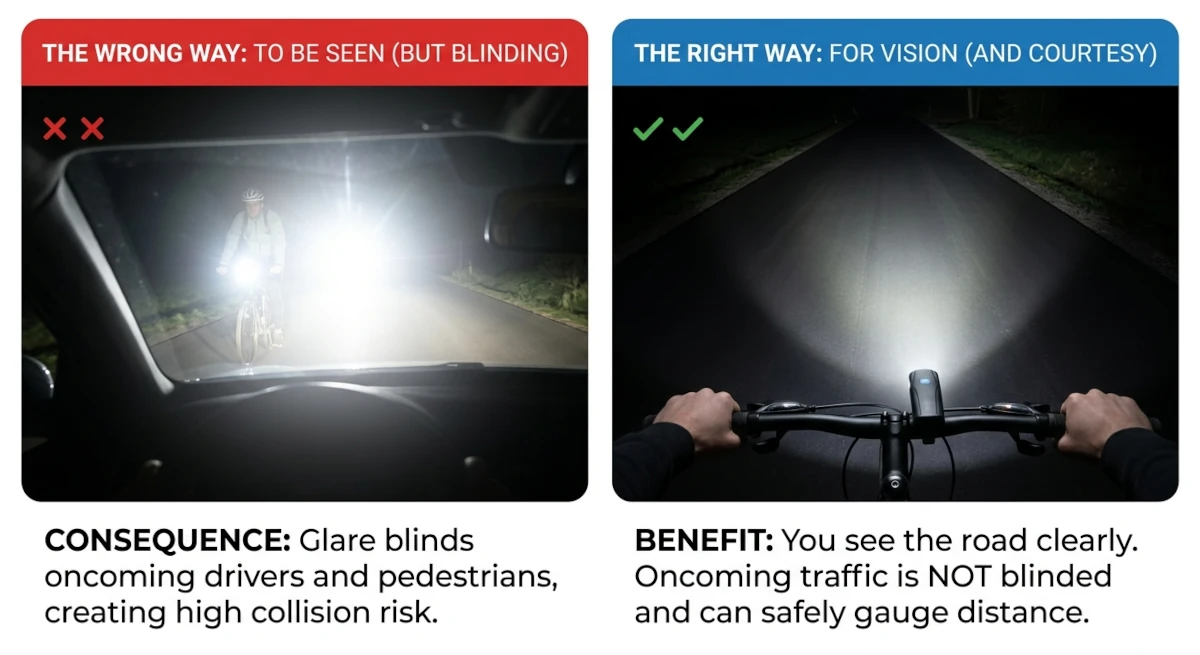
 Question: I grew up in the Netherlands where riding a bike everywhere is normal. I moved to Vancouver and have noticed that there is not much safety common sense with cyclists. My main concern is their "safety" LED lights! They shine them upwards, blinding pedestrians and drivers along the way.
In the Netherlands, you are taught while growing up to slant your lighting downwards to prevent blinding others in traffic. The safety saying is "lighting is to be seen, not to use for vision". Is there a local department I can contact to bring attention to this major safety issue?
British Columbia handles bicycle illumination through equipment basics rather than exact beam angles. Here is what the law dictates, how local cultures compare, and who you can contact to advocate for legislative change.
What does the BC Motor Vehicle Act say about bicycle lights?
The provincial rules are strictly focused on visibility distances. Under Section 183 (6) of the BC Motor Vehicle Act, a cycle operated on a highway between half an hour after sunset and half an hour before sunrise must have:
- A front light: A mounted lamp displaying a white light visible at least 150 metres in the direction the cycle is pointed.
- A rear reflector: A standard red reflector.
- A rear light: A mounted lamp displaying a visible red light.
Section 183 (7) also specifies that a cycle may be equipped with a flashing red light on the rear. The law does not regulate maximum LED brightness levels or beam direction.
How does the "To Be Seen" philosophy compare to local habits?
Your European training highlights a shift in modern cycling technology. In the past, bike lights were dim and served strictly to make the cyclist visible ("to be seen"). Modern LED safety lights can be incredibly bright and are often used by riders to illuminate the entire dark road ahead ("for vision").
When these high-powered LEDs are pointed straight ahead or upward, they act like high-beam car headlights. Slanting the headlight downward safely illuminates the pavement without blinding oncoming traffic.
Which departments handle these traffic regulations?
Two primary provincial entities share control over road safety guidelines, though their submission paths are different:
- RoadSafetyBC: This is the government branch responsible for road safety policies and the Motor Vehicle Act. You can email your legislative feedback and traffic concerns directly to them at RoadSafetyBC@gov.bc.ca.
- Your Local MLA: For policy updates, booking an appointment or writing directly to your local MLA's constituency office remains highly effective, as generic web forms often generate automated responses.
Are there any local cycling groups pushing for better laws?
Yes, you can connect directly with the advocacy teams at HUB Cycling and the BC Cycling Coalition They are a prominent local organization actively working with the provincial government to overhaul BC's cycling regulations and modernize the BC Motor Vehicle Act.
Help Make BC Roads Safer for Everyone!
Have you been blinded by high-powered LED bike lights on your commute, or do you have tips for proper light alignment? Pass this article along to your local cycling groups and driving communities to spread the word about safer road sharing.
- Log in to post comments