
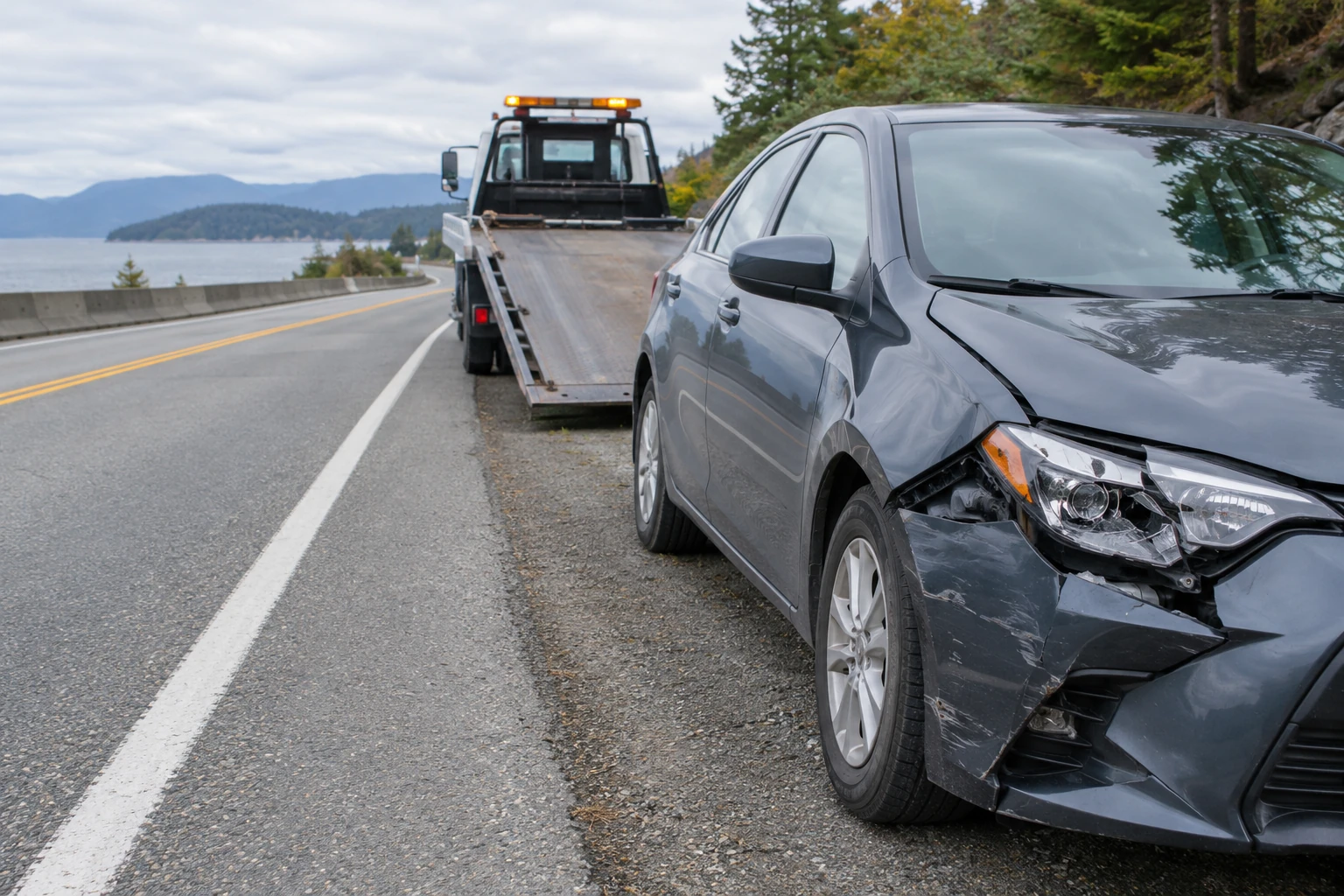
You've been involved in a collision and your vehicle is damaged. Perhaps a headlight is pointing in the wrong direction, a signal light is missing, or a damaged bumper has been removed to provide clearance for a tire. Your insurance assessment and body shop appointment are still pending. Can you keep driving until the repairs are made?
What Does the Law Say?
Section 219 of the Motor Vehicle Act generally prohibits driving or operating a motor vehicle on a highway unless it complies with the Act and its regulations. The question is whether the collision has left your vehicle improperly equipped.
Section 2.02 of the Motor Vehicle Act Regulations deals specifically with this situation. It applies when a vehicle on a highway ceases to be properly equipped under the Act or regulations, whether as a result of a collision or otherwise.
The regulation requires the vehicle to be removed from the highway forthwith or taken on the highway to a garage or repair shop by a tow car or another vehicle capable of safely carrying out the movement. It also permits a vehicle that is not properly equipped to be moved on a highway to a garage or repair shop by such a vehicle.
In either case, the person in charge must take reasonable precautions for the safety of traffic. When those conditions are met, the regulations are suspended with respect to the defective equipment during the permitted movement.
Does All Collision Damage Make a Vehicle Illegal to Drive?
No. The important distinction is between damage that affects appearance and damage that leaves the vehicle improperly equipped or unsafe to operate.
A dented door or scratched fender does not necessarily mean that a vehicle no longer meets the equipment requirements. On the other hand, damage to required lights, steering, brakes or other essential components can prevent lawful or safe operation.
The standards of safety and repair in Division 7.09 of the Motor Vehicle Act Regulations provide further guidance. The schedule to Division 7 addresses matters such as sharp or ragged edges that could injure people or damage objects.
Consider the entire condition of the vehicle rather than relying on one visible sign of damage. A fender that has been removed may be a cosmetic issue in one case, but exposed sharp edges, damaged lighting or interference with a wheel can create additional problems in another.
Can You Tow the Vehicle Yourself?
The regulation refers to a tow car or another vehicle capable of safely carrying out the movement. It does not specifically name every type of towing device or arrangement.
Whether a tow bar, dolly or other arrangement meets the regulation's requirements depends on the circumstances, including how the vehicle is supported, whether its damaged components create a hazard and whether the movement can be carried out safely.
Do not assume that attaching a rope or chain to another vehicle makes it lawful or safe to tow a collision-damaged car. If the vehicle cannot be moved safely, arrange for a professional towing service. A flatbed tow truck can carry the damaged vehicle rather than requiring it to travel on its own wheels.
What Should You Do After a Collision?
Before deciding to drive a damaged vehicle, consider whether its required equipment still works, whether any damage could affect its handling or braking, and whether loose parts or sharp edges could endanger other road users.
If the vehicle no longer meets the required equipment standards, do not simply continue driving while waiting for an insurance assessment or repair appointment. Arrange for it to be moved in accordance with MVAR 2.02, taking reasonable precautions for traffic safety.
If you are uncertain whether the damage makes the vehicle improperly equipped or whether it can be moved safely, the prudent choice is to have it assessed and transported by a qualified professional.
Learn More
- Log in to post comments