
What should you do when a deer suddenly appears in front of your vehicle? Most drivers would instinctively try to avoid it. But what happens if your attempt to avoid the deer causes a crash?
A 2023 British Columbia Supreme Court decision, Dehal v. Dhaliwal, provides an interesting answer. The driver did not hit the deer, but he lost control of his car while trying to avoid it. The court found that the driver had failed to meet the required standard of care.
The Deer Avoidance Crash
The crash happened on Bailey Road south of Vernon at about 2:00 to 2:30 p.m. on June 9, 2018. Gurmel Singh Dhaliwal was driving a 2003 Acura EL southbound toward Kelowna. His wife was seated behind him and her brother was in the front passenger seat.
It had rained earlier in the day and the road was still wet. Bailey Road had one lane in each direction and the area was described as curvy, with a slight downhill grade and sloping rock embankments on both sides.
Mr. Dhaliwal was familiar with the road. He had driven the route almost daily for several years and knew that wildlife, particularly deer, could be found in the area.
He testified that he was travelling at approximately 50 to 60 km/h in a 60 km/h zone. As he came around a curve, he suddenly saw a deer very close to the left side of his vehicle. He steered sharply to the right to avoid it, lost control and left the road.
The Acura travelled approximately 60 metres through the ditch before coming to rest. There was no evidence that the vehicle actually struck the deer. The court concluded that it was likely the deer escaped without being hit.
Was the Driver Negligent?
The two passengers sued Mr. Dhaliwal, alleging that he had been driving too fast for the conditions, was not paying sufficient attention and should have seen the deer sooner.
Mr. Dhaliwal argued that the crash occurred without negligence on his part. After all, a deer had suddenly appeared in his path and he had taken evasive action to avoid it.
The court found that the circumstances did not excuse the driver's failure to meet the required standard of care.
The Driver's Duty of Care
A driver has a duty to take reasonable care to avoid exposing passengers and other road users to an unreasonable risk of harm. The standard is that of an ordinary, reasonable and prudent driver in the same circumstances.
That duty applies during an emergency as well as during ordinary driving. However, it does not require a driver to anticipate every possible road hazard. Drivers are expected to be alert for hazards that are reasonably foreseeable.
The court noted that this duty is reflected in section 144 of the Motor Vehicle Act, which prohibits driving without due care and attention and driving at a speed that is excessive relative to the road, traffic, visibility or weather conditions.
Wildlife Is a Foreseeable Hazard
There is no rule that makes a driver automatically responsible whenever a collision with wildlife occurs. Wildlife collision cases depend on their particular facts.
In this case, however, the judge found that the presence of deer on or near Bailey Road was a reasonably foreseeable hazard. Mr. Dhaliwal knew the area well, had previously seen deer and other animals on the road and was aware of wildlife-related signs in the vicinity.
That knowledge was important. The court concluded that he should have been particularly alert to the possibility of wildlife while driving through the area.
Should He Have Seen the Deer Sooner?
This was the key issue in the decision.
The evidence showed that the driver's view ahead was not completely blocked. Although the driver had just come around a curve, the court found that he could see at least 60 metres ahead and likely farther. There were no trees or bushes obstructing his view, and the weather was clear and bright.
The accident reconstruction evidence was particularly important. At 60 km/h, after allowing for a median perception-response time of about 1.1 seconds, the driver would have had approximately 41.7 metres in which to brake. The expert concluded that with moderate braking the Acura should have been able to stop within that distance. With emergency braking, the stopping distance could have been approximately 26 to 28 metres.
The judge therefore concluded that the driver simply did not see the deer when it was there to be seen. In the circumstances, he should have been paying closer attention to the possibility of wildlife.
Speed Was Also a Factor
The posted speed limit was 60 km/h, but the court found that Mr. Dhaliwal was probably travelling somewhat faster than that. The accident reconstruction expert estimated a speed of approximately 62 to 79 km/h, and the judge accepted that the vehicle was probably moderately exceeding the speed limit.
More importantly, the court did not consider the posted speed limit to be the only consideration. Given the known wildlife hazard in the area, the judge concluded that Mr. Dhaliwal should have been travelling at a speed somewhat lower than 60 km/h.
A lower speed would have given him more time and distance to see the deer, react and bring the vehicle to a stop.
Braking Instead of Swerving
The court's conclusion was not that drivers should never swerve to avoid a deer. Rather, in these particular circumstances, the judge found that Mr. Dhaliwal should have seen the deer early enough to brake instead of making the sharp steering manoeuvre that caused him to lose control.
The judge summarized the findings this way: had Mr. Dhaliwal been paying careful attention, he should have been able to see the deer in time to avoid it by braking. He was also travelling too fast for the conditions, which included the known hazard of wildlife.
Losing Control Does Not Automatically Mean Negligence
There is an important qualification to this decision. The court did not say that losing control of a vehicle proves that the driver was negligent.
Canadian law does not create an automatic presumption of negligence simply because a vehicle leaves the road or the driver loses control. The circumstances surrounding the loss of control must be examined, and the person alleging negligence still has to prove it on the balance of probabilities.
In Dehal v. Dhaliwal, the plaintiffs were able to establish that the driver's conduct fell below the required standard because of the combination of the evidence about his attention, his speed, the known wildlife hazard and the available sight distance.
What Does This Mean for BC Drivers?
A deer appearing suddenly on the road is an emergency, but it does not necessarily relieve a driver of the duty to drive reasonably for the circumstances.
If you are travelling through an area where deer or other wildlife are common, the court's decision is a reminder to reduce speed when appropriate and actively watch for animals near the road. A posted speed limit is a maximum permitted speed under ideal circumstances, not a guarantee that travelling at that speed will always be reasonable.
The decision also illustrates why a sudden evasive manoeuvre can create its own danger. If a driver has enough time and distance to brake, braking may be safer than making a sharp steering input that can cause the vehicle to leave the roadway.
At the same time, this case should not be read as saying that a driver will be liable every time they crash while trying to avoid wildlife. As the court emphasized, wildlife collision cases turn on the particular facts of each incident.
What Happened to the Deer?
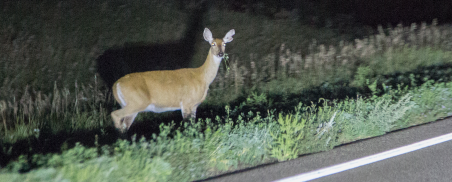
As far as the evidence in this case shows, the deer was not injured. The Acura travelled about 60 metres through the ditch before coming to rest.
The Court's Decision
The Supreme Court of British Columbia concluded that Mr. Dhaliwal owed his passengers a duty of care and had breached the applicable standard of care. The court made a declaration to that effect. The trial at this stage dealt with liability only; the assessment of any damages was to be dealt with separately.
The Bottom Line
Avoiding a deer does not automatically make a driver liable for a crash, but neither does the sudden appearance of wildlife automatically excuse the driver from the duty to drive with reasonable care.
In Dehal v. Dhaliwal, the court found that the driver had an opportunity to see the deer, was travelling too fast for the circumstances and should have been able to brake rather than swerve sharply. For BC drivers, the practical lesson is simple: when wildlife is a known hazard, slow down, stay alert and be prepared for an animal to appear on the road.
- Log in to post comments