
Is hitchhiking illegal in British Columbia? The short answer is not everywhere. However, the law is more complicated than simply saying that hitchhiking is either legal or illegal.
British Columbia's Motor Vehicle Act prohibits a person from being on a roadway to solicit a ride from someone in a vehicle. Other laws prohibit pedestrians from using certain highways, and municipal bylaws may impose additional restrictions.
You can't hitchhike from the roadway
Section 182(3) of the Motor Vehicle Act says:
A person must not be on a roadway to solicit a ride, employment or business from an occupant of a vehicle.
Section 182(4) makes contravention of this section an offence, except where the person is soliciting a ride because of an emergency.
So, if you are standing on the portion of the highway that is used for vehicular traffic and sticking out your thumb to ask motorists for a ride, you are breaking the law.
What about the shoulder?
This is where the answer becomes less straightforward.
The Motor Vehicle Act defines roadway as the portion of a highway that is improved, designed or ordinarily used for vehicular traffic. The definition specifically says that the roadway does not include the shoulder.
Section 182(3) prohibits soliciting a ride while on the roadway. It does not specifically prohibit soliciting a ride while standing on the shoulder.
That does not mean that every shoulder is automatically a legal place to hitchhike. Other provisions of the Motor Vehicle Act, the Motor Vehicle Act Regulations, traffic signs and municipal bylaws can still apply.
If you walk along the highway, face traffic
There is another rule that is particularly important to hitchhikers.
When there is no sidewalk, section 182(2) of the Motor Vehicle Act requires a pedestrian using the highway to use only the extreme left side of the roadway or the shoulder, facing traffic approaching from the opposite direction.
In other words, if you are walking along the highway, you should be on the left side facing approaching traffic. Walking along the right side with traffic approaching from behind is not permitted.
This matters to hitchhikers because it is common to walk along the highway between opportunities to obtain a ride. Being on the shoulder does not give a pedestrian permission to ignore the other rules that apply to pedestrians.
Freeways are different
Pedestrians are generally prohibited from using highways listed in Schedule 1 of the Motor Vehicle Act Regulations.
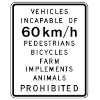
Section 19.07 of the regulations prohibits pedestrians from using a Schedule 1 highway unless they are attending to a disabled vehicle. There is an exception where the Minister has caused signs to be erected permitting pedestrians to use an adjacent footpath or shoulder.
As a result, you cannot simply move onto the shoulder of a freeway and assume that hitchhiking is permitted because the shoulder is not part of the roadway.
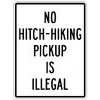
If you are unsure whether a particular highway is subject to these restrictions, look for signs and check the applicable highway regulations before walking or hitchhiking there.
Can a driver stop to pick up a hitchhiker?
There is no general provincial offence that simply says a driver may never pick up a hitchhiker. The problem is where and how the driver stops.
Section 187 of the Motor Vehicle Act restricts stopping and parking on highways. A driver must not stop on a roadway when the vehicle cannot be stopped safely, and must not park in a manner that obstructs the free passage of traffic.
There may also be traffic-control signs that prohibit stopping or specifically prohibit picking up hitchhikers. Drivers must obey applicable traffic-control devices. Section 125 of the Motor Vehicle Act requires drivers and pedestrians to obey the instructions of applicable traffic-control devices.
So even if a person is standing in a place where soliciting a ride is not prohibited, that does not give a driver permission to stop wherever they choose to pick that person up.
Municipal bylaws can add restrictions
Provincial law is not the whole story.
Municipalities in British Columbia can have their own bylaws regulating traffic, stopping, standing, parking and the use of highways. Some municipalities have specific provisions dealing with soliciting rides.
This means that something that is not prohibited by the provincial Motor Vehicle Act may still be prohibited by a municipal bylaw.
If you are hitchhiking within a municipality, check the local traffic or highway bylaw as well as the provincial rules. Rules can also vary according to the particular road and the signs posted there.
What about the Safe Streets Act?
The Safe Streets Act also regulates certain types of solicitation involving people in vehicles. It is important not to confuse those provisions with the Motor Vehicle Act rule that specifically prohibits a person from being on a roadway to solicit a ride.
The Safe Streets Act deals with specified forms of solicitation in particular circumstances. It does not change the basic roadway/shoulder distinction in section 182(3) of the Motor Vehicle Act.
So, is hitchhiking legal in B.C.?
Hitchhiking is not generally prohibited everywhere in British Columbia, but there are important restrictions on where and how it can be done.
You cannot stand on a roadway and solicit a ride. The statutory definition of roadway excludes the shoulder, but other pedestrian rules, highway restrictions, traffic-control signs and municipal bylaws may still prohibit or restrict hitchhiking at a particular location.
Freeways and other Schedule 1 highways present an additional restriction because pedestrians are generally prohibited from using them.
For drivers, picking up a hitchhiker is not automatically illegal, but the driver must still comply with all stopping, parking and traffic-control requirements. A convenient place to pick someone up is not necessarily a legal or safe place to stop.
In short, don't rely on the simple statement that “hitchhiking is legal in B.C. if you stand on the shoulder.” The location and circumstances matter.
Is hitchhiking safe?
Legality and safety are two different questions.
A hitchhiker is vulnerable to traffic and to the people who stop to offer a ride. A driver who stops to pick up a stranger faces the opposite problem: there is no practical way to know in advance who is getting into the vehicle.
If you choose to hitchhike, choose a location where you can remain completely clear of moving traffic and where a driver can stop without creating a hazard. Never step into the roadway to attract a driver's attention or force a vehicle to stop.
Drivers should never stop in a location where doing so creates a hazard for themselves or other road users. If there is no safe and legal place to pull completely clear of traffic, keep driving.
What the law doesn't tell us
There is surprisingly little case law about hitchhiking in British Columbia. Courthouse Libraries BC notes that there are no reported cases citing section 182(3) of the Motor Vehicle Act, and the term hitchhiking has not been judicially defined in British Columbia.
That makes it particularly important to distinguish between what the legislation actually says and assumptions about what must be legal simply because a person is standing on a shoulder.
The safest approach is to follow the pedestrian rules, obey posted signs, stay completely out of moving traffic and check local bylaws where applicable.
Learn More
- Log in to post comments