
What responsibility does a driver have when stopping a vehicle creates a hazard for other road users? A 2009 decision of the Supreme Court of British Columbia illustrates that complying with a specific traffic rule is not necessarily the end of the matter.
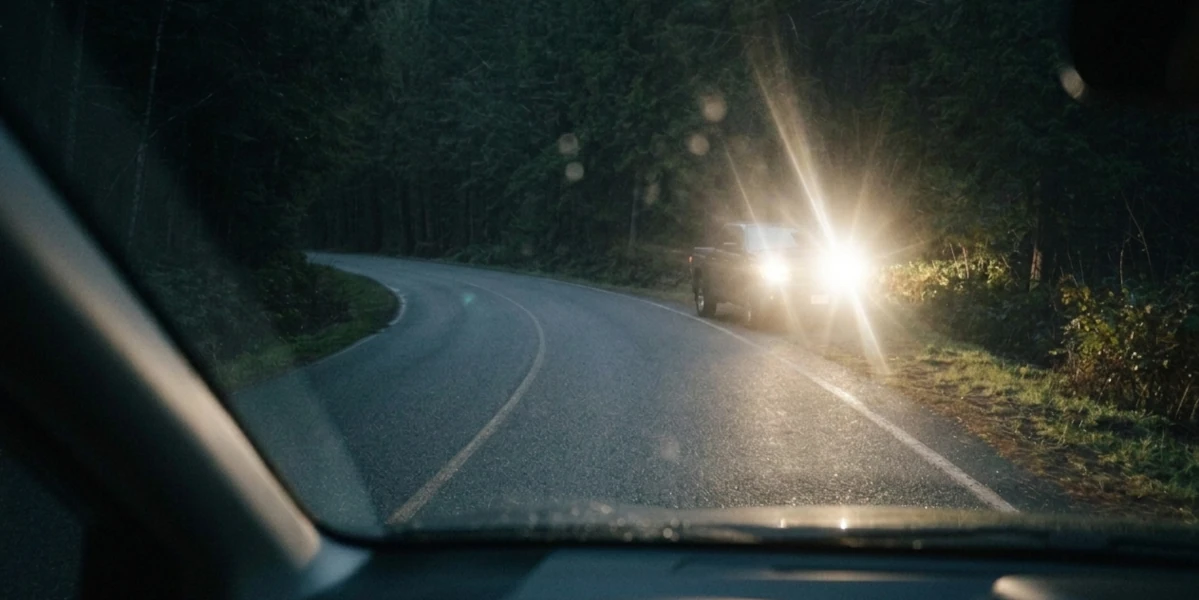
In Scott v. Erickson, 2009 BCSC 1298, the court considered what happened when a driver stopped his vehicle beside a dark, winding highway with its headlights on high beam, shining toward approaching traffic.
The accident
On October 4, 2004, Carel Scott was driving south on Highway 31 near Balfour, British Columbia. It was about 10:30 p.m. and the highway was dark. The applicable speed limit was 80 km/h, although Scott said she was travelling at about 60 km/h.
At about the same time, Paul Erickson was driving north toward his home. He crossed the highway and stopped at a pullout beside the southbound lane so that he and his wife could retrieve their mail from community mailboxes. His SUV remained facing north, toward approaching southbound traffic, and its headlights were on. Erickson could not specifically remember whether they were on high beam, but accepted that they probably were.
As Scott came around a curve, she saw the headlights. Because of the position of the vehicle and the curve in the road, the headlights appeared to her to be those of an approaching vehicle in the northbound lane.
Scott moved to her right to keep clear of what she believed was oncoming traffic. In doing so, she unknowingly drove onto and beyond the shoulder. She realized that the vehicle was stopped as she got closer, but still believed it was on the road. Her pickup then went down a steep embankment.
The court accepted that the headlights initially appeared to be in the oncoming lane and that their high beams likely impaired Scott's ability to see and assess the road ahead.
Was Erickson illegally parked?
Scott argued that Erickson had violated section 190 of the Motor Vehicle Act, which generally requires a driver who stops, stands or parks on a roadway to do so on the right side and with the right-hand wheels parallel to that side.
The court did not agree that section 190 applied. The location where Erickson had stopped was a pullout used for accessing the mailboxes. The judge concluded that, for the purposes of section 190, it was not part of the roadway as that term is defined in the Motor Vehicle Act.
That did not, however, end the case - or the issue with the headlights.
There was also a specific rule about the use of high beams. Section 4.06(5) of the Motor Vehicle Act Regulations prohibited a driver from illuminating the upper beam of a headlamp when another motor vehicle was within 150 metres, subject to an exception for a vehicle that had been overtaken and passed. Scott relied in part on this provision.
The regulations also specifically addressed a vehicle that was parked or standing on a highway. Section 4.06(6) also provided that, when a motor vehicle was parked or standing on a highway, the upper beam of its headlamps must not be illuminated.
The court noted that Erickson's use of high beam aggravated the hazard created by where he had stopped. The high beams interfered further with Scott's ability to see and assess the situation.
A driver has a duty to take reasonable care
The court noted that, apart from specific statutory requirements, every driver has a common-law duty to take reasonable care for the safety of other users of the highway. What amounts to reasonable care depends on the circumstances.
In this case, Erickson knew or should have known that his vehicle was stopped close enough to the travelled portion of the highway that its headlights would be visible to approaching drivers and could be mistaken for an approaching vehicle. He also knew or should have known that there were no streetlights or other sources of illumination to help those drivers determine where his vehicle was actually located.
The judge found that it was reasonably foreseeable that a driver approaching the curve would see Erickson's headlights, believe they belonged to an oncoming vehicle in the northbound lane and move to the right to avoid it.
The use of high beam made the situation worse. The court found that the high beams further interfered with Scott's ability to see and assess what was happening.
What should Erickson have done?
The court concluded that Erickson should have recognized the hazard he was creating and turned off his headlights. If he needed light to retrieve his mail, the judge noted that he could have used a small flashlight instead.
This is an important distinction in the case. Erickson was not found liable simply because he had stopped facing the wrong way. His position was not found to be an illegal parking violation under section 190. He was found negligent because, in the circumstances, he should have recognized that his headlights could confuse approaching drivers and taken reasonable steps to eliminate the hazard.
Was Scott partly responsible?
Erickson argued that Scott should have recognized what was happening in enough time to avoid the crash. The defence suggested that she was inattentive and may have panicked as she approached the vehicle.
The court rejected those arguments as speculative. The judge accepted that there must have been a point when Scott could and should have realized that her vehicle was leaving the road. However, there was not enough evidence to establish when that point occurred or what her speed and position were at the time.
As a result, the court could not conclude that Scott had enough time to stop before reaching the embankment. Erickson failed to establish contributory negligence on her part.
The lesson for drivers
Scott v. Erickson demonstrates that the rules of the road are not limited to checking whether a particular action is specifically prohibited by the Motor Vehicle Act.
A driver must also consider whether what they are doing creates a foreseeable hazard for other road users. A vehicle can be stopped in a location where the statutory parking prohibition does not apply and the driver can still be negligent if the circumstances create a foreseeable risk to others.what
Here, the combination of darkness, the curve in the highway, the position of the stopped vehicle and the use of high-beam headlights created a situation in which an approaching driver could reasonably misunderstand what she was seeing.
The safest choice is to avoid creating that confusion in the first place. If your vehicle is stopped beside a highway in circumstances where your headlights could be mistaken for those of an approaching vehicle, consider whether the headlights are actually helping other drivers see you—or whether they are making it harder for them to understand where you are.
The court's decision
The court found Erickson solely liable for the accident and Scott's injuries. The damages awarded included $60,000 for past income loss, $35,000 for loss of earning capacity, $8,000 for future counselling, $85,000 in non-pecuniary damages and $5,240 in special damages.
Case: Scott v. Erickson, 2009 BCSC 1298, Supreme Court of British Columbia, September 23, 2009.
Learn More
- Log in to post comments