
It doesn't take much to get a retired traffic cop's attention.
A few years ago, I was parked waiting for my wife and had about 15 minutes to watch traffic at a T intersection marked with a stop line, crosswalk and stop sign. Traffic on the side street was steady as it was dusk and near the end of another business day.
During the time I watched, not one driver came to what I would call a proper stop.
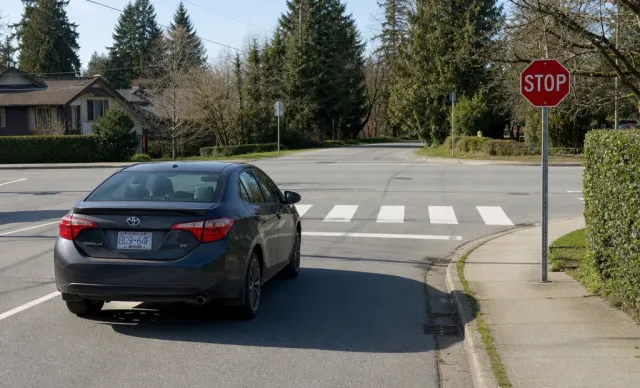
Most stopped with the front tires on the crosswalk. Others simply rolled slowly through the intersection without stopping at all.
I understand why drivers do it. They want to stop where they can see traffic approaching from both directions. Why stop at the line, then move forward and possibly stop again when you can just slide forward, have a look and go?
The answer is that the law tells you where to stop. There is also a good safety reason for doing so: pedestrians may be using the space between your vehicle and the intersection.
Where must you stop?
Section 186 of the Motor Vehicle Act establishes where a driver must stop when approaching an intersection controlled by a stop sign.
There is a specific order to the rule:
- If there is a marked stop line, stop at the line.
- If there is no stop line but there is a marked crosswalk, stop before entering the crosswalk.
- If there is neither a stop line nor a marked crosswalk, stop before entering the intersection at the point nearest the intersecting highway from which you can see approaching traffic.
Notice that the first two rules are not based on where you can see approaching traffic most easily. They tell you where the stop is to be made.
A stop line means stop at the line
If a stop line is marked on the pavement, that is where the stop must be made.
It is not a suggestion about where you should stop if it happens to be convenient. Stopping with the front of your vehicle on the line is not the same as stopping at the line. Neither is stopping several metres beyond it so that you can see farther down the cross street.
If you cannot see approaching traffic adequately from the stop line, that does not give you permission to ignore the line.
Why not stop farther forward?
The most important reason is pedestrians.
A marked crosswalk is a place where pedestrians have a reasonable expectation that vehicles will not be stopped across their path. Section 179 of the Motor Vehicle Act requires drivers to yield to pedestrians in a crosswalk in the circumstances described by the legislation.
A driver who stops on the crosswalk may block a pedestrian's path, obscure the pedestrian from another driver's view, or force the pedestrian to walk around the vehicle and into a potentially dangerous area.
This was brought home to me while watching that intersection.
A father and daughter approached the intersection on the sidewalk. They both saw the vehicle approaching the stop sign. The daughter apparently decided that the vehicle was far enough away, or trusted the driver to stop properly, and began to cross.
The father had a different idea. He put his arm out and stopped his daughter, allowing the vehicle to stop on the crosswalk and proceed before they continued.
The pedestrians had made a reasonable assumption that the driver would stop where the law required. The father correctly recognized that this particular driver was not going to do so.
The lesson is not that pedestrians should compensate for poor driving. The lesson is that where you stop can affect whether a pedestrian is seen, where they can walk, and whether another road user can react in time.
But I can't see traffic from the stop line
A stop line may be positioned far enough back from the intersecting roadway that a driver cannot see clearly to the left and right.
That does not mean that the stop line should be ignored.
Stop first. Then, if necessary, move forward cautiously to obtain a clear view.
Before moving forward, make sure that the crosswalk is clear. Then move ahead slowly and continue to look for pedestrians, cyclists and other road users as well as approaching vehicles.
I think of this as: stop, look, creep and peep.
By stopping at the stop line, you have made the stop required by section 186. Moving forward afterward is about obtaining the view you need to determine whether it is safe to proceed.
Depending on the intersection, you may need to stop again. You should certainly be prepared to stop again if something makes it unsafe to continue.
Scan the whole intersection
When you have stopped and are preparing to turn right, it is natural to concentrate on traffic approaching from your left. That is where you expect the main stream of cross traffic to come from.
Don't let that expectation become a blind spot.
Before moving, scan the entire intersection. A vehicle approaching from your right could be passing another vehicle or cyclist, or otherwise be somewhere you did not expect it to be. If you haven't looked, you won't know.
The same applies to pedestrians and cyclists. They don't necessarily approach from the direction you expect either.
A proper stop gives you time to look. Use it to scan the whole intersection, not just the direction you expect traffic to come from.
What if there is no stop line?
If there is no marked stop line, section 186 moves to the next point in its sequence: stop before entering a marked crosswalk.
If there is neither a marked stop line nor a marked crosswalk, the driver must stop before entering the intersection, at the point nearest the intersecting highway from which the driver has a view of approaching traffic.
In this situation, the law gives you some flexibility in choosing the stopping position because visibility is part of the rule.
That is different from an intersection where a stop line has already established the stopping position.
What about an unmarked crosswalk?
This is an interesting distinction between the wording of the law and driver-training advice.
British Columbia's Motor Vehicle Act defines a crosswalk to include not only a portion of roadway distinctly indicated by signs or pavement markings, but also the portion of a highway at an intersection formed by the extension of the sidewalks across the roadway. In other words, a crosswalk can exist even when there are no painted lines on the road.
However, section 186 specifically tells a driver to stop before a marked crosswalk when there is no stop line.
That does not mean that an unmarked crosswalk is a place where pedestrians have no protection. Other provisions of the Motor Vehicle Act apply to pedestrians at crosswalks, and drivers have a general duty to exercise due care to avoid colliding with a pedestrian.
ICBC's Learn to Drive Smart guide takes a more protective approach. It teaches drivers that when there is an unmarked crosswalk, they should stop where they would stop if the crosswalk were marked.
That is good pedestrian-safety advice, but it is useful to understand the distinction. The legislation tells us where the stop must be made in the circumstances described by section 186; driver training can also recommend a more cautious practice.
Stopping is only the first step
Making a proper stop does not mean that you can simply stop, look once, and go.
A stop is a legal requirement. Proceeding through the intersection safely is a separate responsibility.
Stop where the law requires you to stop. Make sure the crosswalk is clear. Then look carefully for approaching vehicles, pedestrians, cyclists and anything else that could make proceeding unsafe.
If your view is blocked, move forward slowly and cautiously only after you have confirmed that the area immediately in front of your vehicle is clear.
Why do drivers get it wrong?
I suspect part of the problem is that drivers think of a stop sign as an instruction to look for traffic rather than an instruction to stop.
If the driver can see that there is no traffic coming, the temptation is to roll through. If the driver cannot see clearly, the temptation is to stop wherever the view is good.
Neither approach follows the rule. A stop sign requires an actual stop, and where you make that stop is determined by section 186.
Once the required stop has been made, you can deal with the visibility problem safely by moving forward when it is appropriate to do so.
The bottom line
Making a proper stop isn't difficult. It just requires drivers to separate two different tasks:
- Stop where the law requires you to stop.
- Then determine whether it is safe to proceed.
If there is a stop line, stop at it. If there is no stop line but there is a marked crosswalk, stop before the crosswalk. If neither exists, stop before entering the intersection at the point where you can see approaching traffic.
If you cannot see well enough from the required stopping position, don't eliminate the stop. Stop first, make sure the area in front of you is clear, then creep forward carefully until you can see.
And before you move, remember to look not only for the traffic you are waiting for, but also for the pedestrian, cyclist or other road user who may be directly in front of you.
A proper stop takes only a moment.
Learn More
- What Is an Immediate Hazard? — Understanding when a driver must act to avoid a collision, even when another road user may have made a mistake.
- Q&A: Who Has the Right of Way? — A look at why the rules of the road generally require drivers to yield rather than give them an absolute right to proceed.
- Shadow the Brake, They Might Not Stop — Why being prepared for another driver's failure to stop can prevent a collision.
- Log in to post comments