
 If you are parallel parked on a busy British Columbia street and get boxed in by vehicles parking too close to your bumpers, pulling out safely can feel like an impossible task. However, a tight parking space does not excuse a driver from their statutory duties.
In the case of Dahlke v. Davidson (2023 BCSC 1884), the B.C. Supreme Court provided a major reality check for drivers who assume that pulling out of a parking space automatically results in 100% liability if a crash occurs. Instead, Justice Stephens ordered a 60/40 split in liability, penalizing both drivers for distinct failures of safety and attention.
Figure 1: Overhead view of the collision location, showing the lane layout where the parallel parking spots meet active traffic.
The Statutory Framework: MVA Section 169
The legal starting point for any vehicle re-entering traffic from a stopped position is Section 169 of the Motor Vehicle Act (Starting vehicle). The law states that a driver must not move a vehicle that is stopped, standing, or parked unless the movement can be made with reasonable safety.
In this case, Mr. Dahlke faced a difficult environment, but his statutory obligation to ensure the lane was clear before entering remained paramount.
Why Fault Was Shared: The 60/40 Breakdown
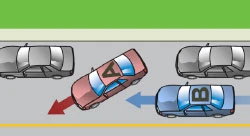
Figure 2: Diagram of a vehicle exiting a parking space into the path of overtaking traffic.
The court looked past standard insurance assumptions and weighed the specific actions of both parties:
- The Exiting Driver (60% Fault): Mr. Dahlke was found majority at fault for pulling out aggressively at a 45-degree angle, occupying up to 80% of the active travel lane, and stopping dead in the path of oncoming traffic. Furthermore, he attempted this maneuver with no driver's side mirror—violating the Motor Vehicle Act Regulations which require operational mirrors for blind-spot monitoring. He also rejected safe assistance, waving on two courtesy drivers who had stopped to let him out safely.
- The Approaching Driver (40% Fault): Ms. Davidson legally held the right-of-way, but the right-of-way is not an absolute license to collide with an obstacle. The court found she was not fully paying attention to the road ahead. Because she failed to keep a proper lookout, she did not react to a visible hazard that was sitting stationary in her lane until it was too late.
Myth vs. Law
| The General Assumption | The Dahlke v. Davidson Reality |
|---|---|
| Pulling out of a spot makes you 100% at fault. | Exiting driver was penalized 60% fault due to maneuver choices. |
| Approaching traffic has absolute right-of-way. | Approaching driver took 40% fault for inattention. |
| Being "boxed in" excuses a blind nudge into a lane. | Statutory safety obligations (MVA Sec. 169) always apply. |
| Missing equipment is just a minor ticket issue. | Missing required mirrors heavily damages your liability claim. |
Key Takeaways for BC Drivers
- Right-of-Way Requires Visual Alertness: Even if someone illegally blocks your lane, you share liability if you have a clear, unimpeded view of the hazard and fail to brake or avoid it.
- Maintain Your Equipment: Driving without mandatory safety equipment like mirrors strips away your legal padding in court if you claim you "looked but couldn't see".
- Accept Help When Offered: If passing motorists stop to create a safe buffer zone for you to exit a tight spot, utilize it rather than risking a blind exit later.
Help spread the word:
Know someone who struggles with tight parallel parking, or a driver who thinks having the right-of-way means total immunity? Use the sharing buttons below to pass this article along to your friends, family, or local driving groups!
- Log in to post comments
Comments
City buses have bumper stickers asking to be given a break when pulling out from the curb.
What I find frustrating is the fact the four way flashers are operating while they are parked. If there is another bus directly behind then you cannot see whether it is 4 way or the turn signal.
In most cases the buses are pulled over to the curb so why use the four way flashers?
One likes to be courteous yet the drivers provide a bit of confusion to the situation by their actions.
- Log in to post comments
Buses